
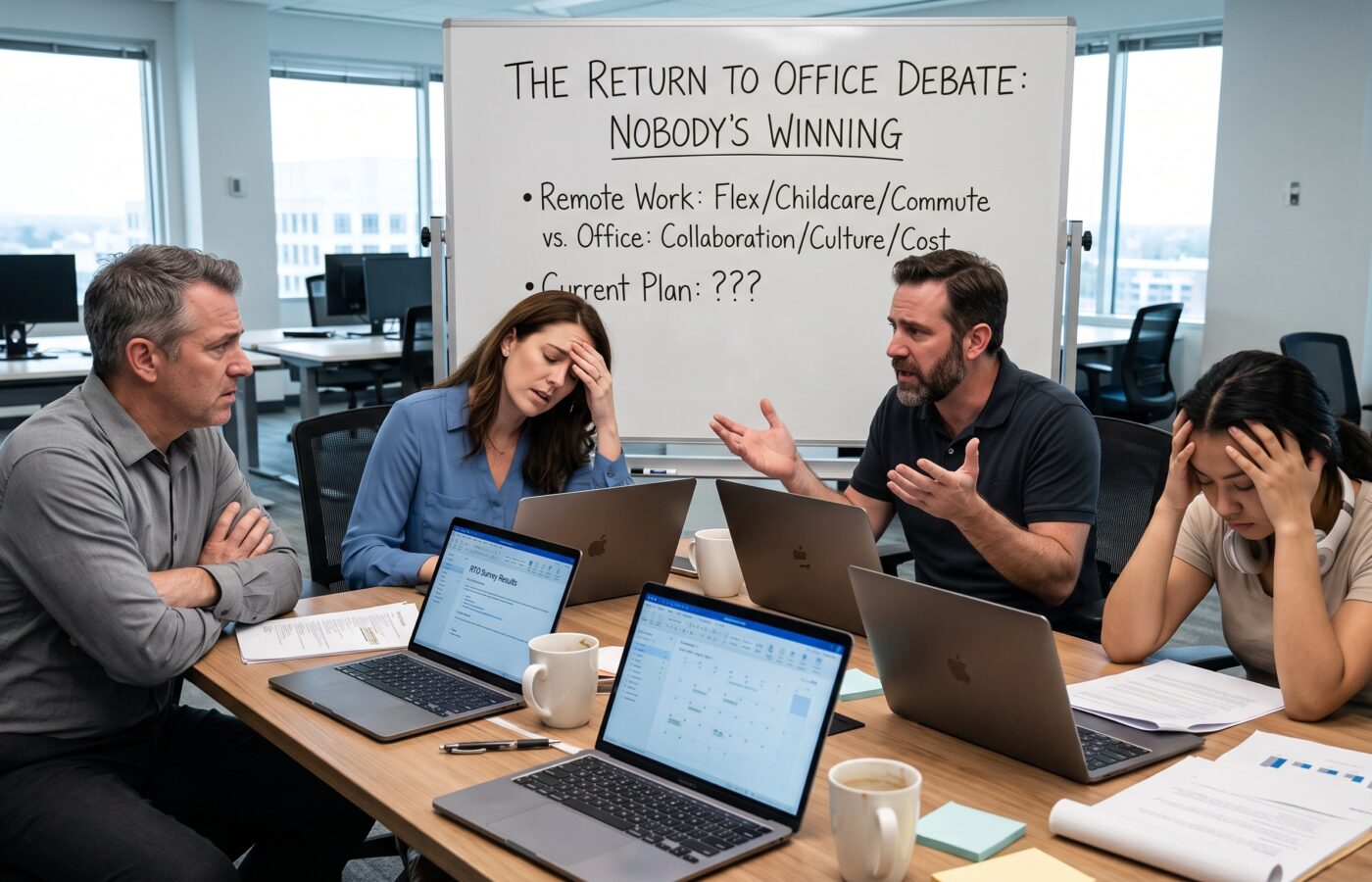
The Return to Office Debate Nobody Is Winning (And What the Numbers Actually Show)

I’ve sat in enough budget meetings over the past few years to notice a pattern. Somewhere around the third quarter, a VP of Operations or a Head of People walks in with a slide about office utilization. The room goes quiet in a very specific way. Nobody wants to be the one who says the office is half empty and still costs what it did in 2019. Nobody wants to be the one who says employees are threatening to quit over a policy that sounded reasonable on a whiteboard. It is the moment where real estate costs clash directly with broader HR services and workplace trends.
As a fractional CFO working across several companies at once — the same lens I bring to Q4 tax and cash planning work — I get a strange vantage point on this fight. In the same week, sometimes the same meeting, I’ll see the real estate line item, the recruiting line item, and the latest engagement survey results. What I keep finding, deal after deal, is that the return to office debate isn’t really about where people sit. It’s a debate about HR services and workplace trends colliding with finance in ways most leadership teams haven’t fully priced in yet.
So let’s get into why nobody, on either side, is actually winning. I’ll show you the numbers I look at when a client asks me to help them decide. And I’ll tell you honestly where the math gets uncomfortable, for both the “everyone back in five days” crowd and the “office is dead” crowd.
The Real Estate Math Nobody Wants to Run
Your Lease Doesn’t Track Attendance
Here’s something that surprises a lot of founders the first time we walk through it. Your lease doesn’t care how many badge swipes happen on a Tuesday. If your company signed a ten year commitment in 2018 or 2019, that obligation sits on the balance sheet no matter what. It doesn’t matter if the building runs at 90% capacity or 30%.
A mandate that fills seats doesn’t create new value out of nowhere. It mostly just makes an existing fixed cost look less wasteful on paper. That’s a very different thing from making the company more profitable.
Executive teams often get the framing backward. The question isn’t “how do we justify the office we already have.” The question is “what does this space need to do for us financially, this year,” a question that sits squarely inside what operations management actually is once you strip away the real estate jargon.
When the Office Is Actually Worth It
Some companies genuinely need the office. Client facing teams benefit from in person trust building. Early career employees learn faster sitting near a manager. Some teams need shared physical equipment. For those companies, a thoughtful in office policy is a real investment with a real return.
I’ve also reviewed plenty of P&Ls where the honest answer is different. The office is a legacy cost nobody has had the nerve to renegotiate. The return to office mandate is a retroactive justification, not a forward looking strategy. When I ask a CEO what business outcome improved because of the mandate, I often get vague answers about culture. Culture matters. But if you can’t point to a number, you’re not making a financial decision. You’re making an emotional one and dressing it up in spreadsheet language.
The companies that handle this well do something simple but uncomfortable. They separate the real estate decision from the culture decision. They model each one honestly, on its own terms, instead of letting one quietly justify the other.
What the Turnover Numbers Actually Say
Who Actually Leaves
If you want to see where a mandate gets expensive fast, look at attrition data, not utilization data. Researchers at Baylor University’s Hankamer School of Business tracked more than three million workers. They followed 54 large technology and financial firms that rolled out return to office mandates between 2020 and 2023.
The findings should make any finance leader sit up. Companies saw a 13 to 14% increase in abnormal turnover following RTO announcements. Job vacancies took 23% longer to fill, stretching from 51 days to 63 days on average, exactly the kind of drift that turns an annual staffing and workforce plan into a Q2 surprise once attrition assumptions stop matching reality. Hire rates dropped 17% after adjusting for national trends.
What stood out most to me was who left. Female employees departed at nearly three times the rate of their male counterparts. Mid level and senior managers, whose institutional knowledge is genuinely hard to replace, showed higher attrition than junior staff. High skilled employees, the ones most likely to have other offers sitting in their inbox, walked at significantly higher rates. Nearly half of departing workers, 46.4%, took lateral or even lower ranked roles elsewhere. They chose flexibility over the title bump they’d normally hold out for. Numbers like these are exactly why HR services and workplace trends coverage has leaned so hard into retention this year.
The Price Tag on Losing Them
Now put a dollar figure on that. SHRM’s own research puts the cost of replacing an employee between 50% and 200% of their annual salary, depending on seniority and role complexity, the same due diligence worth applying to any big line item, including knowing what a marketing agency actually bills for before assuming a flat retainer covers what you think it does. Run that math against a mid sized company that just lost a chunk of its experienced management layer. The “we’re saving money by filling the office” argument starts to look shaky fast.
You didn’t save money. You traded a real estate expense you already had for a recruiting expense you didn’t need to create. This is exactly the kind of tradeoff that HR services and workplace trends research keeps surfacing. It rarely shows up until a quarter or two after the policy announcement, which is precisely why it gets missed in the initial decision.
Engagement Is the Expense Line Nobody Puts on a Spreadsheet
The Numbers Behind the Decline
Gallup’s most recent State of the Global Workplace data shows engagement dropping to 20% globally in 2025. That’s down from 23% in 2022 and 2023, the lowest level recorded since 2020. It’s also the first time global engagement has fallen for two consecutive years. Manager engagement took the sharpest hit, falling from 31% to 22%, a nine point decline. That should worry anyone who understands how much a disengaged manager drags down an entire team.
Gallup estimates that low engagement cost the global economy roughly ten trillion dollars in lost productivity in 2025 alone, about 9% of global GDP. Global figures like that can feel abstract. They don’t obviously help one specific company make one specific decision. But the underlying mechanism is real, and it’s local. A disengaged employee costs you in slower output, more errors, and weaker client work. And they often leave anyway, just more slowly and more expensively than an employee who quits right after a mandate announcement. This is exactly the kind of data serious HR services and workplace trends research should be built around, not anecdotes from the corner office.
Why This Isn’t a Remote Work Story
Only 34% of employees report that they’re thriving. Stress and frustration remain elevated compared to before the pandemic. None of this proves remote work causes low engagement, and I’d push back hard on anyone selling that oversimplified story. Plenty of fully remote teams are miserable. Plenty of fully in office teams are thriving.
What it does mean is this: a return to office policy imposed without attention to why people are disengaged treats a symptom while ignoring the underlying condition. You can fill the parking lot and still bleed productivity.
The Talent Market Is Not Cooperating With Either Side
Employers Are Tightening Just as Hiring Gets Harder
Here’s where it gets genuinely strange. SHRM’s 2026 Talent Trends research surveyed more than two thousand HR professionals. It found that 70% are still struggling to recruit for full time roles, and 42% report ongoing difficulty retaining the employees they already have. Forty one percent are now training existing staff to fill hard to fill positions, because the external market isn’t delivering candidates fast enough.
At the same time, Robert Half’s research shows the job market tilting hard toward onsite work. In the second quarter of 2026, 87% of job postings were fully onsite, up sharply from 65% just two quarters earlier. Only 3% of postings were fully remote, and 10% offered hybrid arrangements. Thirty six percent of employers increased required onsite days over the past year. Employers are demanding more physical presence at the exact moment they admit they can’t find or keep good people. It’s a strange moment for HR services and workplace trends generally, watching two lines move in opposite directions like that.
Employees Are Shopping for What’s Being Taken Away
Meanwhile, 46% of professionals plan to look for a new role in the second half of 2026. Thirty nine percent specifically cite wanting more remote flexibility. Sixty four percent say better work life balance and remote options would pull them toward a new employer.
Read those two sets of numbers side by side. Employers are tightening onsite requirements while struggling to hire and retain. Employees are actively shopping for exactly what employers are taking away. That’s not a market in equilibrium. That’s two groups talking past each other. Closing that gap is exactly the job good HR services and workplace trends analysis exists to do, and it takes actual data, not conviction.
Where HR Services and Workplace Trends Actually Meet in the Middle
The Case for Being in the Room
I want to be fair to the mandate side, because it gets caricatured unfairly in a lot of coverage. There are legitimate, financially defensible reasons to want people together in a physical space. Mentorship happens faster face to face. Client relationships often benefit from in person presence. Some creative and technical work genuinely moves quicker around a whiteboard than across a video call. I’ve watched this play out with clients directly, and I won’t pretend otherwise just to make a tidier argument. Anyone who follows HR services and workplace trends closely knows the in person case is real, even when it gets overstated.
Why Role Based Policy Wins
The mistake isn’t wanting people in the office. The mistake is applying a single policy across every role and every employee. A customer support rep answering tickets and a business development lead building relationships don’t have the same reason to sit at a desk on a Tuesday. A role based approach, where policy follows the actual nature of the work, performs much better in the data I’ve reviewed. It’s also cheaper, because you stop paying the turnover cost of pulling flexibility away from roles that never needed the office to begin with.
This is where smaller and mid sized companies genuinely benefit from outside HR expertise instead of guessing internally. You don’t need a full time Chief People Officer to build a policy grounded in real data. You need someone who can pull the recruiting numbers, the engagement numbers, and the occupancy numbers into one coherent model, the same integration challenge behind a consulting or technology services tech stack that grew in silos instead of by design. That person also needs to have seen enough companies go through this to know which mistakes are avoidable. That’s exactly the gap outsourced and fractional HR services fill. It’s a big part of why demand for that kind of support keeps climbing, even as the broader workplace trends conversation stays unresolved.
What I Tell Clients Who Ask Me to Model This
Three Numbers I Ask for First
When a client brings this decision to me, I resist giving an opinion right away, even though most of them want one. Instead I ask for three numbers. First, what does the real estate footprint actually cost per employee, fully loaded, not just base rent? Second, what would it cost to replace the specific roles most likely to leave? Use a realistic percentage of salary, not the low end of the range everyone likes to quote. And third, how does the recruiting funnel actually look right now, honestly, not the version we tell the board?
None of this is exotic. It’s the same discipline any decent HR services and workplace trends advisor would insist on before signing off on a policy. Once those numbers are on the table, the decision gets a lot less ideological. Sometimes the math supports a stronger onsite requirement, particularly for younger teams or client facing roles where the return is measurable. Other times the math makes it obvious that a rigid mandate would cost more in departures and delayed hiring than it would ever save in office utilization.
Pilot Before You Mandate
I also push clients to pilot before they mandate company wide. Pick one or two teams. Set a clear policy. Measure the actual outcomes against a baseline for a full quarter. Only then decide whether it’s worth scaling.
This sounds obvious said out loud. Yet it’s remarkable how often companies skip straight from “we think people should be in the office more” to “everyone, five days, starting next month.” They never test the assumption in between. A financial decision this size deserves the same rigor you’d apply to any other six or seven figure commitment. Treating it as a values statement instead of a modeled decision is how companies end up losing their best people over a policy nobody actually tested.
A Real Example
I worked with one client last year, a professional services firm with around ninety employees. A handful of senior partners felt the office had gone quiet, and they were about to announce a full onsite mandate. Before they sent the memo, we pulled the real numbers.
It turned out client facing consultants were already onsite most weeks by choice. The analysts driving the loudest internal complaints about a quiet office were the same group with the lowest voluntary turnover and the strongest performance reviews. The actual problem wasn’t attendance. Nobody had updated two conference rooms since the firm moved in, and the outdated setup made spontaneous meetings awkward. People started working from home simply because it was more comfortable.
The firm spent a fraction of what a mandate would have cost in turnover. They fixed the meeting spaces instead. Attendance rose on its own within two months. No one had to order anyone back. The office just became a place people wanted to work from again. It’s the same lesson behind why the same IT ticket keeps coming back — treat the symptom and the real cause just resurfaces in a new form.
The Bottom Line Nobody Wants to Hear
Nobody is winning this debate because both extremes make the same mistake from opposite directions. Both treat a complex, role dependent, financially significant decision as a single company wide policy, driven by conviction rather than data. The mandate side underestimates the cost of turnover, recruiting delay, and lost institutional knowledge. The fully remote side underestimates how much mentorship, client trust, and spontaneous collaboration suffer without a shared room.
Right now, the companies pulling ahead aren’t the loudest ones on either side. They treat workplace policy the way they’d treat any other capital allocation decision: model it, pilot it, measure it, revisit it every quarter, because the numbers keep changing. That’s really the same discipline behind any general business strategy built on habits instead of a document.
That’s not a satisfying answer if you wanted a clean verdict on whether the office is back or remote work won. But if you’re the one signing the lease and the payroll, it’s the only answer that holds up. It’s the only one you can defend with real numbers instead of a hunch.
Frequently Asked Questions
Cost and Turnover Questions
Is return to office actually saving companies money? Not automatically. Filling an existing office reduces the appearance of waste, but it doesn’t lower a fixed lease obligation. If the policy drives turnover among experienced staff, the recruiting cost can easily outweigh whatever was saved on underused space. Gallup’s 2026 workplace data (see references) shows how much low engagement alone costs organizations, separate from any real estate savings.
Why do return to office mandates increase turnover? Research from Baylor University found mandates were followed by a 13 to 14% jump in abnormal turnover. Senior and highly skilled employees, who typically have the most outside options, left at the highest rates. Flexibility has become a genuine bargaining chip, and employees with strong resumes are willing to use it.
How much does it actually cost to replace an employee? SHRM estimates the cost of replacing an employee at 50% to 200% of annual salary. The exact figure depends on seniority and how specialized the role is. For a manager or technical lead, that can easily run into six figures once recruiting, onboarding, and lost productivity are factored in.
Policy and Flexibility Questions
Should every company have the same office policy? Generally, no. The data supports a role based approach far more than a blanket company wide mandate. Client facing, early career, and highly collaborative roles often benefit from more in person time. Independent, output driven roles frequently perform just as well, or better, with flexibility.
What does this have to do with HR services and workplace trends specifically? This decision touches recruiting, retention, real estate, and productivity all at once. That makes it exactly the kind of problem that benefits from dedicated HR expertise rather than an internal guess. Companies without a full internal HR function are increasingly turning to outsourced or fractional HR services instead. It helps them build a policy grounded in their own data, not industry headlines.
Is hybrid work actually the compromise it sounds like? Sometimes. Robert Half’s 2026 data shows hybrid postings still make up a small share of the market compared to fully onsite roles. Hybrid isn’t automatically the safe middle ground it’s often described as. It works best when applied deliberately to roles where it fits, rather than adopted as a default because nobody wanted to commit to either extreme. Most current HR services and workplace trends guidance agrees: hybrid is a design choice, not a shortcut.
References
- Gallup, State of the Global Workplace 2026: gallup.com/workplace/349484/state-of-the-global-workplace
- Robert Half, Remote Work Statistics and Trends for 2026: roberthalf.com/us/en/insights/research/remote-work-statistics-and-trends
- SHRM, 2026 Talent Trends: shrm.org/topics-tools/research/2026-talent-trends
- Baylor University, Hankamer School of Business, Return to Office Mandates and the Hidden Cost of Brain Drain: hankamer.baylor.edu
- SHRM, The Myth of Replaceability: Preparing for the Loss of Key Employees: shrm.org/executive-network/insights/myth-replaceability