
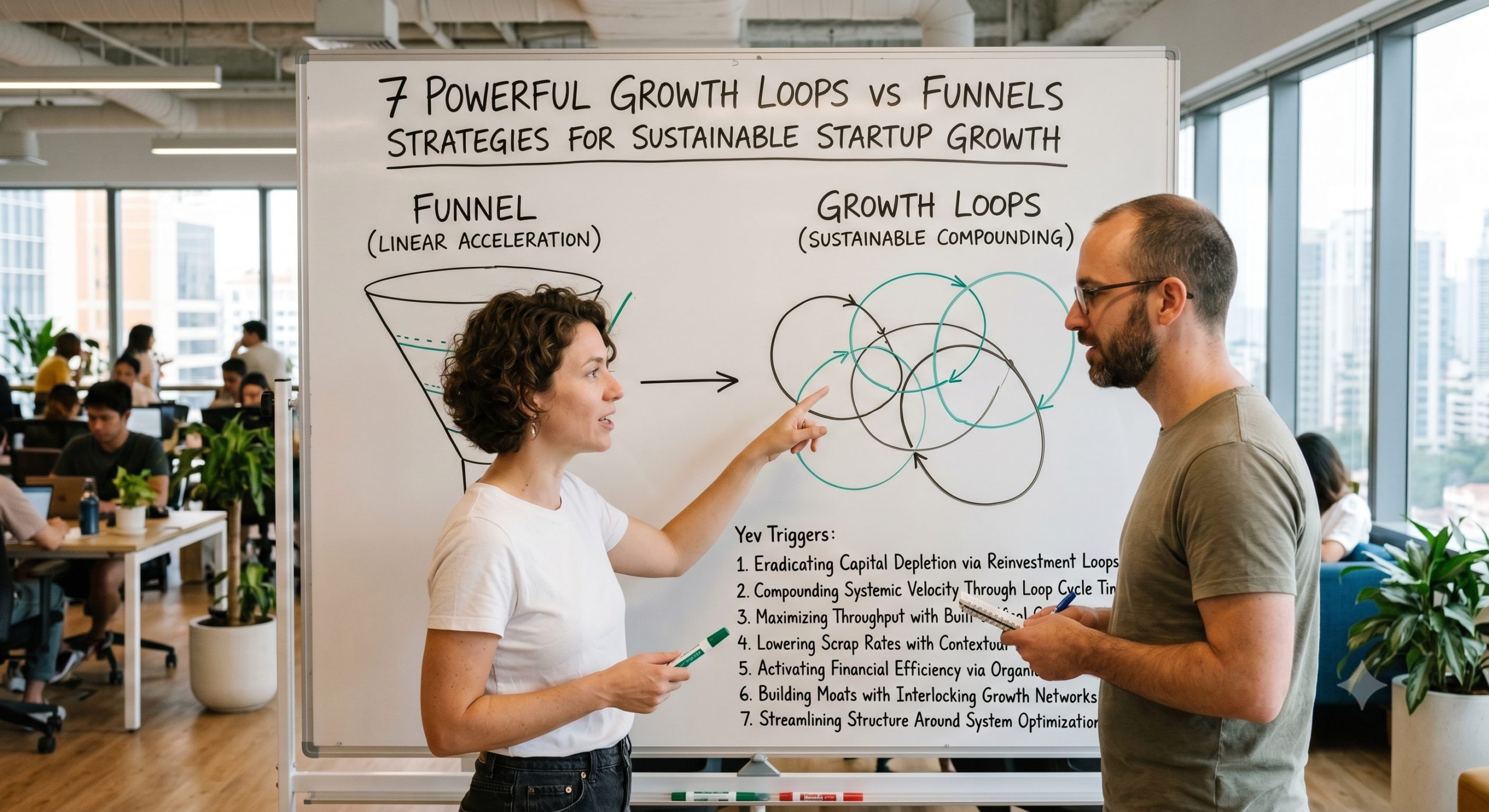
7 Powerful Growth Loops vs Funnels Strategies for Sustainable Startup Growth

Launching a startup is one challenge. Scaling it into a profitable, resilient business is another entirely. Many founders assume that growth is simply a matter of increasing advertising spend, hiring more salespeople, or publishing additional marketing campaigns. Those tactics can certainly generate short-term momentum, but they rarely create the kind of growth that lasts. As competition increases and customer acquisition becomes more expensive, relying solely on paid channels eventually leads to shrinking margins and slower expansion.
This is why understanding Growth Loops vs Funnels has become essential for founders, investors, and growth leaders. A traditional funnel helps measure how prospects become customers, but a growth loop explains how satisfied customers create future customers. That difference changes the way successful startups approach scaling.
From a Chief Growth Officer’s perspective, sustainable growth is built through systems rather than campaigns. Every decision should improve the company’s ability to serve more customers without increasing waste. In operational terms, that means maximizing throughput, reducing cycle time, and minimizing scrap rate. These three principles are widely used in manufacturing, but they are just as powerful when applied to startup growth. Throughput measures how efficiently the business creates value. Cycle time reflects how quickly prospects become loyal customers. Scrap rate represents wasted marketing spend, abandoned onboarding, unnecessary product work, and customer churn.
When these three areas improve together, growth becomes predictable instead of reactive.
Why Growth Requires a Systems Mindset
Think of your startup as a modern production line. Prospects enter the system, experience the product, become customers, achieve success, and eventually encourage others to join. If every stage works efficiently, the business continues generating momentum without constantly increasing acquisition costs.
Unfortunately, many startups optimize only the first part of that journey. They become experts at attracting traffic but invest far less effort into retention, customer advocacy, and product engagement. The result is a business that must continuously replace customers instead of building on previous success.
Understanding Growth Loops vs Funnels encourages leaders to think differently. Instead of asking, “How do we acquire more customers?” the better question becomes, “How can every customer create value that helps attract the next customer?”
That simple shift creates a powerful competitive advantage.
Throughout this article, you’ll discover seven practical strategies that help startups build self-reinforcing growth systems. More importantly, you’ll learn how operational efficiency and customer-centric thinking work together to create businesses capable of sustainable, long-term expansion.
Why Growth Loops vs Funnels Matter in Modern Startups
The marketing funnel has been a trusted framework for decades because it provides a simple way to measure how potential customers move from awareness to purchase. Businesses can see where people leave the buying journey and improve those conversion points.
Even today, funnels remain an important management tool.
What Traditional Funnels Do Well
Funnels answer practical questions that every startup should understand.
How many visitors become leads?
How many leads become customers?
Which stage loses the highest percentage of prospects?
These insights help marketing and sales teams improve conversion rates while identifying weaknesses in the customer journey.
For startups that are just beginning to scale, funnel analysis provides valuable visibility into customer behavior.
Where Funnels Reach Their Limit
Although funnels remain useful, they stop telling the full story once someone becomes a customer.
After conversion, many organizations shift their attention back to attracting the next prospect instead of helping existing customers generate future growth.
Imagine a factory that continually purchases additional raw materials while ignoring inefficient production equipment. Production might increase for a short time, but waste continues growing because the underlying process never improves.
The same problem appears in startups.
Advertising budgets increase.
Sales teams expand.
Marketing campaigns multiply.
Customer acquisition costs continue rising.
Profitability becomes harder to maintain.
This approach creates operational scrap that slows long-term growth.
Why Growth Loops Build Sustainable Momentum
This is where Growth Loops vs Funnels become significantly different.
Growth loops recognize that satisfied customers are not the end of the business process. Instead, they become active participants in future growth.
Customers recommend products to colleagues.
Teams invite coworkers.
Communities create valuable discussions.
Users write reviews that build trust.
Partners introduce new opportunities.
Each successful customer interaction creates another opportunity for expansion.
Viewed through operational excellence, growth loops improve throughput because existing customers continue generating value beyond their initial purchase.
Cycle time becomes shorter because referred prospects already trust the recommendation before they speak with sales.
Scrap rate declines because fewer marketing resources are required to replace lost customers.
Over time, this creates a business that grows through momentum instead of constant spending.
Understanding Growth Loops vs Funnels
Many founders mistakenly believe they must choose between Growth Loops vs Funnels.
The reality is much simpler.
Successful startups need both.
Funnels optimize customer acquisition.
Growth loops optimize customer multiplication.
What Funnels Measure
Funnels focus on customer progression through a structured buying journey.
They help answer questions such as:
How many people visited the website?
How many requested a demonstration?
How many completed a purchase?
Where do prospects abandon the process?
These measurements help improve marketing efficiency and sales performance.
Without funnels, identifying conversion bottlenecks would become much more difficult.
What Growth Loops Measure
Growth loops examine what happens after someone becomes a customer.
Rather than ending the analysis at conversion, they measure how customers contribute to future growth.
Some users invite teammates.
Others recommend the product to friends.
Many leave reviews.
Some create educational content.
Others strengthen communities that naturally attract additional users.
Each activity feeds another cycle of customer acquisition.
The product becomes more valuable as participation grows.
Customer satisfaction generates referrals.
Referrals reduce acquisition costs.
Lower acquisition costs improve profitability.
The cycle repeats continuously.
Why the Two Frameworks Work Better Together
The strongest startups combine funnels and growth loops instead of treating them as competing ideas.
Funnels help organizations convert more prospects.
Growth loops help those customers generate future demand.
Together, they create a growth engine that continuously improves itself.
From a Chief Growth Officer’s perspective, this combination creates healthier operational performance.
Throughput increases because satisfied customers generate additional business.
Cycle time decreases because trusted referrals convert more quickly.
Scrap rate falls because fewer resources are wasted replacing customers who leave after a single transaction.
That combination creates sustainable growth rather than temporary spikes in revenue.
Strategy 1: Build Customer Experiences That Naturally Generate Growth
The fastest-growing startups rarely depend entirely on paid advertising.
Instead, they create products and customer experiences that encourage existing users to introduce new customers naturally.
Make Sharing Part of the Product Experience
Customers willingly recommend products when sharing creates additional value for themselves.
Project management software becomes more useful when teammates join.
Communication platforms improve as more coworkers participate.
Marketplaces depend on buyers and sellers inviting one another.
Financial applications simplify referrals between family members.
In each case, customer behavior becomes part of the acquisition strategy.
That dramatically improves operational efficiency.
Throughput increases because one satisfied customer creates opportunities for several more.
Cycle time becomes shorter because referred customers already trust the recommendation.
Scrap rate declines because referrals generally convert faster while remaining customers longer.
Focus on Customer Success Instead of Customer Volume
Many startups celebrate rapid acquisition without paying enough attention to customer outcomes.
Long-term growth requires helping customers succeed as quickly as possible.
Customers who achieve meaningful results remain loyal.
They upgrade their subscriptions.
They recommend the business.
They write positive reviews.
They introduce additional users.
Every successful customer strengthens the company’s primary growth loop.
As a Chief Growth Officer, I prioritize customer success because it improves nearly every business metric simultaneously. Revenue becomes more predictable, acquisition costs decrease, retention improves, and sustainable growth becomes easier to achieve.
Strategy 2: Reduce Learning Cycles to Accelerate Growth
Adding more product features does not automatically create better growth.
In many startups, unnecessary complexity slows adoption while increasing operational costs.
Every new feature requires development time, testing, documentation, customer education, ongoing support, and future maintenance.
If customers rarely use those capabilities, valuable resources have been wasted.
Learn Faster Than Your Competitors
The highest-performing startups shorten feedback cycles instead of extending development cycles.
Rather than spending a year building massive feature releases, they launch focused improvements, observe customer behavior, gather feedback, and refine the experience continuously.
This approach benefits every department.
Engineering discovers issues earlier.
Marketing gains deeper customer insights.
Sales improves messaging using real conversations.
Customer success identifies recurring challenges before they spread.
Leadership makes better strategic decisions because information remains current.
Short learning cycles improve throughput by delivering valuable improvements more consistently.
Cycle time decreases because customer feedback reaches decision-makers sooner.
Scrap rate falls because fewer resources are invested in low-impact features.
Turn Customer Feedback Into Continuous Improvement
Customer feedback should never become an occasional research project.
Successful startups integrate learning into their daily operations.
Product analytics reveal usage patterns.
Support conversations uncover recurring pain points.
Customer interviews explain unmet needs.
Community discussions highlight emerging opportunities.
User behavior validates future priorities.
Organizations that learn faster almost always adapt faster.
Over time, this continuous improvement process strengthens every stage of Growth Loops vs Funnels. Better customer insights produce better products, stronger customer experiences, higher retention, and more referrals. Those improvements reinforce one another until sustainable growth becomes a natural outcome of the business rather than a constant struggle.
Strategy 3: Strengthen Customer Retention Before Chasing More Customers
Every startup wants to acquire more customers, and there is nothing wrong with pursuing new business. The problem begins when acquisition receives all the attention while retention receives very little. A company that continually replaces departing customers spends more money simply to maintain its current position. Sustainable growth requires a different mindset.
Instead of asking how many new customers arrived this month, growth leaders should also ask how many existing customers stayed, expanded their usage, or recommended the product to someone else.
Why Retention Creates Compounding Growth
Imagine trying to fill a bucket that has several holes in the bottom. Pouring more water into the bucket may keep it full for a while, but it never solves the underlying problem. Repairing the holes produces a much better long-term result.
Customer retention follows exactly the same principle.
Customers who continue using your product create far more value than those who leave after a short period.
They purchase additional services.
They upgrade their subscriptions.
They share positive experiences.
They recommend the product to coworkers and friends.
They provide feedback that helps improve future releases.
Viewed through operational excellence, retention significantly improves throughput because the company generates more value from customers it has already acquired.
Cycle time also becomes shorter because loyal customers adopt new products much faster than first-time buyers.
At the same time, scrap rate declines because fewer marketing resources are spent replacing customers who recently churned.
Create a Company-Wide Retention Strategy
Retention should never belong to a single department.
Engineering improves reliability.
Customer success helps users achieve measurable results.
Marketing continues educating customers after the sale.
Sales establishes realistic expectations before onboarding begins.
Leadership removes unnecessary obstacles that frustrate customers.
When every department shares responsibility for customer success, retention becomes a natural outcome instead of an isolated initiative.
From a Chief Growth Officer’s perspective, customer retention is one of the strongest indicators of sustainable growth because it influences nearly every financial and operational metric across the organization.
Strategy 4: Turn Product Engagement Into a Continuous Growth Engine
Acquiring a customer is only the beginning of the relationship.
The real opportunity begins after customers experience value from the product.
Traditional funnels often stop measuring performance once conversion takes place. Growth loops continue measuring how customers contribute to future expansion through engagement, collaboration, referrals, and advocacy.
Design Products That Encourage Ongoing Participation
Products become significantly more valuable when customers continue returning.
Project teams invite additional coworkers.
Community members answer questions for new users.
Satisfied customers write detailed reviews.
Power users share tutorials and best practices.
Partners introduce the platform to new organizations.
Each of these activities creates another opportunity for growth without requiring equivalent increases in advertising investment.
Throughput increases because existing customers help attract future customers.
Cycle time decreases because referrals already arrive with trust and confidence.
Scrap rate falls because customer behavior reveals which features deserve further investment and which create unnecessary complexity.
Build Features That Reinforce Growth Loops
Every product decision should support long-term scalability.
Before approving a new feature, growth leaders should ask several practical questions.
Will customers use this regularly?
Will it improve retention?
Will it encourage referrals?
Will it increase collaboration?
Will it strengthen customer success?
Features that answer these questions positively contribute to sustainable growth.
Features that fail these tests often increase operational costs without improving customer outcomes.
Maintaining this level of discipline keeps product development aligned with long-term business objectives rather than short-term feature requests.
Strategy 5: Build Operational Systems That Scale With Demand
Growth introduces complexity.
More customers create additional support requests.
Larger teams require better communication.
Higher transaction volumes increase operational workload.
Without efficient systems, expansion eventually slows because internal bottlenecks begin limiting customer experience.
Successful startups recognize this challenge early and build scalable processes before rapid growth exposes weaknesses.
Eliminate Operational Bottlenecks
Every workflow should contribute to customer value.
Processes that create delays without improving quality deserve careful evaluation.
Imagine requiring multiple approvals before activating a new customer account.
Although employees remain busy throughout the process, customers experience unnecessary waiting.
Similarly, sales representatives who spend hours updating spreadsheets instead of speaking with prospects create avoidable waste.
Removing unnecessary friction allows talented employees to focus on activities that directly improve customer outcomes.
Operational improvements also strengthen throughput because more work is completed using the same resources.
Cycle time becomes shorter because customers reach meaningful outcomes faster.
Scrap rate decreases because fewer hours are lost performing repetitive administrative work.
Build Systems That Support Sustainable Scaling
Operational excellence extends far beyond reducing costs.
Efficient systems improve every customer interaction.
Onboarding becomes faster.
Support issues are resolved sooner.
Engineering releases updates more consistently.
Marketing coordinates campaigns more effectively.
Sales responds to opportunities without unnecessary delays.
As a Chief Growth Officer, I view operational systems as strategic assets rather than administrative necessities. Well-designed processes create a foundation that allows organizations to grow confidently without sacrificing customer experience or operational quality.
Over time, these improvements reinforce one another. Teams collaborate more effectively, customers experience greater value, and the business becomes increasingly capable of scaling while maintaining efficiency. That combination creates stronger Growth Loops vs Funnels because operational excellence supports every stage of the customer journey.
Strategy 6: Use Data to Drive Better Decisions Every Day
As startups grow, they naturally generate more information. Marketing platforms track campaign performance, product analytics reveal customer behavior, and sales teams collect valuable insights from conversations with prospects. Having access to data is important, but information alone does not create sustainable growth. The real advantage comes from making faster and better decisions.
Many companies build impressive dashboards but rarely use them to improve execution. Reports become longer, meetings become more frequent, and decision-making slows. A startup cannot scale efficiently when teams spend more time reviewing metrics than acting on them.
Focus on the Metrics That Matter Most
The strongest growth leaders concentrate on measurements that directly influence customer value and business performance.
Customer acquisition cost shows whether marketing investments remain efficient.
Customer lifetime value reveals long-term profitability.
Retention demonstrates whether customers continue finding value.
Referral activity measures the strength of the company’s growth loop.
Product engagement highlights which features encourage customers to return.
Monitoring these metrics consistently allows leadership teams to identify opportunities and solve problems before they become expensive.
Viewed through an operational lens, better measurement increases throughput because resources move toward initiatives that create the greatest impact.
Cycle time becomes shorter because teams respond to customer behavior much earlier.
Scrap rate decreases because ineffective campaigns, low-value features, and inefficient processes are identified before consuming additional time and budget.
Build a Culture of Continuous Improvement
Successful startups never stop learning.
Engineering teams evaluate product performance after every release.
Marketing continuously tests messaging and creative approaches.
Sales shares customer objections with product and marketing teams.
Customer success identifies recurring issues before they affect larger groups of users.
Leadership encourages experimentation while measuring meaningful business outcomes.
These short learning cycles create organizations that adapt faster than competitors.
Every improvement strengthens future decisions.
Every lesson improves customer experience.
Every successful change contributes to stronger Growth Loops vs Funnels because better products naturally create happier customers, higher retention, and more referrals.
Strategy 7: Build a Business That Grows Stronger Over Time
Short-term growth and sustainable growth are very different outcomes.
A company can increase revenue quickly by spending more on advertising or expanding its sales organization. However, if growth depends entirely on continuous investment, momentum disappears as soon as spending slows.
Sustainable businesses create systems that continue producing value long after the initial customer acquisition effort.
That is the true advantage of Growth Loops vs Funnels.
Create Momentum Instead of Constant Activity
Imagine planting a tree.
During the early years, much of its development happens beneath the surface as the roots become stronger. Visible progress may appear slow, yet those roots eventually support rapid and healthy expansion.
Startups develop in a remarkably similar way.
Customer trust grows steadily.
Brand credibility improves over time.
Communities become more active.
Products become better through continuous feedback.
Referral networks expand naturally.
Each improvement strengthens the next one.
Eventually, previous success generates future opportunities without requiring proportional increases in spending.
Throughput continues improving because satisfied customers generate additional demand.
Cycle time becomes shorter because prospects already trust recommendations from existing users.
Scrap rate falls because fewer marketing resources are needed to replace departing customers.
Think Beyond Quarterly Growth Targets
Many organizations evaluate success one quarter at a time.
Strong growth leaders think much further ahead.
Instead of asking how quickly the company can acquire another thousand customers, they ask questions that strengthen the business for years.
Will this product improvement increase customer retention?
Will this operational investment reduce waste?
Will this initiative improve customer experience?
Will this decision strengthen the company’s primary growth loop?
These questions encourage better long-term decision-making while reducing short-term thinking.
As a Chief Growth Officer, I have found that sustainable scaling rarely comes from one breakthrough marketing campaign. Instead, it comes from hundreds of small improvements that reinforce one another over time.
Conclusion
Scaling a startup successfully requires far more than increasing marketing budgets or expanding sales teams.
Long-term growth comes from building systems that improve continuously while creating exceptional customer experiences.
Understanding Growth Loops vs Funnels allows founders to move beyond traditional customer acquisition strategies and focus on creating businesses that generate their own momentum.
Combine Funnels With Growth Loops
Funnels remain valuable because they measure customer progression from awareness to conversion.
Growth loops extend that journey by encouraging satisfied customers to generate referrals, deepen engagement, strengthen communities, and increase product value.
Together, these two frameworks create a scalable growth engine that becomes stronger over time.
Scale Through Operational Excellence
Viewed through operational principles, sustainable startup growth depends on maximizing throughput, reducing cycle time, and minimizing scrap rate.
Every improvement should help customers achieve success more quickly.
Every process should eliminate unnecessary waste.
Every investment should strengthen long-term customer value.
Organizations that consistently improve these areas create stronger competitive advantages while operating more efficiently.
The startups that lead tomorrow’s markets will not necessarily spend the most money.
Instead, they will build the most effective systems.
Those systems will continue learning, improving, and creating value through well-designed Growth Loops vs Funnels that transform satisfied customers into the driving force behind sustainable business growth.
Frequently Asked Questions
What are Growth Loops vs Funnels?
Growth funnels measure how prospects move through the buying journey from awareness to conversion. Growth loops focus on creating continuous cycles where existing customers generate future customers through referrals, collaboration, engagement, and advocacy.
Why are growth loops important for startup growth?
Growth loops reduce dependence on paid acquisition by encouraging satisfied customers to attract additional users. This creates sustainable growth while improving retention, lowering acquisition costs, and increasing customer lifetime value.
Should startups replace funnels with growth loops?
No. Funnels and growth loops serve different purposes. Funnels optimize customer acquisition, while growth loops strengthen retention, referrals, and long-term scalability. Successful startups combine both approaches.
How do growth loops improve operational performance?
Growth loops improve throughput by creating additional customer value, reduce cycle time through trusted referrals and faster adoption, and minimize scrap rate by lowering wasted marketing spend and reducing customer churn.
Which metrics best measure sustainable startup growth?
Startups should monitor customer acquisition cost (CAC), customer lifetime value (LTV), retention rate, referral rate, activation rate, expansion revenue, customer engagement, and customer satisfaction.
Further Reading
If you’d like to dive deeper into Growth Loops vs Funnels and sustainable startup scaling, these articles provide excellent insights from respected growth leaders and organizations.
- Reforge – Growth Loops Are the New Funnels
Brian Balfour explains why the world’s fastest-growing companies rely on growth loops instead of traditional funnels and how compounding systems outperform linear acquisition models. - Ortto – Growth Loops: How to Use Them and Real-World Examples
A practical guide that explains growth loops, compares them with the AARRR funnel, and provides examples from SaaS, ecommerce, and B2B businesses. - Andrew Chen – There’s Only a Few Ways to Scale User Growth
Andrew Chen explores scalable user acquisition, network effects, virality, and feedback loops that support long-term startup growth. This article is frequently referenced by growth practitioners as foundational reading. - Growth Method – Growth Loops: 4 Types, Real Examples & How They Work
An up-to-date guide covering referral loops, user-generated content loops, sales loops, and community-led growth, with examples from companies such as Dropbox, Slack, LinkedIn, Zoom, and HubSpot. - Growth Hackers – Funnels vs Loops: What Drives More Growth?
This article explains why modern growth organizations combine funnel optimization with self-reinforcing growth loops to build sustainable customer acquisition systems.