
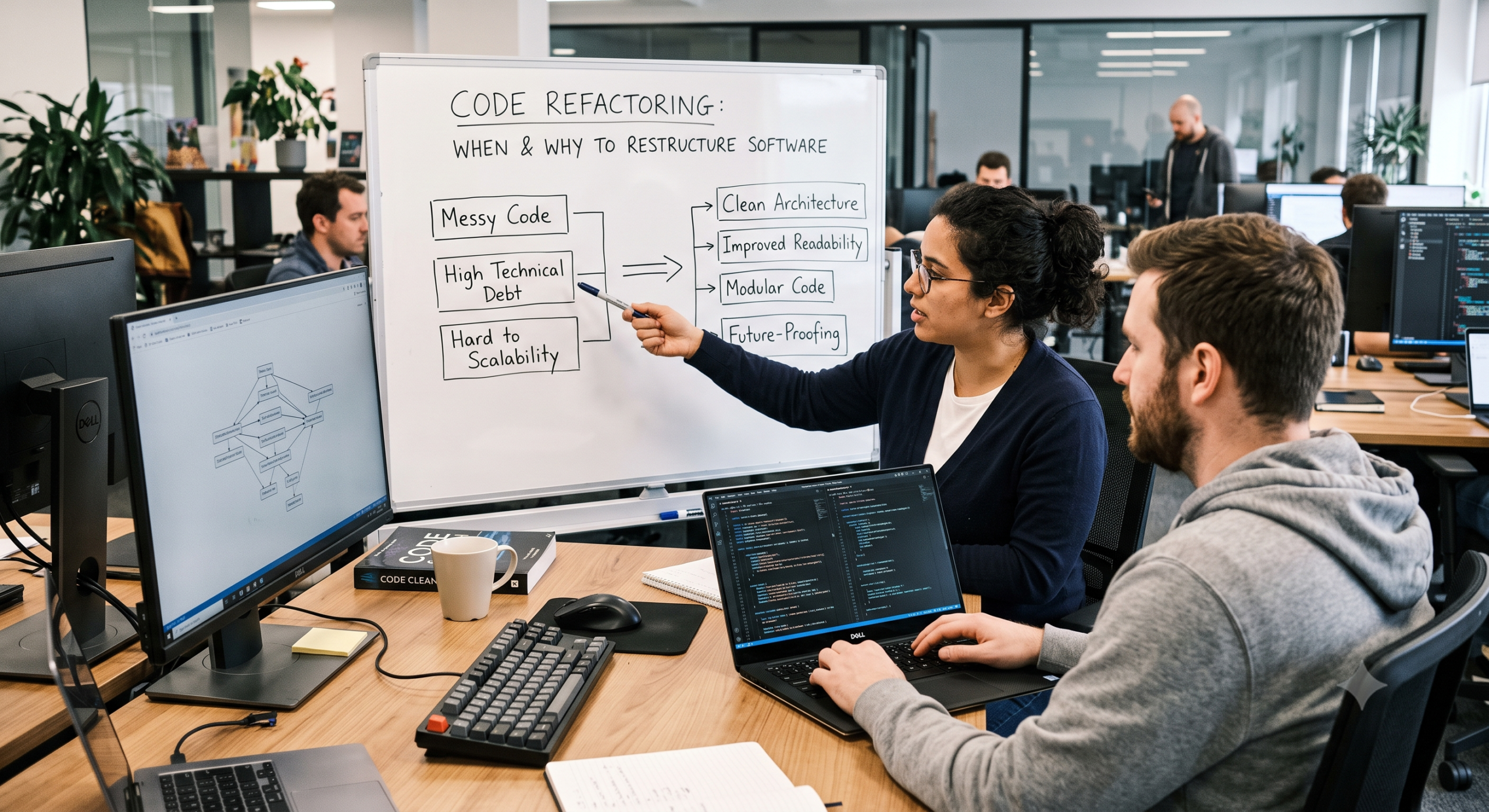
Code Refactoring: When and Why to Restructure Software

Code refactoring is an essential part of building software that can grow, adapt, and remain maintainable over time. As applications evolve, developers add new features, fix bugs, connect third-party services, and respond to changing business needs. These changes can gradually make the code harder to understand and modify. Refactoring helps restructure that existing code without changing how the software is expected to work for users.
Software rarely stays the way it was first built. A small application becomes a business platform. A simple API gains dozens of integrations. A database designed for a few thousand records suddenly handles millions. Features are added, developers come and go, deadlines get tighter, and decisions that once made perfect sense begin creating friction.
This is where code refactoring becomes important.
Code refactoring is the process of improving the internal structure of software without intentionally changing what the software does for the user. The goal is not to add another feature. It is to make the existing system easier to understand, test, maintain, and extend.
From a Software Architect’s perspective, refactoring is not simply “cleaning up code.” It is part of keeping the architecture healthy enough to support future change.
The important question is not whether software will eventually need refactoring.
It will.
The better questions are when to refactor, what to refactor, and how far to go without creating unnecessary risk.
What Is Code Refactoring?
Code refactoring means restructuring existing source code while preserving its expected external behavior.
Martin Fowler, one of the people most closely associated with modern refactoring practices, describes refactoring as a disciplined process built around small, behavior-preserving transformations. Rather than tearing apart a working application and rebuilding it, developers make controlled improvements while keeping the system functional.
A simple example might look like this:
calculateCustomerFinalPriceAfterDiscountAndTax()
Perhaps that function has grown to 180 lines and now performs several unrelated jobs.
A developer could refactor it into smaller functions:
calculateSubtotal()
applyDiscount()
calculateTax()
calculateFinalPrice()
The customer still receives the same final price.
What changed is the internal organization of the code.
That distinction matters.
Refactoring should not be confused with rewriting an application. A rewrite replaces large portions of an existing implementation. Refactoring improves the implementation gradually while preserving behavior.
Why Code Becomes Difficult Over Time
Most messy systems did not start messy.
They became complicated one reasonable decision at a time.
Imagine a development team launching a subscription platform. During the first release, there may be only three plans.
The pricing code is simple.
Six months later, marketing introduces promotions.
Then sales requests enterprise pricing.
Finance adds regional taxes.
Another team introduces coupons.
International expansion brings multiple currencies.
Suddenly, the pricing module that started with a few conditions contains dozens of branches.
Nobody intentionally designed a complicated system. The complexity accumulated as the business changed.
This is normal.
The problem begins when teams continue adding features without occasionally reorganizing the underlying code.
Eventually, developers start saying things like:
“Don’t touch that module.”
“Only Mike understands this service.”
“Changing this usually breaks something.”
“We need three days to make what should be a two-hour change.”
Those statements are architectural warning signs.
Why Code Refactoring Matters
Good software architecture is not about creating a perfect design on day one.
It is about creating a system that can continue adapting.
Refactoring supports that goal by reducing unnecessary complexity.
When done properly, code refactoring can improve:
- readability
- maintainability
- testability
- modularity
- developer productivity
- code reuse
- debugging
- system flexibility
- onboarding
- long-term development speed
Research into refactoring has also connected the practice with software quality characteristics such as maintainability, understandability, complexity, testability, and reusability.
But there is another benefit that businesses sometimes overlook.
Refactoring can reduce the cost of future change.
Suppose adding a new payment method currently requires developers to modify eight files across four modules.
After restructuring the payment architecture, the same type of integration might require changes in only two places.
The immediate refactoring effort costs time.
The return appears during every future change.
That is why architects should think about refactoring as an investment rather than cosmetic work.
13 Signs Your Code Needs Refactoring
There is no universal formula that tells you exactly when to refactor.
However, certain patterns appear repeatedly.
Here are 13 practical warning signs I look for when evaluating whether part of a software system needs restructuring.
1. Functions Have Become Too Large
A function that performs five or six different responsibilities becomes difficult to understand.
Long functions also make testing harder because many behaviors are mixed together.
Breaking a large function into smaller, clearly named functions often improves readability immediately.
Microsoft’s development tools, for example, provide automated “Extract Method” refactoring because this pattern is so common.
2. The Same Code Appears Everywhere
Duplicate code is one of the easiest problems to recognize.
If the same business logic appears in five places, every future change may require updating all five.
Eventually, somebody forgets one.
Now the application contains inconsistent behavior.
Extracting shared logic into reusable components reduces this risk.
3. Variable and Method Names No Longer Make Sense
Names often reveal the history of a system.
Something originally called customerType may eventually represent subscriptions, partners, enterprise accounts, and trial users.
The name no longer describes reality.
Renaming variables, classes, and methods sounds minor, but clear naming dramatically improves comprehension.
4. Small Changes Require Editing Many Files
This is one of the architectural signals I take most seriously.
If a simple feature requires developers to modify many unrelated modules, the system may have excessive coupling.
The components know too much about each other.
Refactoring can help establish cleaner boundaries.
5. Developers Are Afraid to Change Certain Code
Fear is data.
When experienced developers avoid a particular module because changes frequently cause failures, the architecture deserves attention.
The problem could be poor tests, hidden dependencies, global state, unclear responsibilities, or years of accumulated patches.
Whatever the cause, “don’t touch it” is not a sustainable maintenance strategy.
6. Conditional Logic Keeps Growing
Large collections of if, else, and switch statements often indicate that responsibilities are becoming mixed.
Not every conditional needs refactoring.
But when every new feature requires adding another branch to the same enormous decision tree, consider whether the underlying design needs restructuring.
7. Classes Have Too Many Responsibilities
A class that manages users, sends emails, validates payments, generates reports, and writes logs is doing too much.
Large classes tend to become central dependency points.
Separating responsibilities can make the architecture easier to test and change.
8. Bugs Keep Appearing in the Same Area
Repeated defects often point to structural problems rather than careless developers.
When bugs consistently appear in one module, examine the design.
Perhaps responsibilities are unclear. Maybe dependencies are hidden. Maybe several concepts have been compressed into one abstraction.
Fixing individual bugs without addressing the structural cause can become an endless cycle.
9. Tests Are Difficult to Write
Testing difficulty can reveal architecture problems.
Code that depends directly on databases, network calls, global variables, system clocks, or external services can be difficult to isolate.
Refactoring dependencies behind clearer interfaces can make testing easier.
10. Developers Cannot Explain the Code Easily
Ask an engineer to explain what a module does.
If the explanation requires 20 minutes, a diagram, three exceptions, and phrases like “technically this shouldn’t happen, but…” the implementation probably deserves attention.
Complex business rules may genuinely be complicated.
The code does not need to make them worse.
11. New Features Take Longer Every Release
A healthy system should not automatically become slower to develop as it grows.
If feature delivery continuously slows even though the team understands the product better, technical complexity may be accumulating faster than the team can manage it.
Refactoring can restore some of that lost development speed.
12. Dependencies Are Tangled
A clean architecture usually has understandable dependency directions.
When Module A depends on B, B depends on C, C depends on A, and nearly everything depends on shared global utilities, making changes becomes risky.
Refactoring can help restore boundaries between components.
13. Developers Keep Adding Workarounds
One workaround is sometimes reasonable.
Twenty workarounds usually mean something deeper is wrong.
Comments such as:
// temporary fix
// workaround for old implementation
// don't remove this
// special case
deserve investigation, especially when “temporary” code has existed for three years.
Workarounds accumulate interest just like financial debt.
Eventually somebody pays for them.
Code Refactoring and Technical Debt
Technical debt is often discussed as if all debt is bad.
It isn’t.
Sometimes teams knowingly accept a simpler implementation because reaching the market quickly matters more than creating the ideal architecture.
That can be a perfectly rational business decision.
The danger is forgetting about the debt afterward.
Imagine borrowing money to expand a business.
Borrowing itself is not necessarily the problem. The problem comes when interest continues accumulating without a repayment plan.
Software behaves similarly.
A shortcut might save two days today.
But if that shortcut adds two hours to every future feature, the long-term cost can become much larger than the original savings.
Code refactoring is one way teams pay down technical debt before the interest becomes overwhelming.
When Should You Refactor Code?
The best time to refactor is usually close to the work that exposes the problem.
Martin Fowler has written about opportunistic refactoring—improving code when developers encounter areas that need improvement instead of treating refactoring only as a separate project.
I generally prefer this approach.
Suppose you need to add another payment provider.
While implementing it, you discover that payment logic is duplicated across three services.
Instead of adding a fourth copy, you restructure the shared behavior first and then implement the new provider.
The refactoring supports an immediate business need.
This makes the investment easier to justify.
Another useful opportunity is during bug fixing.
If a defect exposes confusing or duplicated logic, clean up that area while fixing the problem—provided you have enough tests to make the change safely.
When You Should Not Refactor
Refactoring is valuable, but unnecessary refactoring can waste enormous amounts of engineering time.
Do not restructure code simply because you would have designed it differently.
Old code is not automatically bad code.
Ugly code that has worked reliably for eight years and rarely changes may be less important than beautifully structured code inside a system the company no longer needs.
Before refactoring, ask:
Does improving this code make future development safer, faster, or easier?
If the answer is unclear, the work may not be worth doing yet.
I am especially cautious about large refactoring efforts immediately before major releases.
Even behavior-preserving changes introduce risk.
Timing matters.
Refactoring vs. Rewriting
These terms are frequently confused.
Refactoring changes internal structure gradually while preserving expected behavior.
Rewriting replaces a significant implementation with new code.
Rewrites sometimes make sense, especially when technology or architecture has reached a genuine dead end.
But rewrites carry significant risk.
Years of hidden business rules may exist inside an old application.
Developers often discover those rules only after the replacement system reaches production.
For that reason, I usually prefer incremental restructuring when the existing system can reasonably evolve.
Refactor first.
Rewrite only when there is a clear architectural or business reason.
Common Code Refactoring Techniques
Developers have many techniques available, but several appear frequently in real projects.
Extract Method moves part of a large function into a smaller function.
Rename Method or Variable replaces unclear names with ones that better describe intent.
Extract Class separates responsibilities from a class that has become too large.
Remove Duplicate Code consolidates repeated logic.
Move Method places behavior closer to the data or responsibility it actually belongs to.
Simplify Conditionals reduces complicated decision structures.
Introduce an Interface creates clearer boundaries between implementations.
Replace Magic Values gives unexplained numbers or strings meaningful names.
Remove Dead Code deletes code that is no longer used.
Modern IDEs can automate many of these operations. Microsoft Visual Studio, for example, includes tools for extracting methods, removing unreachable code, adding checks, simplifying expressions, and modernizing syntax.
Automation helps, but tools do not replace architectural judgment.
A tool can move a method.
It cannot always tell you whether that method belongs in another component.
Tests Are Your Safety Net
Refactoring without tests is much more dangerous.
Remember the basic promise:
The structure changes. The expected behavior does not.
How do you know behavior stayed the same?
Tests.
Before restructuring an important module, make sure its critical behavior is covered.
You do not necessarily need perfect test coverage.
You need enough confidence to detect meaningful regressions.
Then work in small steps:
Change something.
Run the tests.
Commit.
Change something else.
Run the tests again.
This approach may look slower than changing 40 files at once.
In practice, it is usually faster than debugging a massive restructuring effort after something breaks.
Small Refactoring Beats the Big Cleanup Project
Teams sometimes postpone technical improvements for years and eventually announce:
“We need three months to clean everything up.”
That is usually a warning sign.
Large cleanup projects are difficult because they compete directly with product development.
Business leaders naturally ask why feature delivery has stopped.
A healthier model is continuous improvement.
When developers touch an area, leave it slightly better.
Rename the confusing variable.
Extract the repeated function.
Delete the obsolete code.
Add the missing test.
Clarify the interface.
These changes may seem small individually.
Across hundreds of commits, they can significantly improve a system.
Refactoring Should Support Architecture
As a Software/System Architect, I do not measure successful refactoring by how many lines of code were removed.
I look at whether the architecture became easier to change.
Good refactoring should strengthen important boundaries.
For example, business rules should not depend unnecessarily on database details.
Core application logic should not be tightly tied to one external API.
Modules should expose clear responsibilities.
Dependencies should move in understandable directions.
When those boundaries are healthy, technology can evolve around them.
That is the real architectural value of refactoring.
Avoid Refactoring for Perfection
There is a trap experienced engineers sometimes fall into.
They begin refactoring useful code and discover another issue.
Then another.
Soon, a two-hour improvement becomes a three-week architectural redesign.
Refactoring needs boundaries.
The objective is not perfect code.
Perfect code does not exist.
The objective is code that is good enough for the system’s current and expected needs.
Stop when the improvement has delivered enough value.
You can always improve another part later.
A Practical Code Refactoring Process
When I plan meaningful refactoring work, I generally use a simple sequence.
First, identify the business or engineering problem.
Second, understand the current behavior.
Third, add or verify tests around critical behavior.
Fourth, define the architectural improvement you want.
Fifth, break the work into small transformations.
Sixth, make one change at a time.
Seventh, run automated tests continuously.
Eighth, review the changes with another developer.
Ninth, measure whether the original problem improved.
The key is incremental progress.
Refactoring should reduce risk, not create a new source of it.
The Business Case for Code Refactoring
Executives sometimes struggle with refactoring because the result is difficult to see.
A new dashboard is visible.
A new mobile feature is visible.
Cleaner dependency boundaries are not.
Architects and engineering leaders therefore need to explain refactoring in business terms.
Instead of saying:
“We need to improve the architecture.”
Explain:
“Every pricing change currently requires modifications across six modules. Restructuring this area should reduce the effort and regression risk for the pricing work planned over the next two quarters.”
Now the connection is clear.
Refactoring should support business change.
That is how engineering investment becomes easier to understand.
Final Thoughts
Software architecture is never truly finished.
Businesses change.
Requirements change.
Technology changes.
Teams change.
The architecture must change with them.
That is why code refactoring should be treated as a normal part of software engineering rather than an emergency cleanup activity.
The best teams do not wait until their systems become impossible to maintain. They make small improvements while delivering features, fixing bugs, and learning more about the product.
The goal is not to create the cleanest code anyone has ever written.
The goal is to keep the software understandable and adaptable enough that tomorrow’s developers can continue building without being trapped by yesterday’s decisions.
That is when code refactoring delivers its greatest value.
Frequently Asked Questions About Code Refactoring
What is code refactoring?
Code refactoring is the process of restructuring existing source code without intentionally changing its external behavior. Developers refactor code to improve readability, maintainability, testability, and design.
Why is code refactoring important?
Refactoring helps prevent unnecessary complexity from accumulating. Cleaner code can make debugging easier, reduce duplicated logic, improve testing, and make future features easier to implement.
When should code be refactored?
Good opportunities include before adding functionality to difficult code, while fixing bugs, when duplication becomes common, or when developers repeatedly struggle to understand or modify the same area.
Does code refactoring change functionality?
Proper refactoring should preserve expected external behavior. The internal implementation changes, but users should generally see the same functional results.
What is the difference between refactoring and rewriting?
Refactoring improves an existing implementation through controlled changes. Rewriting replaces a significant portion of the implementation with new code.
Can refactoring introduce bugs?
Yes. Any code change can introduce defects. Automated tests, small changes, code reviews, version control, and continuous integration help reduce this risk.
How does code refactoring reduce technical debt?
Refactoring removes structural problems such as duplication, unnecessary complexity, poor boundaries, outdated abstractions, and excessive coupling. Addressing these issues can reduce the cost of future development.
Should refactoring be a separate project?
Not always. Small, continuous refactoring during normal development is often more practical. Larger structural problems may require planned refactoring work when they cannot safely be handled incrementally.
Here’s the rewritten References section with the corresponding links and SEO-safe anchor text. I’ve avoided using your exact focus keyphrase “code refactoring” as the clickable anchor.
References
- Martin Fowler — Refactoring: Improving the Design of Existing Code. Fowler explains a disciplined approach to improving the internal design of software through small, controlled changes while preserving existing behavior.
Source: Martin Fowler’s software design resource - Martin Fowler — Opportunistic Refactoring. This article explains how developers can make small structural improvements during everyday development instead of waiting for a major cleanup project.
Source: Martin Fowler’s opportunistic development practices - Martin Fowler — Workflows of Refactoring. This resource explores how structural improvements fit into normal development workflows, including test-driven development and incremental software improvement.
Source: Martin Fowler’s software development workflow guide - IBM — What Is Code Refactoring? IBM explains how developers can restructure internal software components while maintaining expected external behavior.
Source: IBM Think software engineering guide - Microsoft Learn — Code Cleanup Refactorings. Microsoft’s documentation covers practical IDE-supported techniques for improving and simplifying existing source code.
Source: Microsoft Learn Visual Studio documentation - Microsoft Learn — Extract and Inline Refactorings. Microsoft’s documentation explains techniques for extracting methods and reorganizing code to reduce duplication and improve maintainability.
Source: Microsoft Learn extract method documentation