


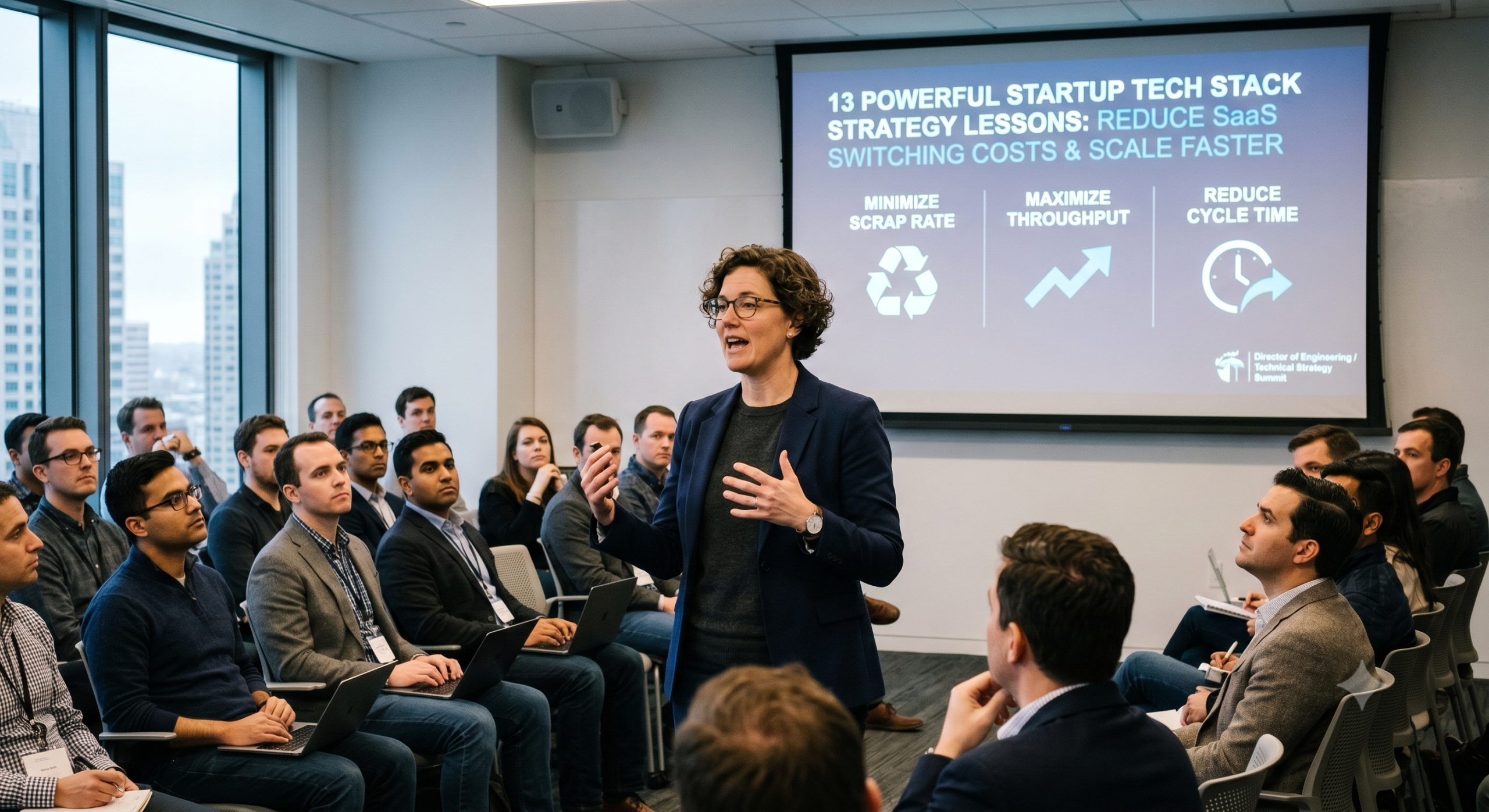
Switching Costs in SaaS become part of the business much earlier than most teams realize. They are not simply the expense of replacing one software application with another. They include the engineering effort required to migrate data, retrain employees, rebuild integrations, rewrite automation, update documentation, and recover from temporary productivity losses. When those hidden costs continue to grow, every future improvement becomes slower, more expensive, and riskier.
As an Enterprise Architect and Director of Engineering, I have seen organizations spend millions solving problems that could have been prevented during their first year. Ironically, many of those startups originally selected their tools because they were inexpensive, popular, or easy to deploy. Months later, those same tools became barriers instead of accelerators.
A successful Startup Tech Stack Strategy should never focus solely on today’s needs. It should support tomorrow’s growth while maximizing engineering throughput, shortening delivery cycles, and minimizing wasted effort across the organization. Every technology decision should make future development easier rather than creating unnecessary friction.
The strongest engineering organizations understand that every new platform introduces a long-term relationship. Once customer data, business processes, integrations, and employee workflows become deeply connected to a product, leaving it becomes increasingly difficult. Those are the real Switching Costs in SaaS, and they often become much larger than subscription fees.
This article explores thirteen practical lessons that help founders, architects, and engineering leaders build technology ecosystems that remain flexible as companies grow. Rather than chasing trends, these lessons focus on reducing waste, improving delivery speed, and protecting long-term scalability.
Why Startup Tech Stack Strategy Is Really a Business Strategy
Many founders assume selecting software belongs entirely to the engineering department. In reality, every technology decision affects marketing, finance, customer support, operations, sales, legal compliance, and future hiring.
A startup may begin with fewer than ten employees, but every new application introduces another system that someone must maintain. At first, those tools seem harmless. A separate CRM here, a project management platform there, another analytics dashboard, another messaging tool, and another automation platform. None of them feels expensive individually.
Eventually the organization discovers that every department stores information differently. Customer records become inconsistent. Reports no longer match. Teams waste hours confirming which dashboard contains the correct numbers.
That confusion is operational scrap.
Manufacturing leaders describe scrap as material that cannot be used to produce value. Software organizations create their own version of scrap whenever duplicated work, manual reconciliation, disconnected systems, or unnecessary complexity consume engineering time.
A thoughtful Startup Tech Stack Strategy reduces those losses before they appear.
Instead of constantly fixing problems between disconnected applications, engineers spend their time building features customers actually want.
The result is higher throughput, faster product delivery, and significantly lower operational waste.
Looking Beyond Subscription Prices
One of the biggest mistakes startups make is evaluating software only by monthly subscription costs.
The subscription often represents the smallest expense over the lifetime of a platform.
Hidden costs appear everywhere.
Engineers build custom integrations.
Operations teams create manual workarounds.
Customer support develops unique procedures.
Finance modifies reporting.
Marketing adjusts campaign tracking.
Leadership requests new dashboards.
Months later, these investments become tightly connected to the original software.
Replacing the platform no longer means paying for new software.
It means rebuilding an entire ecosystem.
That rebuilding effort slows feature delivery, interrupts product roadmaps, and increases technical debt.
When viewed through the lens of throughput and cycle time, unnecessary platform replacement creates one of the highest forms of organizational waste.
The Three Metrics Every Startup Should Optimize
Instead of chasing the newest technology trend, engineering leaders should evaluate every platform according to three operational measurements.
The first is throughput.
Throughput measures how much valuable work reaches customers within a given period. If developers spend weeks maintaining integrations instead of shipping features, throughput decreases.
The second measurement is cycle time.
Cycle time measures how quickly an idea becomes production software.
Long migration projects, difficult upgrades, and fragile integrations extend delivery timelines. Customers wait longer, feedback arrives later, and innovation slows.
The third measurement is scrap rate.
Scrap includes rework, duplicated engineering effort, abandoned migrations, broken integrations, inconsistent data, unnecessary maintenance, and software that no longer delivers meaningful value.
Reducing scrap creates additional engineering capacity without hiring more developers.
These three measurements provide a far better framework than simply asking whether a particular SaaS application is popular.
Lesson 1: Choose Platforms That Can Grow with Your Company
One of the easiest ways to reduce Switching Costs in SaaS is selecting tools that continue serving the business after rapid growth begins.
Many startups purchase lightweight software because it solves immediate pain points. There is nothing inherently wrong with starting small. Problems arise when leadership never evaluates how those platforms will support larger customer volumes, additional employees, expanding compliance requirements, or international operations.
Growth changes everything.
A simple customer database eventually requires role-based permissions.
A basic reporting tool eventually needs embedded analytics.
A lightweight accounting platform eventually connects to payroll, inventory, taxation, forecasting, and investor reporting.
Every new requirement increases dependency on the original system.
Changing platforms later becomes exponentially more expensive.
A scalable Startup Tech Stack Strategy anticipates these future requirements without overengineering today’s environment.
The goal is not buying enterprise software before it is needed.
The goal is selecting products that provide a realistic upgrade path without forcing complete replacement.
That distinction dramatically lowers future migration costs.
Lesson 2: Favor Open Integration over Closed Ecosystems
Every SaaS vendor promises seamless integration.
The reality varies considerably.
Some platforms expose comprehensive APIs, event systems, webhooks, and developer documentation.
Others intentionally make integrations difficult because customer lock-in becomes part of their business strategy.
Closed ecosystems create invisible switching costs.
As more business processes depend on proprietary workflows, leaving becomes increasingly painful.
Open ecosystems create flexibility.
When applications communicate through standardized APIs, replacing one component rarely requires rebuilding the entire architecture.
Think of the technology stack like modular construction.
If one window breaks, replacing the window should not require rebuilding the entire house.
Software architecture should follow the same philosophy.
Loose coupling creates faster change.
Tight coupling creates expensive migrations.
Organizations focused on throughput consistently favor interoperability because it reduces future engineering effort.
Lesson 3: Build Around Data Ownership Instead of Vendor Ownership
Many organizations mistakenly believe their most valuable asset is the software they purchase.
It is not.
Their most valuable asset is their data.
Customer history.
Sales records.
Financial transactions.
Support conversations.
Operational metrics.
Product analytics.
Business intelligence.
These datasets represent years of organizational learning.
A Startup Tech Stack Strategy should always prioritize easy access to business data.
If exporting information becomes complicated, expensive, incomplete, or slow, the organization gradually loses strategic flexibility.
Eventually leadership delays migration simply because retrieving historical information becomes too risky.
That is one of the clearest examples of Switching Costs in SaaS.
Instead of software serving the business, the business begins serving the software.
Strong architectural planning reverses that relationship.
Your systems should always make your data portable, accessible, and reusable.
That single principle protects startups from countless migration challenges as they continue to scale.
Lesson 4: Reduce Tool Sprawl Before It Reduces Your Speed
One of the most common patterns I see in growing startups is tool sprawl. It rarely happens because of poor intentions. Instead, each department solves its own immediate problem by adding another application. Marketing adopts one platform for campaign management, sales chooses a different CRM extension, engineering introduces new monitoring software, customer support adds another ticketing solution, and finance selects a separate reporting tool. Individually, each decision appears reasonable. Collectively, they create an ecosystem that becomes increasingly difficult to manage.
The immediate consequence is not higher subscription costs. The larger problem is that every new application introduces another integration, another data source, another authentication process, and another workflow that employees must learn. Engineers spend valuable time maintaining connections instead of building features. Business teams begin exporting spreadsheets between systems because automation no longer covers every scenario.
This growing complexity increases scrap throughout the organization. Information is entered multiple times, reports become inconsistent, and troubleshooting takes longer because nobody has a complete view of the technology landscape.
An effective Startup Tech Stack Strategy deliberately limits unnecessary software duplication. Every new tool should solve a meaningful business problem that cannot already be addressed by existing platforms. By reducing overlapping functionality, startups simplify maintenance, shorten onboarding time for new employees, and preserve engineering capacity for customer-facing innovation.
Lesson 5: Think Beyond Today’s Requirements
Many startups evaluate software based almost entirely on their current needs. While that approach feels practical during the early stages, it often creates expensive consequences later. A platform that perfectly serves a team of five people may struggle when the company grows to fifty employees, expands into new regions, or introduces multiple product lines.
The most resilient technology strategies ask a different question. Instead of asking whether a tool works today, they ask whether the platform can evolve alongside the business without forcing disruptive migrations.
Future growth introduces new compliance requirements, larger data volumes, additional security controls, more complex reporting, and greater customer expectations. Every one of these changes influences the long-term value of a technology investment.
Planning for future adaptability does not mean purchasing the most expensive enterprise software available. It means selecting solutions that provide clear upgrade paths, mature integration capabilities, reliable vendor support, and a proven history of continuous improvement.
When organizations make decisions with tomorrow in mind, Switching Costs in SaaS remain manageable instead of becoming strategic obstacles. The technology stack continues supporting business growth rather than slowing it, allowing engineering teams to maintain high throughput, shorter delivery cycles, and consistently lower operational waste.
Lesson 6: Design for Change Instead of Designing for Permanence
One of the biggest misconceptions in software architecture is believing that today’s technology decisions will remain unchanged for years. History tells a different story. Programming languages evolve, cloud providers release new services, vendors change their pricing models, startups outgrow their original platforms, and entirely new categories of software appear almost overnight.
A successful Startup Tech Stack Strategy accepts that change is inevitable. Instead of trying to predict every future technology trend, engineering leaders should create an environment where change is relatively inexpensive.
This philosophy dramatically reduces Switching Costs in SaaS because the organization expects components to evolve over time. Applications communicate through well-defined interfaces rather than tightly coupled integrations. Business logic remains separated from vendor-specific features whenever possible. Data is stored using structures that can be migrated without rebuilding every downstream application.
Think about the difference between renovating a modern office building and renovating an old house where electrical wiring, plumbing, and structural supports are hidden behind every wall. The office building was designed for future modifications, while the old house fights every attempt to improve it.
Technology ecosystems behave the same way.
Architectures that anticipate change allow teams to introduce new capabilities without interrupting existing operations. Developers spend less time untangling dependencies and more time delivering value to customers.
From a throughput perspective, flexibility keeps engineering teams productive because change becomes routine rather than disruptive. From a cycle time perspective, new initiatives reach production faster because fewer systems require modification. From a scrap rate perspective, organizations avoid throwing away months of engineering effort every time business priorities evolve.
Lesson 7: Avoid Vendor Lock-In Wherever Practical
Vendor lock-in is often discussed as a technical problem, but its biggest impact is actually strategic.
A startup that cannot easily change vendors loses negotiating power. Pricing increases become harder to challenge. Product limitations become harder to escape. New business opportunities may even be delayed because existing software cannot support them.
None of this happens overnight.
Vendor lock-in grows gradually as integrations multiply, employees become experts in proprietary workflows, automation expands, customer data accumulates, and documentation increasingly reflects one vendor’s ecosystem.
Eventually the business becomes dependent on decisions it no longer controls.
That dependency directly increases Switching Costs in SaaS.
Avoiding lock-in does not mean refusing to use commercial SaaS products. Modern startups benefit enormously from cloud-based software. The goal is to understand where dependency creates unnecessary risk and to manage it thoughtfully.
For example, choosing platforms that support standard authentication protocols, open APIs, widely accepted export formats, and comprehensive documentation gives the organization far more flexibility than relying on proprietary technologies that cannot communicate with anything else.
Similarly, maintaining internal documentation of critical business processes instead of depending entirely on vendor documentation preserves organizational knowledge even if software changes in the future.
Architectural independence does not eliminate switching costs, but it prevents those costs from becoming overwhelming.
Lesson 8: Standardization Creates Speed That Compounds Over Time
Many startups celebrate flexibility by allowing every team to choose its preferred tools.
Initially, this appears empowering. Engineers enjoy experimenting with new frameworks. Marketing selects specialized analytics platforms. Customer support adopts unique productivity software.
For a while, everything seems to work.
As the company grows, however, inconsistency becomes expensive.
Different authentication systems require different security policies.
Different reporting platforms generate conflicting metrics.
Different monitoring tools create fragmented operational visibility.
Different deployment pipelines require separate maintenance.
Engineers moving between teams must repeatedly learn entirely new environments before contributing meaningful work.
Cycle time increases even though the organization has hired more people.
Standardization solves this problem.
A standardized Startup Tech Stack Strategy does not eliminate innovation. Instead, it defines a reliable foundation upon which innovation can happen more efficiently.
Developers reuse proven deployment pipelines.
Security teams apply consistent governance.
Operations automate repeatable processes.
Support teams troubleshoot familiar environments.
New employees become productive much faster because every project follows similar architectural principles.
The resulting improvement in throughput compounds year after year.
Organizations that standardize intelligently often deliver software faster with smaller engineering teams because less effort is spent managing unnecessary complexity.
Lesson 9: Measure Total Cost of Ownership Instead of Initial Cost
One of the most expensive mistakes startups make is confusing purchase price with ownership cost.
A software subscription costing only a few hundred dollars each month may appear inexpensive.
Yet that same platform could require dedicated administrators, custom integrations, manual reporting, ongoing consulting, employee training, specialized security reviews, and continuous maintenance.
Suddenly the subscription itself represents only a small fraction of the actual investment.
A comprehensive Startup Tech Stack Strategy evaluates technology using Total Cost of Ownership rather than monthly licensing fees.
This broader perspective includes several important questions.
How many engineers will maintain integrations?
How much downtime could migration create?
Will employees require significant retraining?
Does the software reduce manual work or simply relocate it?
Will future upgrades require expensive consulting engagements?
Can business processes continue if the vendor changes pricing or licensing?
Every answer influences Switching Costs in SaaS.
Organizations that ignore these questions frequently discover hidden expenses years after implementation, when replacing the platform becomes significantly more difficult.
Looking beyond purchase price encourages better long-term decisions.
Engineering leaders gain a clearer understanding of which technologies genuinely increase productivity and which quietly consume valuable organizational capacity.
Lesson 10: Treat Technical Debt Like Financial Debt
Technical debt receives plenty of attention within engineering circles, but startups often underestimate how closely it connects to software selection.
Every rushed integration, undocumented workflow, duplicated automation, or temporary workaround accumulates interest over time.
Initially those shortcuts seem harmless.
A manual spreadsheet bridges two applications.
A custom script synchronizes customer records.
A developer writes a quick API connector without documentation.
Operations create an unofficial process because the existing platform lacks required functionality.
Each decision solves an immediate problem.
Together they create a fragile ecosystem.
Eventually engineers become afraid to modify systems because nobody fully understands how everything fits together.
Delivery slows.
Testing becomes more difficult.
Unexpected failures increase.
Cycle times expand.
Throughput declines.
Technical debt behaves remarkably like financial debt because today’s convenience becomes tomorrow’s obligation.
Reducing Switching Costs in SaaS requires actively managing this debt before it grows beyond control.
Successful engineering organizations schedule regular architectural reviews rather than waiting for major failures.
They simplify integrations.
They retire unused software.
They eliminate duplicate workflows.
They document critical business logic.
They replace temporary fixes with sustainable solutions whenever practical.
This continuous improvement mindset keeps technology ecosystems healthy.
More importantly, it prevents technical debt from turning every future migration into a massive engineering project.
The Hidden Relationship Between Switching Costs and Engineering Productivity
Engineering productivity is often measured by how quickly developers release new features. While delivery speed is important, it tells only part of the story. A team may appear productive on the surface while quietly spending a significant portion of its time maintaining unnecessary complexity.
Every hour spent repairing brittle integrations, reconciling inconsistent data, or working around limitations imposed by legacy software is an hour that cannot be invested in customer value. These activities rarely generate competitive advantage. Instead, they consume engineering capacity that could have been used to improve the product.
This is where Switching Costs in SaaS become more than a financial concern. They directly influence the daily productivity of the entire organization.
High switching costs encourage teams to postpone improvements because replacing outdated software feels overwhelming. Over time, this hesitation slows innovation, extends release schedules, and creates frustration across departments. Employees begin accepting inefficient workflows simply because changing them appears too difficult.
Organizations with a mature Startup Tech Stack Strategy take the opposite approach. They continuously evaluate whether existing platforms still support business objectives. Small adjustments happen regularly, making large-scale migrations less frequent and far less disruptive.
The result is an engineering organization that remains adaptable. Instead of reacting to technology constraints, teams proactively improve their ecosystem, preserving high throughput and consistently reducing operational waste.
Building an Ecosystem Instead of Collecting Software
Many startups unknowingly collect software rather than building a technology ecosystem. The difference may seem subtle, but its long-term impact is enormous.
A collection of software consists of independent applications that happen to coexist within the same company. Each department purchases tools based on immediate needs, with little consideration for how those platforms interact with the broader organization.
A technology ecosystem is intentionally designed. Every platform supports a defined architectural vision. Information flows consistently between systems. Security policies remain aligned. Reporting follows common standards. Employees understand where data originates and how it moves across the business.
This ecosystem approach significantly lowers Switching Costs in SaaS because every technology decision considers future flexibility from the beginning.
When a platform eventually reaches the end of its useful life, replacing it becomes a manageable improvement rather than a company-wide crisis.
The strongest engineering organizations rarely achieve this overnight. They build it gradually through disciplined decision-making, regular architectural reviews, thoughtful governance, and a commitment to reducing unnecessary complexity wherever possible.
That discipline pays dividends every time the business grows, enters a new market, launches another product, or adapts to changing customer expectations.
Lesson 11: Create Governance That Accelerates Decisions Instead of Slowing Them Down
The word governance often makes startup founders nervous because it sounds like unnecessary bureaucracy. In reality, effective governance does exactly the opposite. It removes uncertainty, eliminates repeated debates, and allows teams to make faster, more consistent decisions.
A growing startup eventually reaches a point where multiple teams begin selecting their own technologies. Without a common decision-making framework, every department optimizes for its own short-term needs. Engineering chooses one authentication platform, marketing purchases a separate analytics tool, customer success adopts another reporting application, and finance implements software that cannot easily exchange data with the rest of the business.
The result is not innovation.
The result is fragmentation.
A well-designed Startup Tech Stack Strategy introduces lightweight governance that helps everyone make better choices without slowing delivery. Rather than requiring lengthy approval processes, engineering leadership defines a set of architectural principles that guide future decisions.
For example, every new platform should support open APIs, standard authentication methods, documented export capabilities, and reliable vendor support. New software should demonstrate how it integrates with existing systems before procurement begins.
This approach dramatically reduces Switching Costs in SaaS because every technology investment is evaluated within the context of the entire ecosystem instead of solving one isolated problem.
From an operational perspective, governance reduces scrap by preventing duplicate purchases, redundant integrations, and conflicting architectures before they ever reach production.
More importantly, it keeps engineering throughput high because teams spend less time debating tools and more time building products.
Lesson 12: Continuously Review Your Technology Portfolio
One characteristic separates mature engineering organizations from struggling ones.
They regularly retire technology.
Many startups assume that once software is implemented, it will remain part of the business indefinitely. Unfortunately, every application has an operational cost, whether it is actively used or not.
Old integrations continue running.
Unused automation still requires maintenance.
Inactive user accounts remain security risks.
Legacy reports continue consuming storage and administrative attention.
Over time, forgotten software quietly increases organizational complexity.
Technology portfolios should receive the same attention as financial investments.
Business leaders periodically evaluate whether each application still contributes measurable value.
Questions worth asking include:
Does this software still solve an important business problem?
Has another platform replaced most of its functionality?
Are employees actively using it?
Does it introduce security, compliance, or maintenance overhead?
Could the organization simplify its architecture by consolidating multiple applications?
These reviews often uncover surprising opportunities to eliminate waste.
Removing unnecessary software reduces maintenance costs, simplifies integrations, improves security, and shortens onboarding for new employees.
Most importantly, portfolio reviews prevent Switching Costs in SaaS from growing unnoticed.
Rather than waiting until migration becomes unavoidable, organizations continuously simplify their technology landscape while change remains manageable.
This steady approach reduces disruption and keeps cycle times consistently low.
Lesson 13: Build a Technology Ecosystem That Serves the Business, Not the Other Way Around
The final lesson may also be the most important.
Technology exists to support business outcomes.
Unfortunately, many organizations eventually reach a point where business decisions become constrained by software limitations.
Marketing cannot launch campaigns because integrations require months of development.
Sales cannot introduce new pricing models because billing systems are tightly coupled to application logic.
Customer support cannot improve service because information lives across disconnected platforms.
Engineering delays innovation because replacing legacy software appears too risky.
At that stage, technology no longer enables growth.
It limits it.
An effective Startup Tech Stack Strategy reverses this relationship.
Every platform should increase organizational flexibility rather than reducing it.
Every integration should simplify operations rather than introducing additional maintenance.
Every automation should eliminate repetitive work rather than creating another fragile dependency.
Every architectural decision should improve throughput, shorten delivery cycles, and reduce operational scrap.
Organizations that consistently follow these principles rarely avoid change altogether.
Instead, they become exceptionally good at managing change.
That capability becomes a competitive advantage.
Markets evolve.
Customer expectations change.
New technologies emerge.
Companies that adapt quickly consistently outperform those trapped by outdated technology decisions.
Reducing Switching Costs in SaaS is ultimately about preserving that adaptability.
The easier it becomes to evolve your technology ecosystem, the easier it becomes to evolve your business.
Conclusion
Choosing software has never been easier.
Building a sustainable technology ecosystem has never been more challenging.
Thousands of SaaS platforms promise faster deployment, lower costs, and greater productivity. Many genuinely deliver on those promises. The challenge is recognizing that every implementation creates long-term architectural consequences.
A successful Startup Tech Stack Strategy is not measured by the number of tools a company owns. It is measured by how effectively those tools work together to support business growth.
When viewed through the operational lens of maximizing throughput, reducing cycle time, and minimizing scrap rate, the objective becomes remarkably clear.
Reduce unnecessary complexity.
Protect data ownership.
Favor open integration.
Standardize where it creates efficiency.
Continuously simplify the technology portfolio.
Plan for change instead of resisting it.
These principles lower Switching Costs in SaaS while creating an engineering organization capable of delivering new ideas faster, responding to market changes more confidently, and scaling without accumulating unnecessary operational waste.
Technology should create momentum.
The best startup technology strategies ensure it continues doing exactly that, even years after the first line of code is written.
Frequently Asked Questions (FAQ)
What are Switching Costs in SaaS?
Switching Costs in SaaS refer to the total effort required to replace one software platform with another. Beyond subscription fees, they include data migration, employee retraining, rebuilding integrations, updating documentation, modifying business processes, testing, and temporary productivity losses.
Why is a Startup Tech Stack Strategy important?
A Startup Tech Stack Strategy ensures that technology decisions support long-term business growth instead of creating future bottlenecks. It helps startups scale efficiently while reducing operational complexity and technical debt.
How do switching costs affect engineering productivity?
High switching costs consume engineering time through migration projects, maintenance, custom integrations, and workaround development. Lower switching costs allow developers to spend more time building customer-facing features and less time maintaining infrastructure.
How can startups reduce Switching Costs in SaaS?
Startups can reduce switching costs by selecting platforms with open APIs, maintaining ownership of business data, avoiding unnecessary vendor lock-in, standardizing core technologies, documenting integrations, and regularly reviewing their software portfolio to eliminate redundant applications.
Should startups always choose enterprise software?
Not necessarily. The best choice is software that fits current business needs while providing a realistic path for future growth. Overengineering can be just as costly as underinvesting. The goal is scalability without unnecessary complexity.
What metrics should engineering leaders monitor?
Engineering leaders should prioritize throughput, cycle time, and scrap rate. Together, these metrics provide a practical view of how efficiently the technology ecosystem supports product delivery and long-term business scalability.
References and Further Reading
The following resources provide excellent insights into startup architecture, engineering strategy, SaaS platforms, and scalable technology ecosystems:
- Martin Fowler – Feature Toggles (Feature Flags) – Practical guidance on managing change safely in software systems.
- AWS – Building Software Platforms: A Guide to SaaS Transition – An in-depth resource on platform engineering and scalable SaaS architecture.
- Aalpha – SaaS Product Lifecycle Guide – Covers the lifecycle of building and scaling SaaS products from idea to growth.
- Choosing the Right Tech Stack for SaaS – A practical overview of technology stack selection for modern SaaS applications.
- Stigg Engineering – Entitlements Untangled – Explains how decoupling pricing, feature access, and application logic reduces long-term architectural complexity.
These resources complement the principles discussed in this article and provide additional perspectives on designing technology ecosystems that remain scalable, adaptable, and efficient as startups grow.