
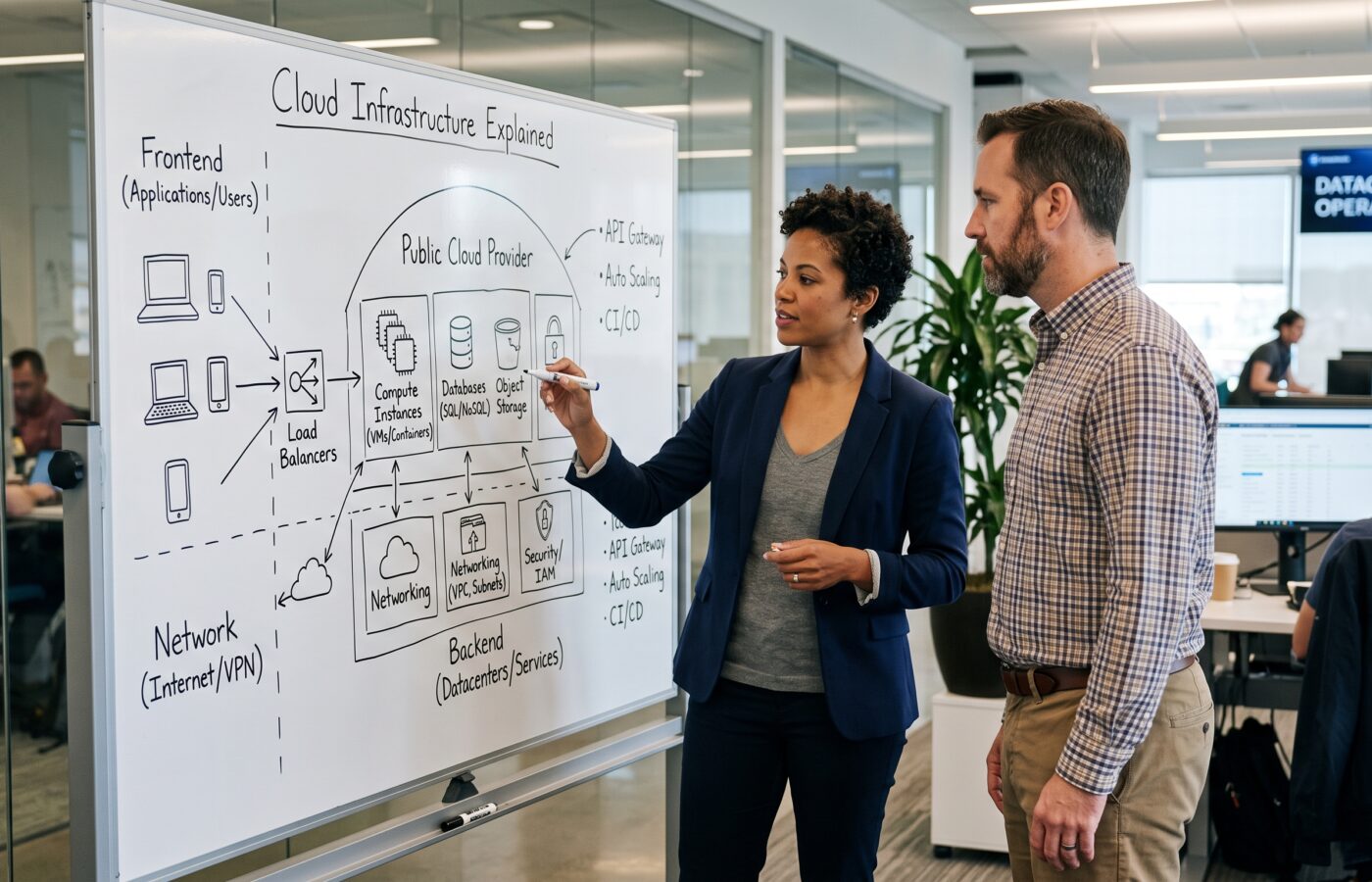
Cloud Infrastructure Explained

Cloud infrastructure serves as the essential backbone of modern digital business. By seamlessly combining physical hardware, virtualization layers, and software-defined services, it delivers on-demand computing resources over the internet. Consequently, for organizations scaling applications, reducing operational overhead, or enabling global availability, a well-architected cloud infrastructure is entirely non-negotiable.
This article, written from the perspective of a practicing cloud architect, comprehensively breaks down what cloud infrastructure really means in 2026. Specifically, it explores the core components you need to understand, the architectural patterns that work in production, and the 12 practical considerations every team should evaluate before committing to a design.
What Is Cloud Infrastructure?
Fundamentally, cloud infrastructure refers to the integrated collection of hardware and software components—including servers, storage, networking, virtualization, and orchestration tools—that collectively enable the delivery of cloud computing services over the internet.
In stark contrast to traditional on-premises data centers, cloud infrastructure is fully abstracted, highly elastic, and consumed as a dynamic service. As a direct result, engineering teams can provision enterprise-grade resources in minutes rather than weeks.
At its foundation, modern cloud infrastructure consists of four distinct operational layers:
- Physical Infrastructure Layer: The foundational data centers housing physical servers, high-density storage arrays, specialized GPUs, and networking gear managed entirely by cloud providers.
- Virtualization Layer: Advanced hypervisors and container runtimes that safely enable multiple isolated workloads to share the same physical hardware securely.
- Service Layer: Fully managed platform services for compute, storage, databases, networking, security, and observability that are exposed directly via APIs and web consoles.
- Application Layer: The top-tier environments where modern applications execute, leveraging cloud-native services to deliver tangible business value.
Ultimately, this layered model allows architects to focus strictly on application logic and operational resilience without ever having to manage physical servers or network switches.
Core Components of Cloud Infrastructure
Every resilient cloud infrastructure design rests upon six foundational components. Therefore, deeply understanding these building blocks is essential for making informed, forward-looking architectural decisions.
1. Compute
Compute resources provide the essential processing power required for running applications. Typically, these options include:
- Virtual Machines (VMs): General-purpose virtual instances such as AWS EC2, Azure Virtual Machines, or Google Compute Engine.
- Containers: Lightweight and highly portable runtime environments orchestrated by systems like Kubernetes or managed services like AWS ECS and Azure AKS.
- Serverless Functions: Event-driven, ephemeral compute engines such as AWS Lambda, Azure Functions, or Google Cloud Functions.
Naturally, architects choose among these models based on specific workload characteristics. For instance, stateful services often run best on VMs or containers; however, short-lived, event-driven tasks fit serverless models much more efficiently.
2. Storage
Cloud storage systems are engineered to handle vast amounts of structured and unstructured data at scale. As a result, several specialized storage types have emerged:
- Object Storage: Built specifically for unstructured files, media assets, and system backups (e.g., Amazon S3, Azure Blob, and Google Cloud Storage).
- Block Storage: Dedicated, high-performance virtual disks attached directly to VMs (e.g., AWS EBS and Azure Disks).
- Managed File Systems: Distributed, shared file storage designed for legacy migration or collaborative workloads (e.g., AWS EFS and Azure Files).
- Databases: Specialized engines ranging from relational systems (RDS, Cloud SQL) to NoSQL models (DynamoDB, Cosmos DB) and large-scale data warehouses (Redshift, BigQuery).
Because storage decisions profoundly impact long-term cost, performance, and durability, architects must evaluate access patterns, retention policies, and compliance requirements very early in the design cycle.
3. Networking
Networking components function to connect resources securely and efficiently across environments. Key elements include:
- Virtual Private Clouds (VPCs): Isolated virtual network environments equipped with custom subnets, route tables, and gateways.
- Load Balancers: Traffic distributors that route incoming requests across multiple healthy instances to maximize availability and scale.
- API Gateways: Front-line proxies that manage, throttle, and secure API traffic between external clients and backend services.
- Content Delivery Networks (CDNs): Edge-caching networks that cache static and dynamic content close to end users in order to reduce latency.
- DNS Services: Reliable translation systems that resolve human-readable domain names into IP addresses (e.g., Route 53, Cloud DNS).
Consequently, robust network design must always account for physical latency, available bandwidth, strict security boundaries, and hybrid connectivity options.
4. Security and Identity
Security is not an afterthought; rather, it is embedded across every single layer of cloud infrastructure. Core controls include:
- Identity and Access Management (IAM): Granular policy frameworks that define exactly who can access specific resources and under what precise conditions.
- Encryption: Comprehensive protective controls for data at rest and in transit using centralized Key Management Services (KMS).
- Network Security: Layered defenses such as security groups, network firewalls, and zero-trust policies that restrict unauthorized traffic flows.
- Secrets Management: Dedicated vaults that securely store API keys, SSL certificates, and database credentials.
By systematically applying the principle of least privilege and adopting zero-trust architectural models, teams can effectively minimize their overall attack surfaces.
5. Management and Orchestration
Management tools serve to automate provisioning, monitoring, and governance across systems. Furthermore, common capabilities include:
- Infrastructure as Code (IaC): Methods to define and version infrastructure declaratively using code-based tools like Terraform, CloudFormation, Pulumi, or Bicep.
- Orchestration: Systems that coordinate containers, virtual machines, and serverless tasks seamlessly across heterogeneous environments.
- Cost Management: Financial tools that track cloud spend, enforce budgets, and optimize resource utilization.
- Compliance and Governance: Automated policies that continuously enforce strict standards for tagging, encryption, and access controls.
Indeed, robust automation dramatically reduces human error while enabling highly repeatable and auditable deployments.
6. Observability
Observability provides actionable visibility into overall system health and performance. Specifically, modern observability toolsets encompass:
- Monitoring: Real-time operational metrics for CPU utilization, memory allocation, latency, and error rates (e.g., CloudWatch, Datadog).
- Logging: Centralized log aggregation engines indispensable for system debugging and auditing.
- Tracing: End-to-end request tracing spanning microservice boundaries (e.g., OpenTelemetry).
- Alerting: Automated notification systems that alert engineering teams to unusual anomalies or threshold breaches.
Without adequate observability, operations teams essentially operate blind; consequently, incident response and capacity planning become extremely difficult.
Cloud Architecture Patterns That Work in Production
Architectural patterns effectively translate complex business requirements into scalable technical designs. Therefore, the following patterns are widely adopted in 2026 for high scalability, resilience, and operational maintainability.
Microservices Architecture
Microservices decompose monolithic applications into loosely coupled, independently deployable micro-services. As a direct result, this pattern offers key benefits:
- Independent horizontal scaling of individual services based on actual real-time demand.
- Significantly faster release cycles and higher engineering team autonomy.
- Excellent fault isolation that effectively prevents single-point failures from escalating into cascading outages.
However, trade-offs do exist. Specifically, teams must contend with increased operational complexity, mandatory distributed tracing needs, and potential data consistency challenges.
Serverless Architecture
Serverless architectures leverage event-driven functions and fully managed cloud platform services to eliminate server management overhead completely. Consequently, key advantages include:
- True pay-per-use pricing model aligned strictly with actual code execution time.
- Automatic, instantaneous scaling without complex capacity planning.
- Drastically reduced operational maintenance burden for routine infrastructure management.
Nevertheless, architects must carefully account for potential limitations such as cold-start latencies, vendor lock-in risks, and runtime constraints on long-running processes.
Auto-Scaling and Load Balancing
Auto-scaling dynamically adjusts compute capacity based on live metrics like CPU load or incoming request rate; meanwhile, load balancers seamlessly distribute that incoming traffic across all healthy instances. Working together, they enable:
- Highly elastic responses during sudden, unannounced traffic spikes.
- Superior high availability during instance or availability zone failures.
- Maximized cost efficiency by automatically scaling down compute fleets during idle periods.
Therefore, architects must define precise scaling policies, health check parameters, and threshold limits to strike the ideal balance between raw performance and total cost.
Multi-Cloud and Hybrid Strategies
Multi-cloud and hybrid architectures intentionally spread workloads across multiple cloud providers or synthesize public cloud capacity with on-premises data centers. Principal drivers behind this pattern include:
- Avoiding restrictive vendor lock-in while gaining superior price negotiation leverage.
- Meeting stringent local regulatory or strict data residency mandates.
- Strategically leveraging best-of-breed specialized services offered by different cloud vendors.
Although beneficial, architectural complexity increases significantly—especially regarding multi-cloud networking, identity federation, and cross-cloud data synchronization. To manage this, teams typically adopt standardized abstraction layers and unified IaC workflows.
Event-Driven Architecture
Event-driven systems immediately react to system state changes via asynchronous message queues, event streams, or pub/sub services. Key benefits include:
- Thoroughly decoupled services that can evolve and scale independently.
- Real-time processing capability for complex, event-driven business workflows.
- Enhanced system resilience obtained through built-in asynchronous retry mechanisms.
Ultimately, architects must carefully select messaging patterns (such as FIFO queues versus log-based streams) based on exact ordering requirements, durability needs, and targeted throughput goals.
12 Practical Considerations for Cloud Infrastructure Design
When designing a modern cloud infrastructure, architects must systematically evaluate a dozen critical dimensions to ensure the ultimate design aligns with all business, technical, and operational goals. Therefore, these 12 considerations form a comprehensive checklist for sound cloud architecture:
- Scalability Requirements: Precisely define expected growth trajectories for users, transaction volumes, and overall data storage.
- Availability and Resilience: Establish firm uptime targets (e.g., 99.9% or 99.99%) and intentionally design for multi-AZ or multi-region failures.\
- Security and Compliance: Thoroughly map regulatory obligations (such as GDPR, HIPAA, or SOC 2) to concrete technical controls like encryption and access policies.
- Cost Optimization: Continuously model the total cost of ownership (TCO), accounting for compute runtime, storage pricing, data egress fees, and managed services.
- Performance and Latency: Identify latency-sensitive application components and strategically place resources closer to end users via regional deployments and CDNs
- Data Management Strategy: Systematically plan for reliable backups, rapid disaster recovery, long-term retention schedules, and automated lifecycle rules.
- Identity and Access Governance: Enforce strict least-privilege IAM policies, role-based access controls (RBAC), and comprehensive audit logging.
- Observability and Monitoring: Instrument applications with comprehensive metrics, centralized logging, and distributed tracing from day one.
- Automation and IaC: Declaratively encode all infrastructure assets in version-controlled templates to guarantee deployment repeatability and auditability.
- Vendor Lock-In Risk: Proactively evaluate service portability and consider cloud-agnostic abstraction layers wherever appropriate.
- Hybrid and Multi-Cloud Needs: Determine early whether workloads must span distinct environments for compliance, low-latency edge computing, or redundancy.
- Operational Maturity: Ensure operations teams possess fully tested runbooks, clear incident response plans, and structured on-call procedures.
By addressing these 12 practical areas early, teams can effectively prevent extremely costly architectural rewrites later, thereby ensuring their infrastructure continuously delivers business value.
Best Practices for Cloud Infrastructure in 2026
Based on proven industry patterns and real-world lessons learned from production systems, the following best practices help modern teams construct exceptionally robust cloud infrastructure:
- Design for Scalability First: Always assume rapid growth from the outset; consequently, build stateless, horizontally scalable microservices right from the start.
- Automate Everything: Fully embrace Infrastructure as Code, robust CI/CD pipelines, and automated testing to eliminate error-prone manual interventions.
- Adopt Managed Cloud-Native Services: Whenever practical, leverage managed databases, serverless platforms, and managed message queues to reduce administrative burden.
- Implement Zero-Trust Security: Consistently enforce strict access control, encrypt all data at rest and in transit, and aggressively segment virtual networks.
- Monitor and Optimize Continuously: Actively track performance, expenditure, and security metrics; subsequently, iterate on your architecture as business needs evolve.
- Plan for Failure: Architect multi-AZ and multi-region deployments equipped with automated failover mechanisms and resilient disaster recovery plans.
- Document and Govern: Diligently maintain Architecture Decision Records (ADRs), enforce standardized resource tagging, and gather compliance evidence continuously.
Together, these standard practices form the core foundation of a mature, modern cloud operating model.
Common Pitfalls to Avoid
Even highly experienced architecture teams occasionally stumble upon predictable anti-patterns. Therefore, be sure to watch out for these frequent mistakes:
- Over-Provisioning Resources: Unnecessarily paying for idle compute capacity due to poorly configured or overly conservative auto-scaling policies.
- Neglecting Security Basics: Leaving open security group ports, granting overly permissive IAM roles, or storing data in unencrypted storage buckets.
- Tight Coupling to Vendor Services: Becoming so tightly coupled to proprietary APIs that future cloud migrations or hybrid implementations become nearly impossible.
- Insufficient Observability: Operating essentially blind during critical production outages due to missing metrics, incomplete logs, or absent tracing.
- Ignoring Cost Signals: Allowing cloud invoices to spiral out of control because of a lack of spending alerts, budgets, or cost allocation tags.
- Manual Deployments: Relying on risky manual “click-ops” management through cloud web consoles instead of enforcing strict IaC practices.
Proactively mitigating these common pitfalls early saves significant time, financial capital, and operational friction over the long run.
The Role of the Cloud Architect
Cloud architects play a vital strategic role by translating high-level business goals into concrete, executable technical blueprints. Specifically, their day-to-day responsibilities include:
- Defining Topology: Structuring complete infrastructure topologies across geographic regions, availability zones, and virtual networks.
- Selecting Platforms: Carefully selecting appropriate platform services (e.g., databases, orchestrators, message brokers) tailored to specific workload needs.
- Establishing Patterns: Setting core integration patterns—such as RESTful APIs, event streams, and microservices—for seamless application connectivity.
- Setting Governance: Establishing operational standards for system observability, identity management, security enforcement, and cloud cost allocation.
Ultimately, cloud architects must collaborate closely with software developers, security specialists, and operational engineers to ensure the underlying infrastructure supports rapid feature iteration while maintaining uncompromised reliability and strict compliance.
Frequently Asked Questions
What is cloud infrastructure?
Cloud infrastructure is the combined ecosystem of physical hardware, virtualization layers, and software-defined services that collectively deliver scalable computing resources over the internet.
What are the main components of cloud infrastructure?
The six core components are compute processing, data storage, networking, security and identity management, operational management and orchestration, and observability.
How is cloud infrastructure different from traditional data centers?
Unlike traditional data centers, cloud infrastructure is abstracted from physical hardware, highly elastic, and consumed as an on-demand service. Consequently, it allows rapid, automated resource provisioning without manual hardware management.
What architectural patterns work best in the cloud?
The most proven patterns include microservices, serverless computing, auto-scaling combined with load balancing, multi-cloud/hybrid strategies, and event-driven architectures.
How do I optimize cloud infrastructure costs?
Implement aggressive auto-scaling, right-size underutilized compute instances, leverage serverless models for unpredictable workloads, continuously monitor cloud spend, and consistently apply detailed cost-allocation tags.
What security controls are essential for cloud infrastructure?
Essential controls include strict IAM policies following least privilege, encryption for data at rest and in transit, virtual network segmentation, and comprehensive zero-trust access frameworks.
Why is observability important in cloud infrastructure?
Observability offers real-time insight into system health. As a result, engineering teams can resolve production incidents much faster, optimize performance, and perform accurate capacity planning.
What are the 12 key considerations for cloud infrastructure design?
They are scalability, availability, security, cost optimization, performance, data management, identity governance, observability, IaC automation, vendor lock-in risk, hybrid/multi-cloud needs, and operational maturity.
References
- Microsoft Learn. “Best Practices in Cloud Applications – Azure Architecture Center.” Microsoft.
- Amazon Web Services. “AWS Well-Architected Framework: Reliability, Performance, and Security.” AWS Documentation.
- Google Cloud. “What Is Cloud Architecture? Benefits, Components, and Framework.” Google Cloud Knowledge Base.
- IBM Think Topics. “What Is Cloud Architecture? Core Components and Design Strategies.” IBM.
- VMware. “What Is Cloud Infrastructure? Virtualization, Compute, and Storage.” VMware Tech Topics.
- Red Hat. “5 Essential Components of a Hybrid Cloud Architecture.” Red Hat Enterprise Blog.
- Cloudflare Learning Center. “What Is Cloud Infrastructure and How Does It Work?” Cloudflare.
- Datadog. “Monitoring and Observability Principles for Modern Infrastructure.” Datadog Engineering Blog.