


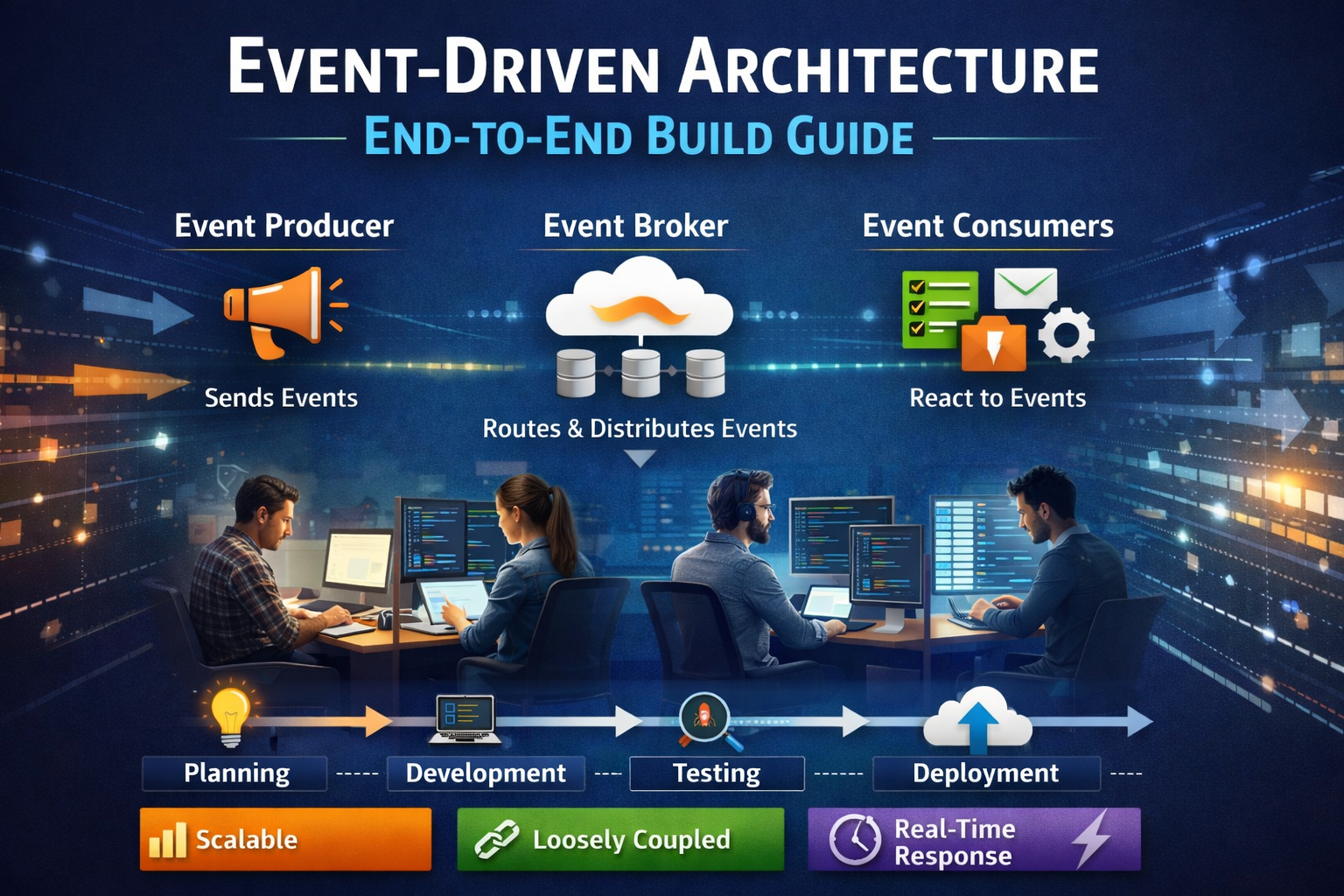
Building modern software products is no longer just about writing code and launching a website. Today’s systems must scale, react in real time, integrate with multiple services, and evolve quickly. One architectural pattern that enables this flexibility is Event-Driven Architecture.
This guide explains how software products are built end-to-end. If you want a broader breakdown of the full development lifecycle, read our detailed guide on how software products are built from start to finish. In this article, we focus specifically on how event-driven systems work, when to use them, and why they matter in modern development.
How Software Products Are Built from Start to Finish?
Before diving deep into event-based systems, it helps to understand the full product development lifecycle.
Most software products are built through these stages:
- Ideation and validation
- System architecture design
- Development
- Testing
- Deployment
- Monitoring and scaling
Architecture decisions happen early and influence everything that follows. Choosing an event-driven design affects how services communicate, scale, and recover from failure.
What Is Event-Driven Architecture?
Event-Driven Architecture (EDA) is a design pattern where software components communicate through events. An event represents a meaningful change in state. For a broader industry explanation, you can explore this detailed event-driven architecture guide by Future Processing, which breaks down real-world use cases and implementation strategies.
Examples of events:
- A customer places an order
- A payment succeeds
- A user updates their profile
- A sensor reports a temperature change
Instead of one service directly calling another, a producer emits an event. Other services subscribe and react asynchronously.
In simple terms, systems respond to what happens rather than constantly requesting updates.
Traditional Architecture vs Event-Driven Systems
In traditional request-response systems:
- Service A directly calls Service B.
- Service B responds immediately.
- Both systems are tightly connected.
In event-driven systems:
- Service A publishes an event.
- Multiple services independently react.
- No direct dependency exists between them.
This shift enables better scalability and flexibility.
| Traditional Model | Event-Based Model |
|---|---|
| Synchronous calls | Asynchronous messaging |
| Tight coupling | Loose coupling |
| Limited scalability | Independent scaling |
| Harder to evolve | Easier to extend |
Where Event-Driven Architecture Fits in the Build Process?
1. Product Planning
During planning, architects evaluate system needs:
- Will the system require real-time updates?
- Will multiple services react to the same action?
- Is scalability a priority?
If the answer is yes, an event-driven approach becomes a strong candidate.
2. System Design
In this stage, teams define:
- Event producers
- Event consumers
- Message brokers
- Event schemas
Designing event contracts early ensures consistency across services.
3. Development Phase
Developers build services independently:
- Producers emit events.
- Consumers subscribe to specific events.
- Communication is asynchronous.
This allows parallel development across teams.
4. Testing and Validation
Testing distributed event systems includes:
- Verifying event delivery
- Handling duplicate events
- Testing failure recovery
- Ensuring schema compatibility
Proper testing is critical because asynchronous flows are harder to trace.
5. Deployment and Scaling
Event-driven design works well in cloud environments. Services can scale independently based on workload.
For example:
- A notification service can scale during peak traffic.
- A billing service can remain unchanged.
Core Components of an Event-Driven System
To understand Event-Driven Architecture clearly, you need to know its core building blocks.
Event Producer
An event producer detects a change and publishes an event.
Example:
When an order is placed, the order service emits an “Order Created” event.
The producer does not need to know who consumes the event.
Event Broker
The broker routes events to interested consumers.
Common broker technologies include:
- Apache Kafka
- RabbitMQ
- AWS EventBridge
The broker ensures reliable and scalable event distribution.
Event Consumer
Consumers subscribe to relevant events and act upon them.
Continuing the order example:
- Inventory updates stock.
- Shipping schedules delivery.
- Email sends confirmation.
- Analytics logs the transaction.
Each service reacts independently.
Real-World Example: Online Marketplace
Imagine building an e-commerce platform.
When a customer checks out:
- Order service publishes “Order Completed.”
- Payment service processes transaction.
- Inventory adjusts stock.
- Shipping prepares dispatch.
- Loyalty service adds reward points.
- Reporting service records metrics.
None of these services call each other directly. They simply react to the event.
This allows new services to be added later without rewriting existing logic.
Why Modern Software Favors Event-Driven Architecture?
1. Scalability
Services scale independently based on demand.
2. Flexibility
New features can subscribe to existing events without modifying core systems.
3. Resilience
If one service fails, others continue operating.
4. Faster Innovation
Teams deploy services independently, enabling continuous delivery.
For high-growth platforms, this flexibility is essential.
Challenges of Event-Driven Design
Despite its advantages, this architecture introduces complexity.
Debugging Difficulty
Tracing issues across multiple services requires distributed logging and monitoring tools.
Event Ordering
Some systems require events to be processed in strict order. Managing this can be challenging.
Data Consistency
Distributed systems often rely on eventual consistency instead of immediate consistency.
Operational Overhead
Monitoring brokers, scaling consumers, and handling retries require operational maturity.
These trade-offs must be carefully considered before adopting this model.
Best Practices for Implementing Event-Driven Architecture
To build reliable event-driven systems, follow these guidelines:
Define Clear Event Schemas
Events should follow a consistent structure. Use versioning when changes are necessary.
Keep Events Immutable
Once published, events should not be altered.
Design Idempotent Consumers
Consumers must handle duplicate events safely.
Monitor Everything
Use centralized logging and tracing tools to observe system behavior.
Avoid Over-Engineering
Not every project needs complex distributed messaging. Start simple and evolve when needed.
When Should You Use Event-Driven Architecture?
This architectural pattern works best when:
- You are building microservices.
- You require real-time processing.
- Multiple systems react to the same business event.
- Scalability is critical.
- Cloud-native infrastructure is in place.
However, for small applications with limited traffic and simple workflows, traditional architectures may be more practical.
Choosing the right architecture depends on business goals, technical requirements, and team expertise.
Event-Driven Architecture in Cloud and Serverless Systems
Cloud platforms and serverless computing have accelerated the adoption of Event-Driven Architecture.
Many cloud providers offer:
- Managed message brokers
- Event routing services
- Serverless functions triggered by events
This reduces operational burden while maintaining scalability.
As digital transformation accelerates globally, event-driven patterns continue to grow in importance.
Final Thoughts
Understanding Event-Driven Architecture is essential for building scalable, modern software products. From planning to deployment, architectural decisions shape performance, resilience, and growth potential.
Event-based systems allow services to react independently, scale efficiently, and evolve without tight dependencies. While they introduce complexity, the long-term benefits often outweigh the challenges for large and fast-growing platforms.
If you are building a modern application today, learning the fundamentals of Event-Driven Architecture will give you a strong foundation for designing flexible and future-ready systems.
Smart architecture choices are not just technical decisions. They are strategic business decisions that determine how well your software adapts to change.