


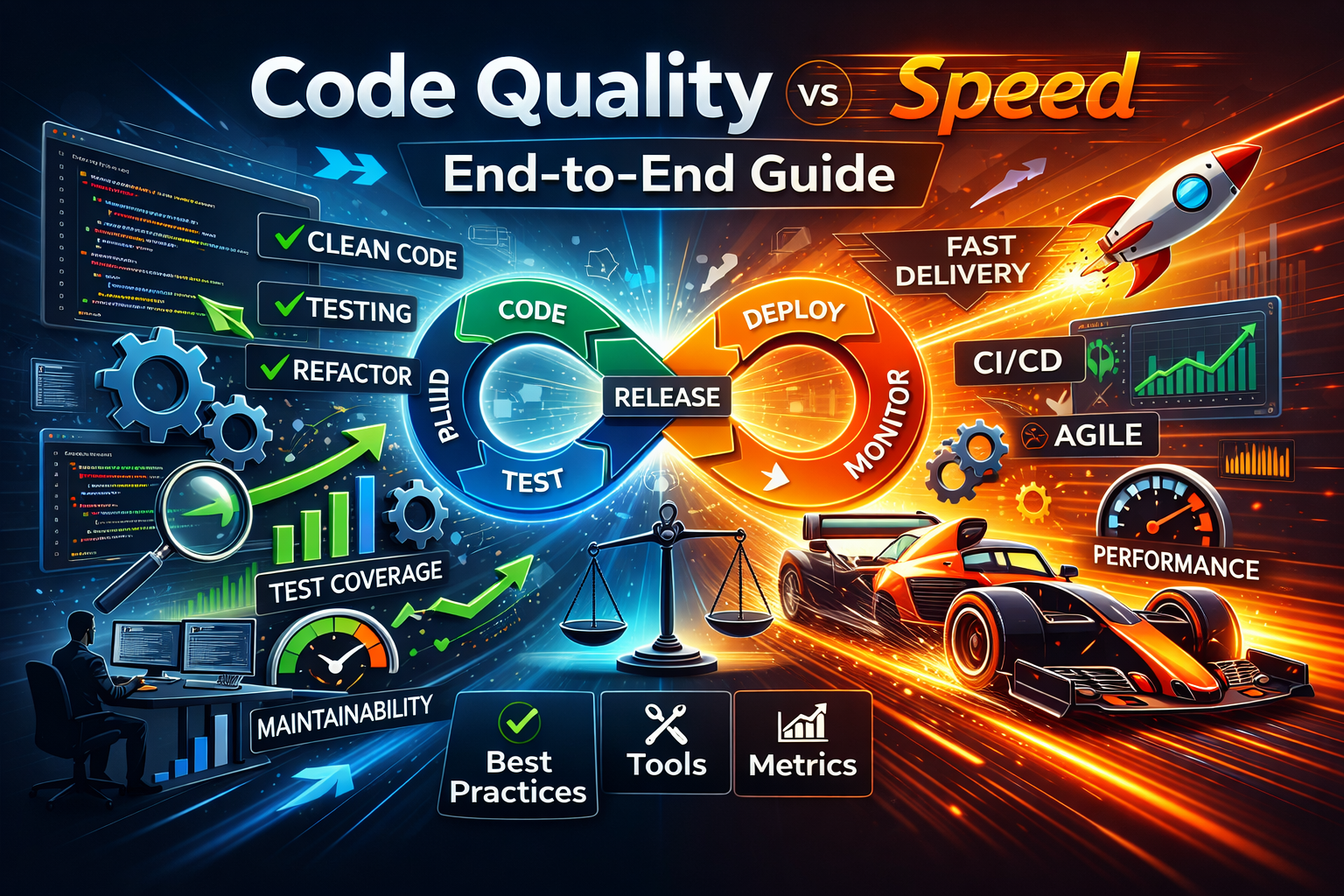
Building successful software requires mastering the balance between Code Quality vs Shipping Speed. From idea validation to deployment and scaling, every product team must decide how fast to move and how much engineering discipline to apply.
One of the biggest strategic tradeoffs in software development is balancing speed and code quality. While startups often prioritize rapid shipping, long-term scalability requires discipline. For a deeper technical breakdown, see the Graphite guide on balancing code quality and delivery speed.
Understanding this balance is essential for building software products that deliver value quickly without creating long-term technical problems. If you want a deeper overview of the full development lifecycle, read our complete guide on how software products are built end to end.
This beginner-friendly end-to-end guide explains how software products are built while exploring the real-world trade-offs between delivery speed and engineering quality.
What Code Quality vs Shipping Speed Really Means?
Code Quality vs Shipping Speed is the strategic balance between delivering features quickly and maintaining clean, scalable, and reliable code.
On one side, teams want to release features fast to stay competitive. On the other side, they must ensure that the codebase remains stable and maintainable.
If speed dominates, bugs and technical debt increase.
If perfection dominates, releases slow down and opportunities disappear.
The goal is not choosing one over the other. The goal is balance.
Phase 1: Idea Validation and Product Discovery
Every software product begins with a problem worth solving.
During discovery, teams:
- Identify user pain points
- Research competitors
- Define target users
- Outline core features
- Build a Minimum Viable Product (MVP)
At this stage, shipping quickly often matters more than perfect architecture. Startups especially prioritize fast validation. However, ignoring basic engineering discipline creates future rework.
The smartest teams move fast while keeping the foundation clean enough to evolve.
Phase 2: Product Design and System Architecture
After validation, teams design both the user experience and the technical foundation.
User Experience and Interface Design
Designers create:
- Wireframes
- User journeys
- Interactive prototypes
Clear design reduces confusion during development. It also minimizes costly changes later.
System Architecture Planning
Engineers decide:
- Frontend frameworks
- Backend technologies
- Database structures
- API design
- Cloud infrastructure
Here, the speed-quality tradeoff becomes critical. A rushed architectural decision may allow faster early releases. However, it can also cause scaling problems later.
For example:
- Poor database design leads to performance bottlenecks.
- Weak modularization makes updates harder.
- Missing standards increase integration issues.
Strong architecture does not mean overengineering. It means building for realistic growth.
Phase 3: Development and Implementation
This phase turns plans into working software.
A typical development workflow includes:
- Sprint planning
- Task breakdown
- Coding
- Code review
- Testing
- Deployment
What Defines High Code Quality?
High-quality code is:
- Clean and readable
- Modular and reusable
- Properly documented
- Tested through automation
- Secure by design
It reduces long-term costs and improves team productivity.
What Drives Shipping Speed?
Fast delivery depends on:
- Clear requirements
- Small feature releases
- Automated workflows
- Efficient collaboration
- Minimal unnecessary process
The tension between Code Quality vs Shipping Speed is most visible here. If teams skip testing to move faster, bugs increase. If they over-engineer small features, progress slows.
Discipline, not perfection, creates momentum.
Phase 4: Testing and Quality Assurance
Testing protects users from defects and protects teams from chaos.
Common testing types include:
- Unit testing
- Integration testing
- End-to-end testing
- Manual quality assurance
- Performance testing
- Security testing
Skipping structured testing may increase short-term speed. However, it almost always slows long-term development.
High-performing teams rely heavily on automation. Automated testing allows rapid releases without sacrificing reliability. As a result, the conflict between engineering standards and release velocity becomes manageable.
Phase 5: Deployment and Release
Modern software teams rarely deploy large updates anymore. Instead, they release small, incremental improvements.
Key practices include:
- Continuous Integration (CI)
- Continuous Deployment (CD)
- Automated pipelines
- Feature flags
- Rollback mechanisms
These practices reduce risk. Smaller updates are easier to monitor and fix.
When done correctly, teams can maintain both delivery speed and structural integrity.
Phase 6: Monitoring and Continuous Improvement
Shipping a feature is not the end. It is the beginning of feedback.
After deployment, teams monitor:
- System performance
- Error rates
- User behavior
- Infrastructure health
- Security vulnerabilities
Monitoring tools help detect issues early. Continuous improvement cycles allow teams to refine both speed and stability.
Ignoring monitoring increases technical debt. Investing in observability strengthens long-term success.
What Happens When Speed Dominates?
Prioritizing rapid delivery without sufficient engineering care leads to:
1. Technical Debt
Quick fixes accumulate. Eventually, teams spend more time fixing problems than building new features.
2. Frequent Production Bugs
Customers experience instability, which damages trust.
3. Developer Frustration
Engineers forced to constantly patch issues often burn out.
4. Scaling Barriers
Poor architecture becomes expensive to refactor.
Short-term wins can become long-term setbacks.
What Happens When Quality Dominates?
Excessive focus on perfection also creates problems.
1. Delayed Releases
Slow development allows competitors to capture the market.
2. Overengineering
Teams build complex systems for simple problems.
3. Reduced Experimentation
Fear of imperfection limits innovation.
4. Increased Costs
Time spent polishing unused features wastes resources.
Balance prevents these extremes.
Practical Strategies to Balance Speed and Quality
Experienced teams use structured approaches to manage this tradeoff effectively.
1. Define “Good Enough”
Not every feature requires enterprise-level architecture. Determine acceptable standards based on impact and risk.
2. Invest in Automation
Automated testing and deployment dramatically reduce friction. Automation supports rapid releases without sacrificing engineering discipline.
3. Adopt Modular Design
Smaller, independent components reduce complexity. They also make future updates safer and faster.
4. Enforce Code Reviews
Peer review improves code standards while sharing knowledge across the team.
5. Schedule Refactoring Time
Allocate dedicated time to improve existing systems. Preventing technical debt is cheaper than cleaning it up later.
6. Track Performance Metrics
Measure:
- Deployment frequency
- Lead time for changes
- Change failure rate
- Mean time to recovery
These metrics reveal whether your balance is healthy or drifting toward instability.
The Role of Leadership
Leadership strongly influences how teams manage Code Quality vs Shipping Speed.
Product managers often push for faster releases to meet business goals. Engineering leaders advocate for maintainability and risk reduction.
Alignment is essential.
Instead of asking, “How fast can we ship this?”
Ask, “How fast can we ship this responsibly?”
Shared goals reduce friction between departments.
Startup vs Enterprise Approach
Context matters.
Startup Environment
Startups often prioritize rapid validation. They need quick feedback from real users. However, even startups benefit from maintaining basic engineering standards to avoid full rewrites later.
Enterprise Environment
Enterprises handling financial, healthcare, or large-scale systems emphasize reliability. Compliance and risk management require stronger quality controls.
Both environments deal with the same tradeoff. The acceptable balance simply shifts.
Modern Tools That Reduce the Tradeoff
Today’s technology makes balancing speed and quality easier than ever.
Examples include:
- Cloud infrastructure for scalability
- DevOps automation
- Containerization for environment consistency
- Static analysis tools
- AI-assisted development tools
These innovations reduce manual work and improve reliability at the same time.
As tooling improves, the gap between development speed versus maintainability becomes smaller.
Final Thoughts
Building software products end to end requires structured planning, disciplined execution, and continuous refinement. The debate around Code Quality vs Shipping Speed is not about choosing extremes. It is about understanding when to move fast and when to strengthen the foundation.
Fast software that constantly fails loses trust.
Perfect software that never launches loses relevance.
The most successful teams:
- Ship in small increments
- Maintain strong coding standards
- Automate aggressively
- Monitor continuously
- Refactor regularly
When managed intentionally, the balance between engineering excellence and rapid delivery becomes a competitive advantage.
Master that balance, and you build software products that scale, adapt, and endure.