


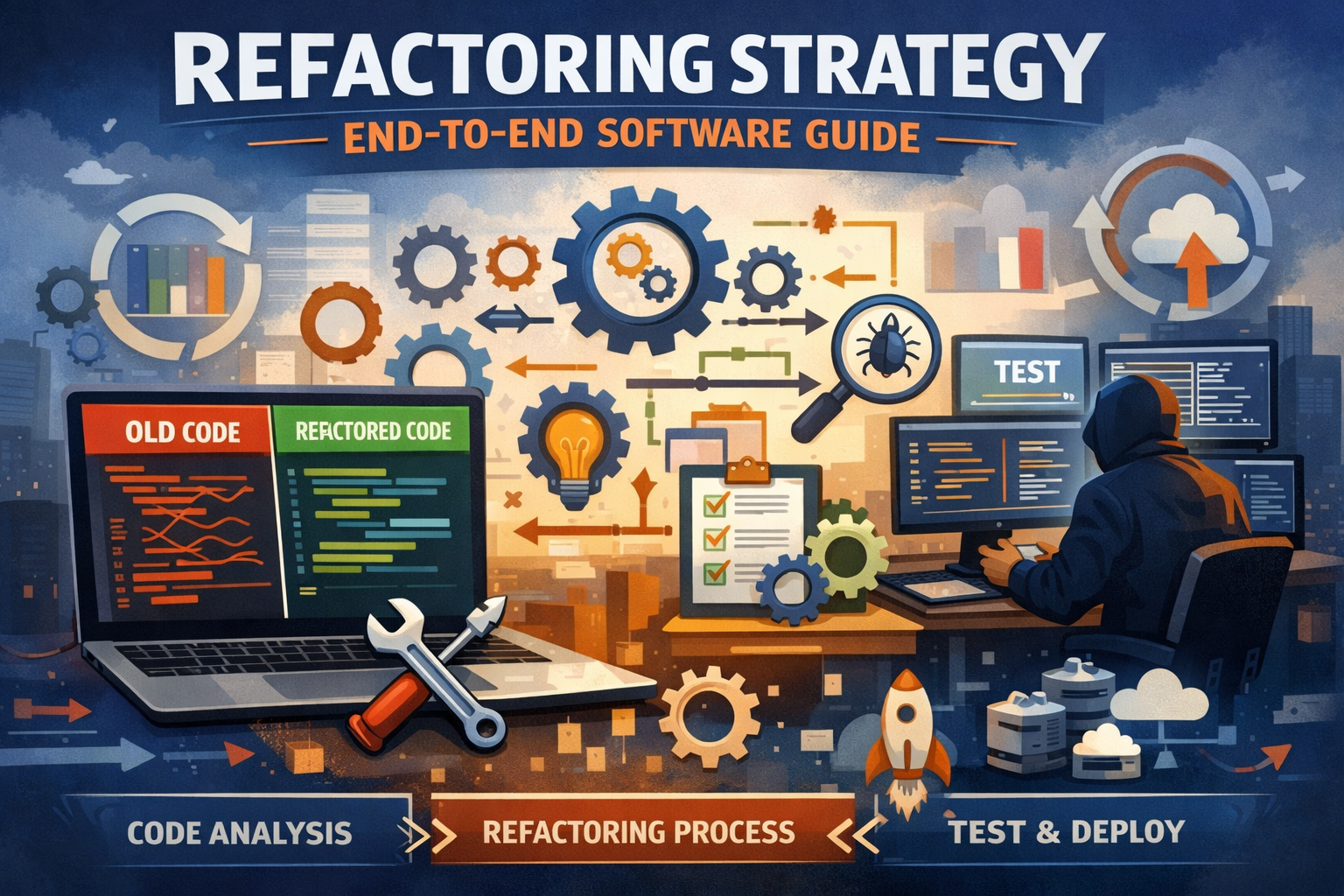
Building software is not just about writing code. It is about solving problems, delivering value, and continuously improving systems over time. If you want a deeper overview of how software products are built, you can explore this complete guide to the end-to-end process.
This refactoring strategy guide will walk you through how software products are built from idea to deployment, and how refactoring plays a critical role at every stage. Whether you are a beginner developer, startup founder, product manager, or tech enthusiast, this guide will give you a clear, practical understanding of the full lifecycle.
What Is a Refactoring Strategy?
A refactoring strategy is a structured plan for improving existing code without changing its external behavior. Following proven code refactoring best practices helps teams improve maintainability while protecting system stability. Refactoring makes code cleaner, more maintainable, scalable, and easier to understand.
Instead of adding new features immediately, teams pause to:
- Simplify complex logic
- Remove duplicate code
- Improve naming conventions
- Restructure modules
- Reduce technical debt
A strong refactoring strategy ensures long-term product stability and growth.
Step 1: Idea and Problem Validation
Every software product begins with a problem.
Before any code is written, teams focus on:
- Identifying a real user pain point
- Validating demand
- Researching competitors
- Defining a unique value proposition
At this stage, refactoring is not yet technical. Instead, the strategy focuses on refining the product idea. The clearer the problem definition, the cleaner the system architecture later.
Beginner Tip
Do not rush into development. Many failed software products were built perfectly but solved the wrong problem.
Step 2: Product Planning and Requirements
Once the idea is validated, teams create:
- Product Requirement Documents (PRD)
- User stories
- Feature lists
- Acceptance criteria
Here, a refactoring strategy begins to take shape conceptually. Teams decide:
- How flexible should the architecture be?
- Will this system scale?
- What tradeoffs are acceptable?
Planning reduces future refactoring costs.
Step 3: System Architecture Design
Architecture determines how components interact.
Typical layers include:
- Frontend (UI)
- Backend (business logic)
- Database
- APIs
- Infrastructure
A strong architectural foundation reduces excessive refactoring later.
Common Architectural Choices
- Monolithic architecture
- Microservices architecture
- Serverless architecture
Each choice affects how refactoring will be handled in the future. For example, refactoring a monolith may require larger coordinated changes, while microservices allow isolated improvements.
Step 4: Development and Initial Coding
This is where developers write the first version of the product.
At this stage:
- Speed often matters
- Deadlines are tight
- MVP (Minimum Viable Product) is prioritized
This is also when technical debt begins.
What Is Technical Debt?
Technical debt is the cost of choosing quick solutions instead of clean, scalable ones.
Examples include:
- Hardcoded values
- Duplicate logic
- Poor naming
- Lack of tests
A good refactoring strategy acknowledges that some debt is strategic — but it must be managed.
Step 5: Testing and Quality Assurance
Before release, teams perform:
- Unit testing
- Integration testing
- Manual QA testing
- Performance testing
Refactoring becomes safer when automated tests exist.
Why Testing Supports Refactoring
Refactoring changes internal code structure. Without tests, you risk breaking functionality. With strong test coverage:
- You can refactor confidently
- Bugs are detected early
- Regression issues are minimized
Testing is the safety net of any refactoring strategy.
Step 6: Deployment and Release
After testing, the product is deployed to production.
Modern teams use:
- CI/CD pipelines
- Cloud infrastructure
- Containerization
- Monitoring tools
Refactoring does not stop after release. In fact, production usage reveals:
- Performance bottlenecks
- Scalability issues
- Security vulnerabilities
- Code complexity problems
Real-world usage exposes where refactoring is necessary.
Step 7: Continuous Improvement and Refactoring
This is where the refactoring strategy becomes critical.
Software is never finished. As features grow, complexity increases. Without intentional refactoring, systems become fragile.
When Should You Refactor?
You should refactor when:
- Code is difficult to understand
- Bugs frequently appear in the same module
- New features take too long to implement
- Performance degrades
- Developers avoid touching certain files
These are warning signs of growing technical debt.
Types of Refactoring in Software Development
A complete refactoring strategy guide must include different types of refactoring.
1. Code-Level Refactoring
- Renaming variables
- Extracting functions
- Simplifying conditionals
- Removing duplicate code
This improves readability and maintainability.
2. Structural Refactoring
- Breaking large classes into smaller ones
- Modularizing components
- Redesigning data models
This improves scalability and clarity.
3. Architectural Refactoring
- Migrating from monolith to microservices
- Introducing caching layers
- Switching databases
This improves long-term growth potential.
4. Performance Refactoring
- Optimizing queries
- Reducing API calls
- Improving memory usage
This enhances user experience.
How to Build an Effective Refactoring Strategy?
A refactoring strategy must be intentional, not reactive.
1. Schedule Refactoring Time
Do not treat refactoring as an afterthought. Allocate dedicated time in sprints.
For example:
- 20% of sprint capacity for technical debt
- Monthly refactoring sessions
- Dedicated cleanup releases
2. Prioritize High-Impact Areas
Focus on:
- Frequently modified modules
- Performance-critical systems
- Security-sensitive areas
Not all code needs immediate refactoring.
3. Refactor Incrementally
Avoid massive rewrites.
Instead:
- Improve code gradually
- Refactor during feature development
- Use small, safe changes
Large rewrites often fail because they delay business value.
4. Maintain Strong Test Coverage
Before refactoring:
- Add missing tests
- Increase automated coverage
- Validate edge cases
Tests protect the product during structural improvements.
The Role of Refactoring in Long-Term Product Success
Many startups fail not because of lack of ideas, but because of poor system maintainability.
Without refactoring:
- Development slows down
- Bugs increase
- Onboarding new developers becomes difficult
- Innovation stalls
With a strong refactoring strategy:
- Code remains clean
- Features are added faster
- System reliability improves
- Scaling becomes manageable
Refactoring is an investment in future velocity.
Common Refactoring Mistakes
Even experienced teams make mistakes.
1. Over-Refactoring
Not every piece of code needs perfection. Over-optimization wastes time.
2. Refactoring Without Tests
This increases risk and may introduce hidden bugs.
3. Big-Bang Rewrites
Rewriting the entire system often leads to delays and budget overruns.
4. Ignoring Business Impact
Refactoring should align with product goals. Business value must remain the priority.
How Beginners Can Start Using Refactoring?
If you are new to software development, start simple.
- Write readable code
- Use meaningful variable names
- Keep functions small
- Follow consistent formatting
- Learn design principles gradually
Practice improving your own code after writing it. Compare before and after versions. This builds strong engineering habits.
Refactoring Strategy Guide: Final Thoughts
Building software products is an end-to-end process that includes idea validation, planning, architecture design, development, testing, deployment, and continuous improvement.
Refactoring is not a luxury. It is a strategic necessity.
A disciplined refactoring strategy:
- Reduces technical debt
- Improves maintainability
- Increases development speed
- Supports scalability
- Protects long-term product health
The most successful software products are not those written perfectly the first time. They are the ones continuously improved through smart refactoring decisions.
If you want to build software that lasts, treat refactoring as a core engineering practice — not an optional cleanup task.
By applying this refactoring strategy guide throughout the software development lifecycle, you create systems that are easier to manage, safer to change, and ready to scale.
And that is how great software products are truly built.