


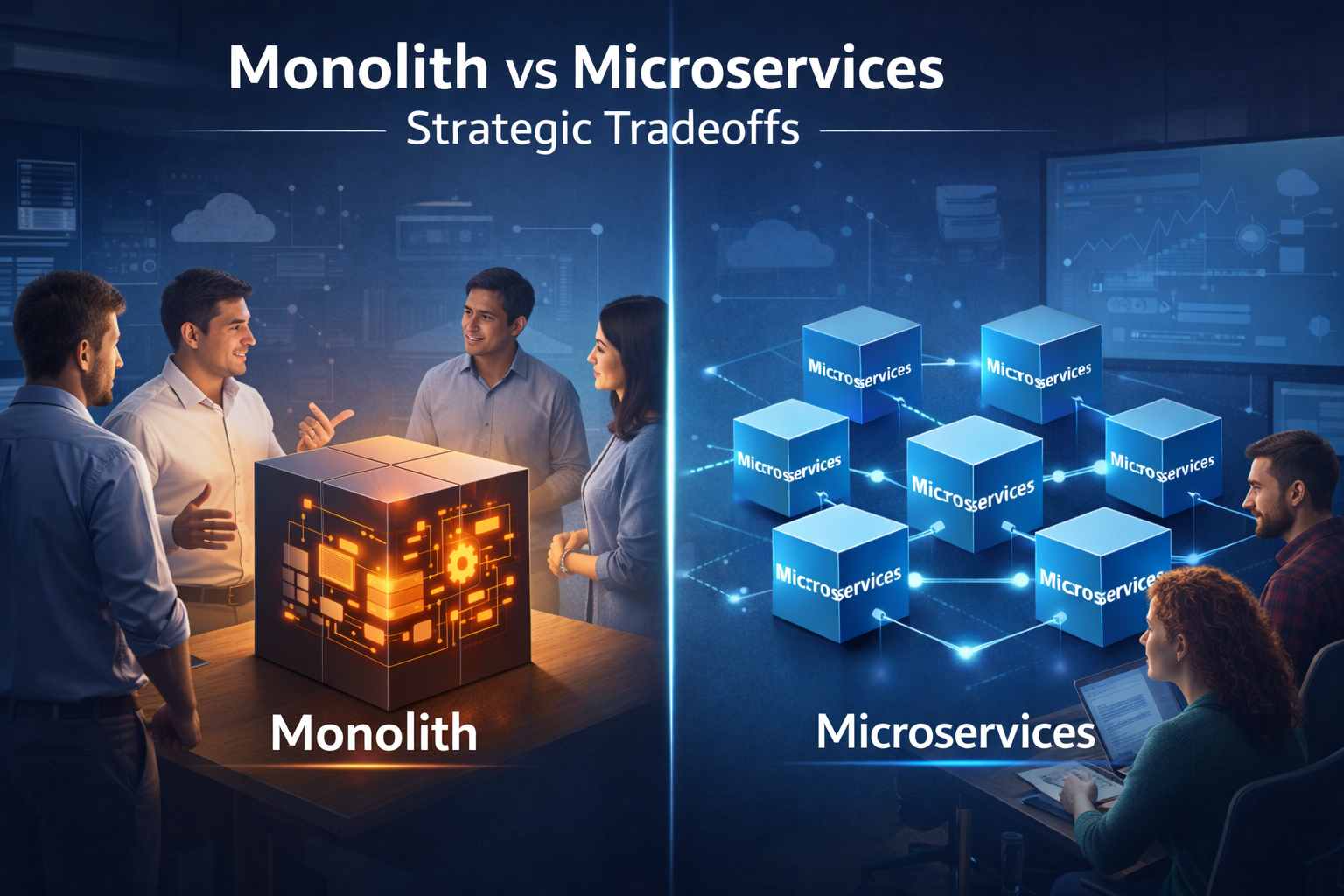
Monolith vs Microservices is one of the most important architectural decisions in software product development. Choosing between these two approaches affects scalability, speed of development, operational complexity, cost, and long-term flexibility. Understanding the strategic tradeoffs between monolithic and microservices architecture helps teams build strong software product foundations from day one.
In this beginner-friendly yet expert-level guide, we will explore Monolith vs Microservices: Strategic Tradeoffs, break down the differences clearly, and help you understand which approach fits your product goals.
Understanding Software Product Foundations
Before diving into architecture patterns, let’s clarify what software product foundations mean.
Software product foundations refer to the core structural decisions that shape how your system is built, deployed, scaled, and maintained over time. These include:
- Application architecture
- Data management strategy
- Deployment model
- Infrastructure design
- DevOps processes
Your architecture decision is not just technical — it is strategic. It determines how fast you can innovate and how resilient your system becomes as it grows.
What Is a Monolithic Architecture?
A monolith is a single unified application where all components are tightly integrated and deployed together. Many developers and engineering teams compare monolith vs microservices when deciding how to scale their applications. As explained in this detailed breakdown by FreeCodeCamp’s guide on microservices vs monoliths, the choice depends on complexity, team structure, and long-term scalability needs.
In a monolithic system:
- The user interface
- Business logic
- Data access layer
- Background jobs
… all exist within one codebase and are deployed as one unit.
Simple Example
Think of a traditional eCommerce application:
- Product catalog
- Shopping cart
- Payment processing
- User authentication
In a monolith, all these features run inside one application server.
Advantages of Monolithic Architecture
- Simple to develop (initially)
Beginners find monoliths easier to understand. - Easier debugging
Since everything runs together, tracing errors is straightforward. - Simpler deployment
You deploy one application. - Lower operational complexity
No need for service orchestration or distributed systems management. - Faster MVP development
Ideal for startups building a Minimum Viable Product.
Disadvantages of Monolithic Architecture
- Scaling challenges
You must scale the entire application, even if only one feature needs more resources. - Slower deployments over time
As the codebase grows, releases become riskier. - Tight coupling
Small changes can impact the whole system. - Technology lock-in
You must use the same tech stack across the entire application.
What Is a Microservices Architecture?
Microservices break an application into small, independent services. Each service:
- Has its own responsibility
- Runs independently
- Communicates via APIs
- Can be deployed separately
For example, in the same eCommerce system:
- Product service
- Order service
- Payment service
- User service
Each runs independently and may even use different programming languages.
Advantages of Microservices Architecture
- Independent scaling
Scale only the services that need it. - Faster team productivity
Different teams can work on separate services. - Improved fault isolation
If one service fails, others can continue functioning. - Technology flexibility
Teams can use the best technology for each service. - Continuous deployment friendly
You can release updates to one service without redeploying the entire system.
Disadvantages of Microservices Architecture
- Operational complexity
Requires service discovery, monitoring, and orchestration. - Distributed system challenges
Network latency, retries, and partial failures must be handled. - Higher infrastructure costs
More services mean more compute resources. - Complex debugging
Tracing issues across services requires observability tools.
Monolith vs Microservices: Strategic Tradeoffs
Now let’s compare the two architectures across strategic dimensions.
1. Speed vs Flexibility
- Monolith: Faster to build early-stage products.
- Microservices: More flexible as the product grows.
If you are validating an idea, monolith wins. If you are building a long-term scalable platform, microservices may offer more future-proofing.
2. Simplicity vs Scalability
- Monolith: Simpler operational model.
- Microservices: Better horizontal scalability.
A monolith can scale vertically (bigger server). Microservices scale horizontally (more instances per service).
3. Cost Efficiency vs Long-Term Investment
- Monolith: Lower initial cost.
- Microservices: Higher upfront cost but optimized scaling later.
Microservices require containerization tools like Docker and orchestration platforms such as Kubernetes. These add complexity and expense.
4. Team Structure Alignment
Architecture should match your organization size.
- Small team (2–5 developers): Monolith works well.
- Large engineering organization: Microservices enable parallel development.
This is aligned with Conway’s Law — your system design mirrors your communication structure.
5. Deployment Risk
- Monolith: Entire application redeployed.
- Microservices: Partial deployments possible.
However, distributed systems introduce new risks such as service dependency failures.
When Should You Choose a Monolith?
A monolithic architecture is ideal when:
- You are building an MVP.
- Your team is small.
- Your domain is simple.
- You need rapid development.
- Infrastructure budget is limited.
Many successful companies, including early versions of major platforms, started as monoliths.
When Should You Choose Microservices?
Microservices make sense when:
- You have high traffic and scaling demands.
- Teams are large and distributed.
- You need frequent independent deployments.
- Different features require different scaling patterns.
- You are building a complex ecosystem platform.
However, adopting microservices too early can slow you down.
The Hybrid Approach: Modular Monolith
There is a third strategy that many experts recommend: the modular monolith.
This approach:
- Keeps one deployable unit.
- Enforces strict internal module boundaries.
- Allows future extraction into microservices.
It combines simplicity with future scalability.
For most startups and growing businesses, a modular monolith offers the best strategic tradeoff.
Common Misconceptions About Microservices
1. Microservices Are Automatically Modern
Microservices are not automatically better. They are simply better suited for specific contexts.
2. You Must Use Microservices to Scale
Large monolithic systems can scale effectively with proper design and caching strategies.
3. Microservices Reduce Complexity
Microservices shift complexity from code to infrastructure.
Performance Considerations
In monoliths:
- Calls are in-memory.
- Latency is low.
In microservices:
- Calls are over the network.
- Latency and failure handling become critical.
Distributed systems require advanced monitoring, logging, and tracing.
Security Implications
Monolith:
- Simpler internal security model.
- Larger blast radius if breached.
Microservices:
- Service-level security.
- More attack surfaces.
- Requires API gateways and authentication layers.
Security complexity increases with microservices.
Business Impact of Architectural Decisions
Choosing between monolith and microservices is not just technical. It affects:
- Time to market
- Developer productivity
- Cloud infrastructure costs
- Customer experience reliability
- Long-term innovation capacity
The wrong choice at the wrong stage can create unnecessary overhead.
Final Thoughts: Strategic Decision, Not Trend Following
The debate between monolith vs microservices is often framed as old vs modern. That framing is misleading.
The real question is:
What does your product need right now?
If you are building foundations, prioritize:
- Clarity
- Maintainability
- Speed of iteration
- Cost efficiency
Microservices are powerful, but they introduce operational complexity that many early-stage teams underestimate.
In software product foundations, architecture should evolve with your product maturity. Start simple, design cleanly, and refactor when complexity justifies it.
Conclusion
Understanding Monolith vs Microservices: Strategic Tradeoffs is essential for anyone building modern software products.
Monoliths offer simplicity, speed, and lower initial cost.
Microservices provide scalability, flexibility, and independent deployment.
The best choice depends on your:
- Team size
- Product complexity
- Growth expectations
- Budget
- Operational maturity
In many cases, starting with a modular monolith and evolving into microservices as needed is the most strategic path.
Architecture is not about trends. It is about alignment with business goals.
Choose wisely — your software foundation determines your product’s future.