


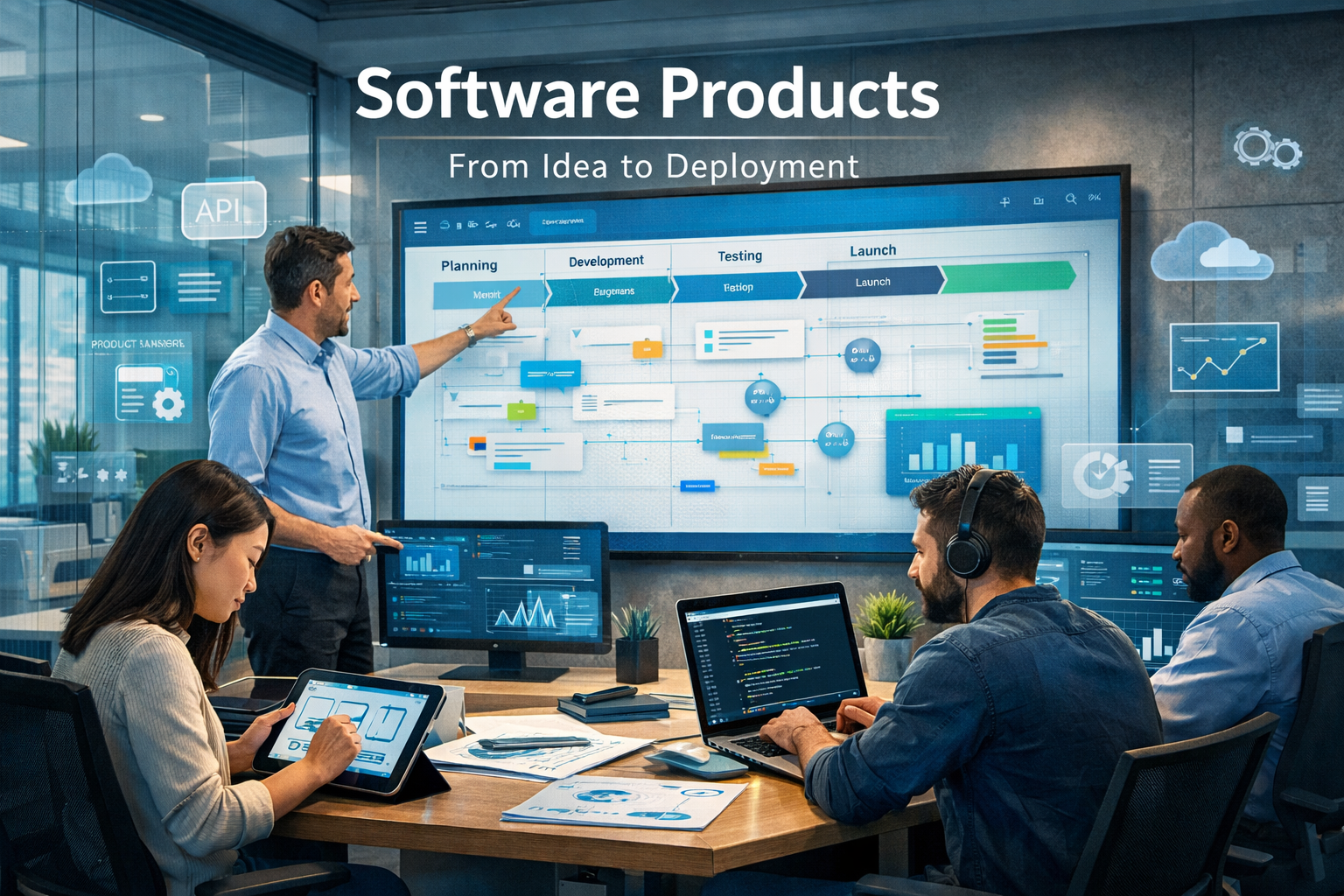
Building a successful software product is not just about writing code. It is a structured, strategic process that combines business vision, user experience, technology, and continuous improvement. Whether you are a founder, product manager, aspiring developer, or tech enthusiast, understanding how software products are built end-to-end will help you make smarter decisions and avoid costly mistakes.
This beginner-friendly yet expert-level guide explains the complete lifecycle of software product development — from idea to launch and beyond.
What Is a Software Product?
A software product is a digital solution designed to solve a specific problem for a target audience. It can be:
- A web application (e.g., project management tool)
- A mobile app (e.g., fitness tracker)
- A SaaS platform (Software as a Service)
- Enterprise software
- AI-powered tools
- Desktop applications
Unlike custom software built for one client, a software product is typically designed for multiple users or a broad market.
Phase 1: Idea Validation and Product Strategy
Every successful software product starts with a clear problem.
1. Identify the Problem
Ask:
- What pain point are we solving?
- Who experiences this problem?
- How are they solving it today?
If the problem is unclear, the product will struggle.
2. Market Research
Before writing a single line of code, research:
- Competitors
- Market demand
- Target users
- Pricing expectations
- Industry trends
Validate your idea through:
- Surveys
- Interviews
- Landing page tests
- Pre-launch signups
This step reduces risk and improves product-market fit.
3. Define the Product Vision
A strong product vision answers:
- What will this product become in 3–5 years?
- What makes it unique?
- What core value does it deliver?
Clear vision guides all technical and design decisions.
Phase 2: Product Planning and Requirements
Once validated, the next step in how software products are built is structured planning.
1. Define the Minimum Viable Product (MVP)
The MVP (Minimum Viable Product) includes only essential features that solve the main problem.
Instead of building everything, focus on:
- Core functionality
- Basic user flows
- Critical integrations
This helps launch faster and gather real feedback.
2. Write Product Requirements
Product requirements typically include:
- User stories (e.g., “As a user, I want to…”)
- Functional requirements
- Non-functional requirements (security, performance, scalability)
- Technical constraints
Clear documentation prevents miscommunication between stakeholders and developers.
3. Choose the Technology Stack
The tech stack includes:
- Frontend framework (React, Vue, etc.)
- Backend language (Node.js, Python, etc.)
- Database (SQL or NoSQL)
- Cloud provider (AWS, Azure, etc.)
- DevOps tools
Technology choices impact scalability, speed, and long-term maintenance.
Phase 3: UX and UI Design
Good software products are not only functional — they are intuitive.
1. User Experience (UX) Design
UX focuses on:
- User journeys
- Navigation flow
- Ease of use
- Accessibility
Designers create:
- Wireframes
- Prototypes
- User flow diagrams
The goal is to remove friction.
2. User Interface (UI) Design
UI is the visual layer:
- Layout
- Colors
- Typography
- Buttons
- Branding
A clean, professional interface builds trust and improves engagement.
Before development begins, teams usually validate designs through usability testing.
Phase 4: Software Development
Now comes the technical build phase. For a deeper breakdown of the technical workflow, this guide on end-to-end software development process provides additional practical insights into how development teams structure their build cycles.
1. Frontend Development
Frontend developers build:
- User interface
- Interactive components
- Responsive layouts
- Client-side logic
They ensure the product works smoothly across devices.
2. Backend Development
Backend developers build:
- APIs
- Business logic
- Database structure
- Authentication systems
- Payment integrations
This is the engine of the software product.
3. Database Design
Database structure determines:
- How data is stored
- How quickly it can be retrieved
- How scalable the system is
Poor database design leads to performance issues later.
4. Version Control and Collaboration
Teams use tools like Git to:
- Track code changes
- Manage branches
- Review code
- Prevent conflicts
Professional development always includes structured collaboration workflows.
Phase 5: Testing and Quality Assurance
Testing ensures the software product works as expected.
1. Types of Testing
Common testing types include:
- Unit testing (testing individual functions)
- Integration testing
- System testing
- User acceptance testing (UAT)
- Performance testing
- Security testing
Quality assurance (QA) reduces bugs and protects user trust.
2. Bug Tracking
Teams use tracking tools to:
- Log issues
- Assign responsibility
- Monitor resolution progress
Testing happens continuously — not only at the end.
Phase 6: Deployment and Launch
Deployment is the process of making the software live.
1. Cloud Infrastructure Setup
Most modern software products use cloud services for:
- Hosting
- Storage
- Load balancing
- Auto-scaling
This allows the system to handle growth efficiently.
2. CI/CD Pipelines
Continuous Integration and Continuous Deployment (CI/CD):
- Automate testing
- Automate deployments
- Reduce human errors
- Speed up releases
This modern practice ensures reliable updates.
3. Product Launch Strategy
A successful launch includes:
- Marketing campaigns
- Beta users
- Influencer outreach
- Press announcements
- Customer onboarding systems
Software success is not only technical — it is strategic.
Phase 7: Post-Launch Growth and Maintenance
Many beginners think development ends at launch. In reality, it just begins.
1. Monitoring and Analytics
After launch, teams track:
- User behavior
- Conversion rates
- Churn rate
- Feature adoption
- Performance metrics
Analytics guide future improvements.
2. Iterative Development
Based on feedback:
- Improve features
- Fix usability issues
- Add new functionality
- Optimize performance
Successful software products evolve continuously.
3. Security and Updates
Cybersecurity threats constantly change. Teams must:
- Patch vulnerabilities
- Update dependencies
- Improve authentication systems
Ignoring maintenance leads to product failure.
Agile vs. Waterfall: How Teams Manage Development
Two common development approaches are:
Waterfall Model
- Linear process
- Each phase completed before the next
- Works well for fixed requirements
Agile Methodology
- Iterative cycles (sprints)
- Continuous feedback
- Flexible and adaptive
Most modern software products use Agile because it supports fast iteration and user-driven improvements.
Key Roles in Software Product Development
Building software is a team effort.
Common roles include:
- Product Manager – Defines vision and priorities
- UX/UI Designer – Designs user experience
- Frontend Developer – Builds interface
- Backend Developer – Builds logic and database
- QA Engineer – Ensures quality
- DevOps Engineer – Manages infrastructure
- Marketing Team – Drives adoption
Clear role definition improves efficiency.
Common Mistakes in Building Software Products
Understanding how software products are built also means knowing what to avoid.
1. Skipping Market Validation
2. Overbuilding Before MVP
3. Ignoring User Feedback
4. Poor Documentation
5. Weak Security Practices
6. No Scalability Planning
Avoiding these mistakes significantly increases product success.
The Software Product Lifecycle Summary
Here is a simplified overview:
- Idea & Validation
- Strategy & Planning
- UX/UI Design
- Development
- Testing
- Deployment
- Growth & Optimization
Each phase builds upon the previous one.
Final Thoughts: Building Software the Right Way
Understanding how software products are built end-to-end gives you clarity, structure, and confidence. Successful software products are not accidental — they are the result of:
- Clear problem definition
- Strong product strategy
- Smart technology decisions
- User-centered design
- Continuous iteration
- Long-term maintenance
Whether you are launching a startup, managing a tech team, or entering the software industry, mastering these foundations will help you build scalable, reliable, and profitable digital products.
Software development is both a science and an art. When done correctly, it transforms ideas into powerful tools that change industries and improve lives.
If you are serious about building a successful software product, start with strategy, validate your idea, build lean, iterate fast, and always prioritize user value.