


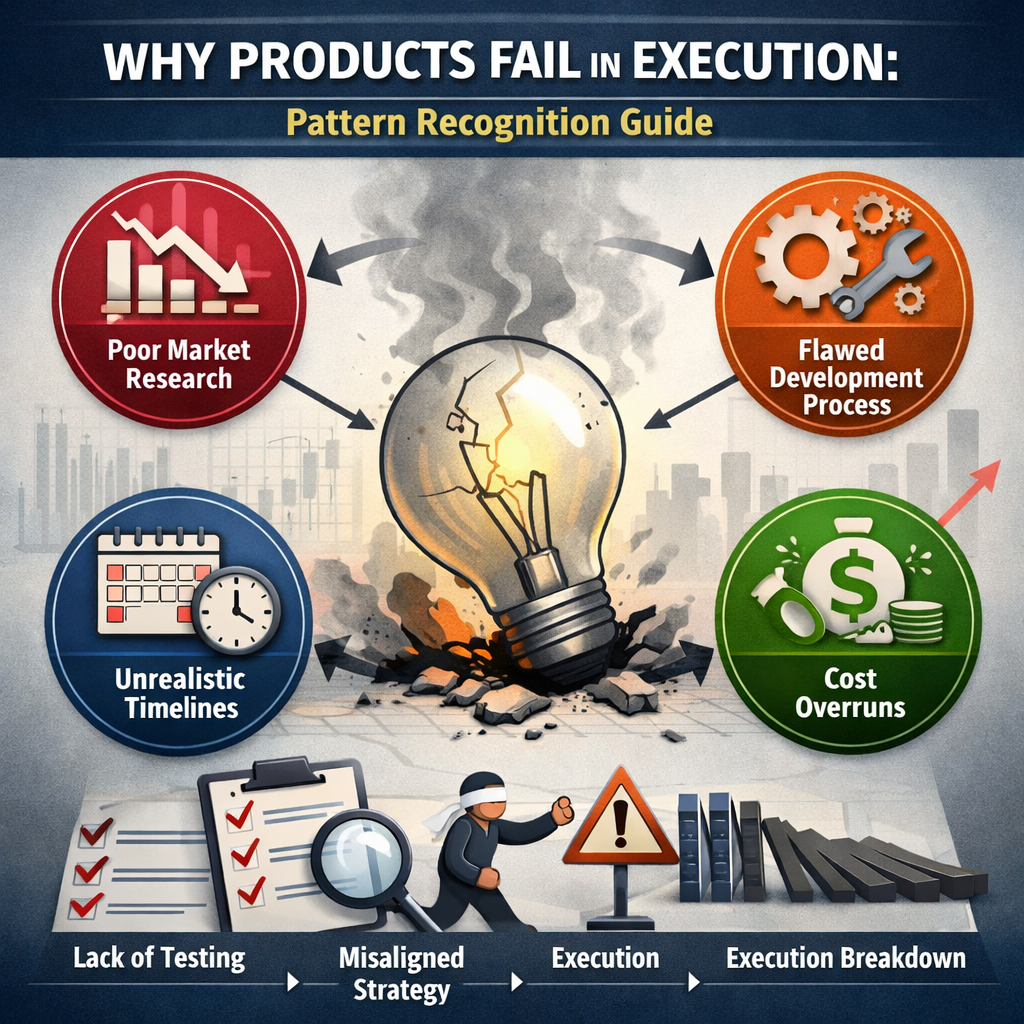
In today’s hyper-competitive markets, product failure is rarely caused by a lack of ideas. Most organizations fail not at the ideation stage, but during execution. Despite strong market research, significant funding, and talented teams, many products still underperform or disappear entirely. Understanding why products fail in execution requires more than postmortems and surface-level analysis—it requires pattern recognition and insight.
Pattern recognition enables leaders to identify recurring behaviors, decisions, and structures that consistently lead to failure. Insight transforms those patterns into strategic learning. Together, they form a powerful framework for diagnosing execution problems and preventing costly mistakes.
This article explores the most common execution failures in product development, how pattern recognition reveals hidden risks, and what organizations can do to improve product success rates.
The Execution Gap: Where Most Products Die
Execution is the bridge between strategy and reality. While strategy defines what should happen, execution determines what actually happens. The execution gap emerges when:
- Strategic goals are misaligned with operational capabilities
- Teams lack clarity, ownership, or accountability
- Feedback from users is ignored or misunderstood
- Resources are poorly allocated
When organizations fail to recognize these patterns early, problems compound silently until the product collapses under its own weight.
Pattern recognition helps identify these gaps before they become irreversible.
Pattern 1: Building the Wrong Product for the Right Market
One of the most common reasons why products fail in execution is not market fit—but problem fit. Teams often misinterpret user needs, focusing on features instead of outcomes.
Execution Symptoms:
- Feature-heavy releases with low adoption
- High churn after initial onboarding
- Users use workarounds instead of core features
Insight:
Organizations mistake activity for progress. Pattern recognition reveals that successful products prioritize behavioral data over assumptions. Teams that observe real user patterns—how users behave, not what they say—build more resilient solutions.
Pattern 2: Strategy Without Operational Reality
Many products are built on elegant strategies that collapse in real-world environments. This usually happens when leadership defines vision without understanding operational constraints.
Execution Symptoms:
- Unrealistic timelines
- Constant scope changes
- Burnout among development teams
- Cost overruns
Insight:
Patterns show that execution success depends on strategic realism. Leaders who regularly connect strategy to delivery metrics—velocity, defect rates, cycle times—reduce failure risk significantly.
Pattern 3: Siloed Teams and Fragmented Ownership
Another recurring execution failure occurs when departments operate in isolation. Product managers, developers, marketers, and support teams often work toward different objectives.
Execution Symptoms:
- Misaligned KPIs
- Conflicting priorities
- Delayed launches due to internal friction
- Blame-shifting when problems occur
Insight:
Pattern recognition shows that high-performing products use cross-functional ownership models. Shared accountability ensures that execution remains aligned with user value instead of departmental goals.
Pattern 4: Ignoring Weak Signals from the Market
Products rarely fail suddenly. They emit warning signals long before collapse:
- Declining engagement
- Support tickets increasing
- Negative reviews
- Lower conversion rates
Execution Symptoms:
- Leadership dismisses early indicators
- Teams delay pivots
- Marketing compensates for product flaws
Insight:
Organizations that practice pattern recognition treat weak signals as strategic intelligence. They build feedback loops that continuously inform execution decisions.
Pattern 5: Overengineering and Underlearning
Another major reason why products fail in execution is excessive complexity. Teams often pursue perfection instead of learning.
Execution Symptoms:
- Long development cycles
- Feature bloat
- Delayed user testing
- Low adaptability
Insight:
Pattern recognition shows that successful products prioritize learning velocity over feature velocity. Rapid experimentation reveals what actually works, reducing waste and risk.
The Role of Cognitive Bias in Execution Failure
Human psychology plays a significant role in product failure. Common cognitive biases include:
- Confirmation bias: Teams seek data that supports their assumptions.
- Sunk cost fallacy: Organizations continue failing projects because they have already invested heavily.
- Optimism bias: Leaders underestimate risks and overestimate readiness.
Pattern recognition helps surface these biases by comparing internal decisions with historical outcomes across multiple projects.
How Pattern Recognition Improves Execution?
Pattern recognition is not intuition—it is structured observation over time. Organizations that systematize learning gain a competitive advantage.
Key Techniques:
- Post-implementation reviews: Analyze what actually happened versus what was planned.
- Data pattern analysis: Track user behavior, not just performance metrics.
- Portfolio-level learning: Compare outcomes across multiple products.
- Failure taxonomies: Classify failures by root cause.
Over time, these patterns form a knowledge base that guides future execution.
Turning Insight into Action
Insight is useless without behavioral change. Organizations must operationalize learning through:
1. Decision Frameworks
Use repeatable criteria for product decisions, such as:
- Value vs. complexity
- User impact vs. development cost
- Risk vs. learning potential
2. Execution Metrics
Track leading indicators, not just lagging ones:
- Activation rate
- Time-to-first-value
- Feature adoption curves
- Retention cohorts
3. Organizational Design
Structure teams around outcomes, not functions:
- Product squads
- Embedded analytics
- Continuous discovery models
Case Pattern: Why “Good Products” Still Fail
Many failed products were technically strong:
- Google Glass
- Microsoft Zune
- Amazon Fire Phone
- Quibi
These products had funding, talent, and marketing—but failed in execution due to:
- Misaligned user behavior
- Poor feedback interpretation
- Overconfidence in strategy
- Lack of operational learning
Pattern recognition reveals that execution failure is rarely technical—it is systemic.
The Strategic Value of Failure Patterns
Failure patterns are assets. Each failed product contributes to organizational intelligence—if captured correctly.
High-performing organizations:
- Treat failure as structured data
- Reward early problem discovery
- Build institutional memory
- Continuously refine execution models
Low-performing organizations:
- Hide failure
- Blame individuals
- Repeat mistakes
- Reset without learning
The difference lies in pattern recognition maturity.
Building a Pattern-Driven Product Culture
To reduce execution failure, organizations must embed pattern recognition into culture:
Leadership Level:
- Encourage transparency
- Replace blame with analysis
- Fund experimentation
Team Level:
- Document assumptions
- Validate early and often
- Share learning across projects
System Level:
- Build knowledge repositories
- Use analytics dashboards
- Track execution health continuously
Conclusion: Why Products Fail in Execution—and How to Prevent It
Most products fail not because of poor ideas, but because organizations fail to recognize repeating execution patterns. Without insight, teams repeat the same mistakes under new names.
Pattern recognition provides the missing link between experience and improvement. It transforms isolated failures into strategic knowledge and replaces reactive decision-making with informed execution.
Understanding why products fail in execution is not about finding someone to blame—it is about finding the system that needs redesigning. Organizations that master pattern recognition and insight will not eliminate failure entirely, but they will fail smarter, recover faster, and build products that actually survive in the real world.
In the long run, execution excellence is not about working harder—it is about seeing clearer.