


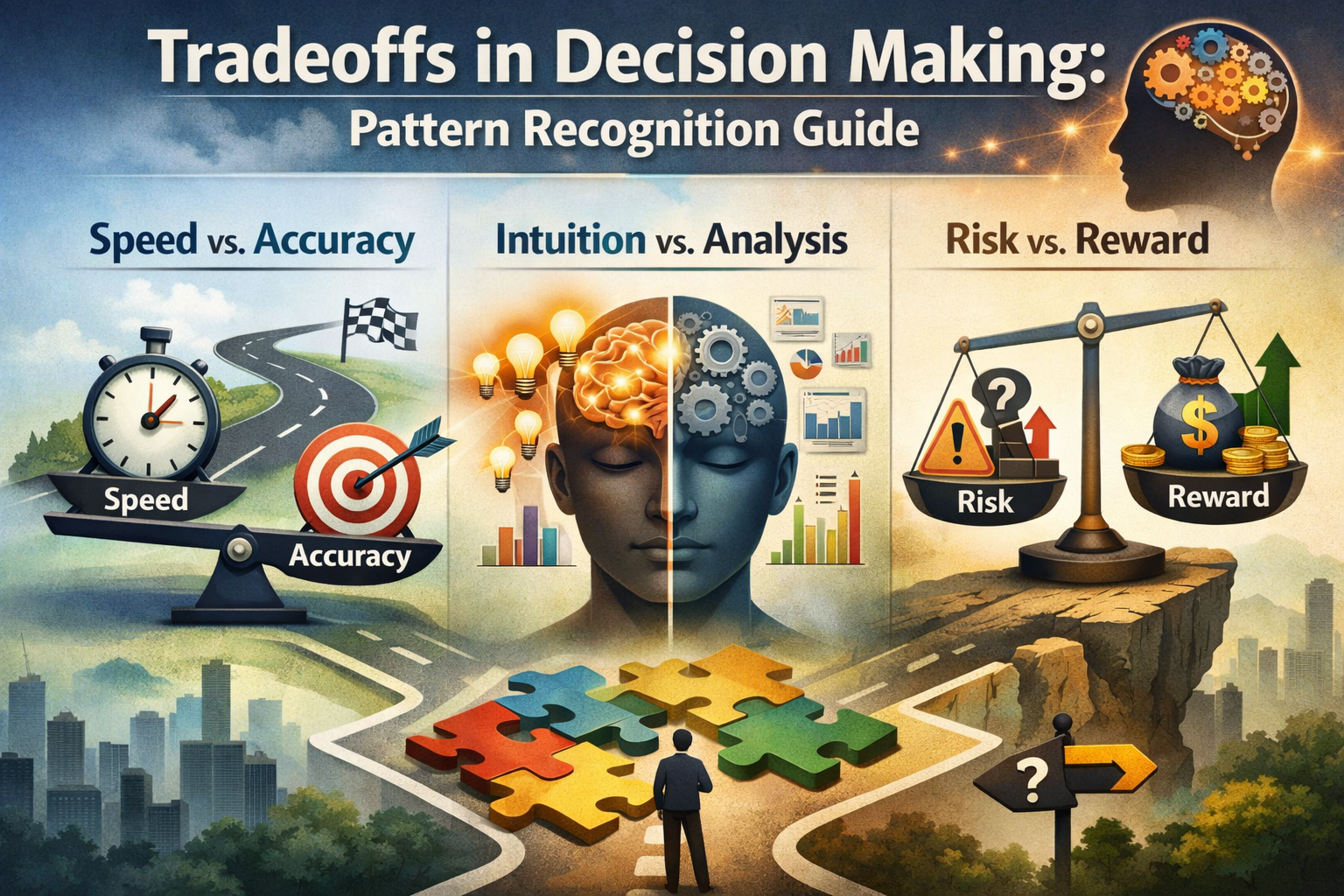
Every meaningful decision involves a tradeoff. Whether in business, technology, leadership, or personal life, choosing one path means forgoing another. Yet many organizations treat decisions as binary problems with right or wrong answers, rather than as complex systems of competing priorities. Understanding tradeoffs in decision making requires more than analytical tools—it requires pattern recognition and insight.
Pattern recognition helps identify recurring decision structures across different contexts. Insight transforms those patterns into strategic understanding. Together, they allow leaders to make better choices by recognizing what is being gained, what is being sacrificed, and what consequences are likely to follow.
This article explores how pattern recognition improves decision quality, the most common decision tradeoffs leaders face, and how organizations can build more effective decision systems.
Why Tradeoffs Are the Core of All Decisions?
At its core, every decision balances limited resources:
- Time
- Money
- Attention
- Talent
- Information
Because these resources are finite, no decision can optimize everything simultaneously. Pattern recognition helps leaders understand which tradeoffs are structural and unavoidable, and which are artificial and caused by poor design.
The Role of Pattern Recognition in Decision Making
Most leaders rely on experience and intuition. While useful, intuition is often biased and inconsistent. Pattern recognition adds a systematic layer by identifying:
- Repeating decision contexts
- Similar outcomes across different scenarios
- Structural constraints that limit options
Instead of evaluating each decision as unique, pattern recognition treats it as part of a larger system.
Common Tradeoffs in Decision Making
Across industries and roles, certain tradeoffs appear repeatedly. Recognizing these patterns allows leaders to anticipate consequences more accurately.
1. Speed vs. Accuracy
One of the most common tradeoffs in decision making is between acting quickly and gathering more information.
Fast decisions offer:
- Competitive advantage
- First-mover benefits
- Reduced opportunity cost
Slow decisions offer:
- Higher confidence
- Lower error rates
- Better risk management
Insight:
Pattern recognition shows that high-performing organizations differentiate between reversible and irreversible decisions. They move fast on reversible choices and slow down on irreversible ones.
2. Quality vs. Cost
Every organization balances quality with cost.
High quality means:
- Better user experience
- Lower defect rates
- Stronger brand reputation
Low cost means:
- Higher margins
- Faster scalability
- Lower financial risk
Insight:
Patterns reveal that competing purely on cost leads to commoditization, while competing purely on quality limits scalability. Sustainable strategies balance both based on market positioning.
3. Flexibility vs. Control
Leaders often struggle between empowering teams and enforcing standards.
Flexibility provides:
- Innovation
- Autonomy
- Faster adaptation
Control provides:
- Predictability
- Consistency
- Risk mitigation
Insight:
Pattern recognition shows that early-stage systems benefit from flexibility, while mature systems require more structure. The optimal balance shifts over time.
4. Short-Term Gains vs. Long-Term Value
Many decisions favor immediate results at the expense of future potential.
Short-term focus delivers:
- Quick revenue
- Visible performance
- Stakeholder satisfaction
Long-term focus delivers:
- Sustainable growth
- Brand equity
- Strategic resilience
Insight:
Patterns show that organizations that consistently sacrifice long-term value eventually erode competitive advantage.
5. Centralization vs. Decentralization
Another recurring tradeoff is where decisions should be made.
Centralized decisions offer:
- Strategic alignment
- Resource efficiency
- Standardization
Decentralized decisions offer:
- Speed
- Local optimization
- Context awareness
Insight:
Pattern recognition reveals that decentralized systems outperform in complex environments, while centralized systems perform better in stable ones.
Cognitive Bias and Tradeoffs
Human psychology heavily distorts how tradeoffs are perceived.
Common biases include:
- Loss aversion: Overweighting potential losses
- Status quo bias: Preferring existing options
- Overconfidence: Underestimating uncertainty
- Anchoring: Fixating on initial information
Pattern recognition helps neutralize these biases by grounding decisions in historical outcomes rather than emotional reactions.
How Insight Improves Tradeoff Evaluation?
Insight emerges when leaders move from isolated decision-making to comparative learning.
Instead of asking:
- What is the best option?
They ask:
- What typically happens when this type of choice is made?
This shift improves:
- Risk forecasting
- Scenario planning
- Strategic alignment
Decision Frameworks Based on Pattern Recognition
High-performing organizations formalize tradeoff evaluation using structured frameworks.
1. Opportunity Cost Analysis
What is being sacrificed by choosing this option?
2. Second-Order Effects
What are the indirect consequences?
3. Reversibility Assessment
Can this decision be undone?
4. Asymmetry Analysis
Does upside outweigh downside?
These frameworks transform intuition into disciplined judgment.
Tradeoffs in Strategic Decision Making
At the strategic level, tradeoffs shape entire organizations.
Common strategic tradeoffs include:
- Innovation vs. efficiency
- Growth vs. profitability
- Standardization vs. customization
- Risk vs. stability
Pattern recognition reveals that strategic success depends more on consistent tradeoff logic than on individual decisions.
Case Pattern: Why Good Decisions Still Fail
Even well-reasoned decisions sometimes produce poor outcomes due to:
- Hidden variables
- Environmental shifts
- Incomplete information
Pattern recognition teaches leaders to separate decision quality from outcome quality. A good process can still yield bad results—and vice versa.
Building a Pattern-Based Decision Culture
Organizations can improve decision quality by embedding pattern recognition into operations.
Leadership Level:
- Document major decisions
- Review outcomes regularly
- Share decision logic transparently
Team Level:
- Encourage debate
- Challenge assumptions
- Use data consistently
System Level:
- Maintain decision logs
- Analyze historical patterns
- Build institutional memory
The Strategic Value of Tradeoff Awareness
Leaders who understand tradeoffs gain:
- Better prioritization
- Reduced regret
- Higher adaptability
- Stronger execution
They stop seeking perfect answers and start optimizing for best possible outcomes under constraints.
Conclusion: The Real Skill Behind Better Decisions
There are no perfect decisions—only better tradeoffs. Pattern recognition and insight allow leaders to move beyond simplistic thinking and embrace the true complexity of choice.
Understanding tradeoffs in decision making is not about avoiding mistakes. It is about building systems that learn, adapt, and improve over time. Organizations that master this discipline do not eliminate uncertainty—they manage it intelligently.
In a world of increasing complexity, the most valuable leadership skill is not intelligence or experience—it is the ability to recognize patterns, extract insight, and choose wisely between imperfect options.