


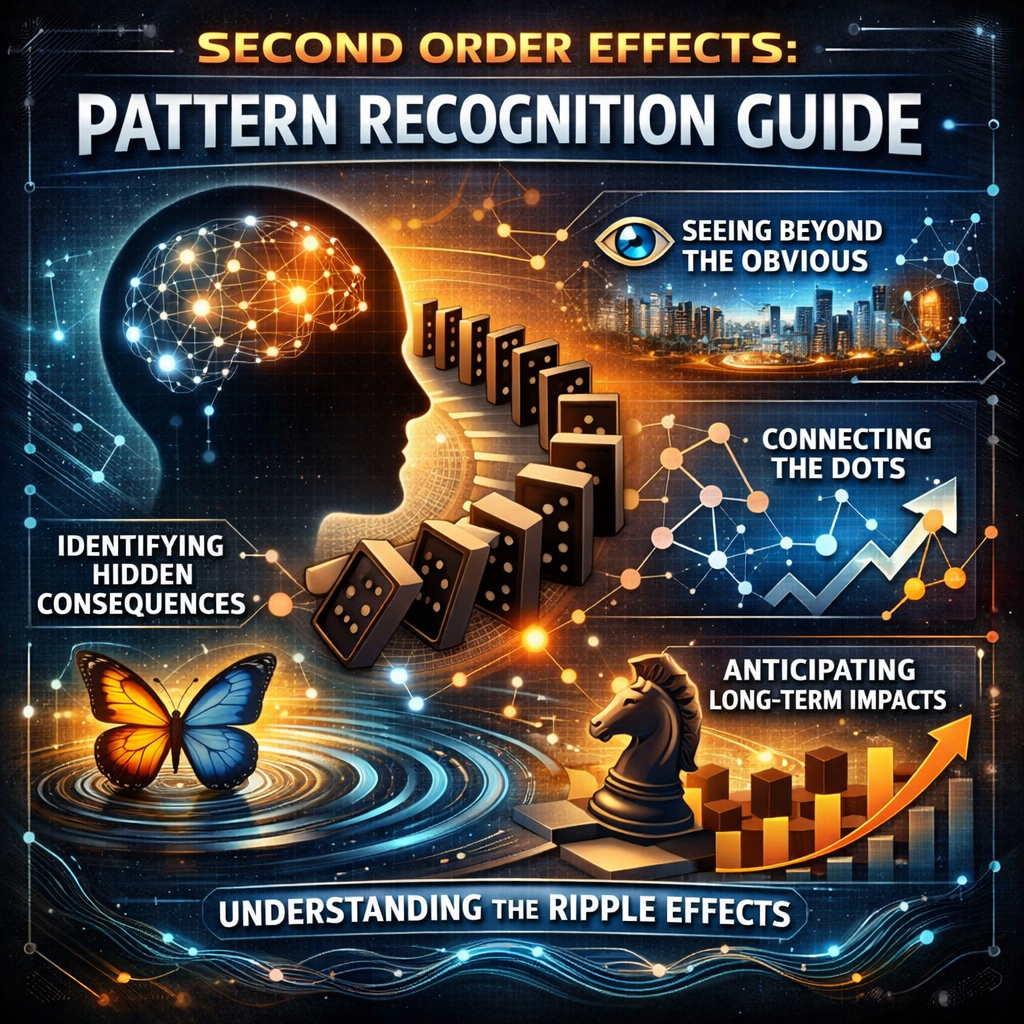
Every decision creates consequences. However, most people evaluate decisions only by their immediate outcomes. While these first-order effects are visible and easy to measure, they often mask a deeper and more powerful layer of impact: second order effects. These are the indirect, delayed, and frequently unintended results that emerge after the initial consequence unfolds.
In complex systems, second order effects determine long-term success or failure. Therefore, leaders who rely solely on short-term metrics consistently underestimate risk and overestimate control. Pattern recognition and insight provide the tools required to see beyond surface outcomes and understand how systems truly behave over time.
What Are Second Order Effects?
Second order effects are consequences that arise because of the first outcome, rather than directly from the original action.
For example, a company may introduce remote work. Initially, employees gain flexibility and reduce commuting time. However, over time, new patterns emerge. Collaboration habits change. Informal communication declines. Office culture shifts. Eventually, employee retention improves while innovation may slow.
In this way, second order effects are not separate events. Instead, they are systemic consequences produced by feedback loops inside complex environments.
Why Second Order Effects Matter?
In practice, most strategic failures occur not because of poor ideas, but because of unexamined consequences. Organizations often optimize for short-term performance indicators while ignoring how those decisions reshape behavior, incentives, and structure.
As a result, leaders experience:
- Unexpected resistance
- Cultural erosion
- Operational inefficiencies
- Strategic drift
Consequently, second order thinking becomes a competitive advantage. It allows decision-makers to manage systems rather than react to symptoms.
The Role of Pattern Recognition
Pattern recognition transforms isolated experiences into strategic intelligence. Instead of treating each decision as unique, leaders identify recurring cause-and-effect structures across multiple contexts.
For instance, whenever a company centralizes authority, communication becomes slower. Similarly, when incentives focus solely on output, quality declines. Over time, these patterns repeat with remarkable consistency.
Therefore, insight does not come from prediction. Instead, it comes from observing what typically happens when similar decisions are made.
Common Areas Where Second Order Effects Appear
Second order effects occur across all domains of organizational life. However, some areas produce especially strong systemic consequences.
Technology and Automation
Initially, automation increases efficiency and reduces labor costs. Over time, new risks emerge.
For example:
- Human judgment declines
- Employees lose critical skills
- Organizations become dependent on systems
- Failures become more catastrophic
As a result, productivity improves in the short term but resilience decreases in the long term.
Incentive Systems
At first, performance bonuses increase output. Eventually, behavioral distortions appear.
Specifically:
- Teams optimize metrics rather than outcomes
- Collaboration declines
- Ethical shortcuts emerge
- Innovation slows
Therefore, incentives reshape culture more powerfully than strategy documents ever could.
Cost Cutting
Reducing costs improves margins. However, deeper consequences follow.
Over time:
- Quality declines
- Employee morale weakens
- Brand reputation erodes
- Customer loyalty decreases
Consequently, cost savings often transform into hidden expenses.
Rapid Growth
Growth increases revenue and market presence. Yet complexity expands simultaneously.
Eventually:
- Communication structures break
- Culture fragments
- Leadership bottlenecks appear
- Decision speed declines
In contrast, organizations that redesign systems before scaling avoid these collapse patterns.
Cognitive Blind Spots That Hide Second Order Effects
Human psychology naturally favors immediate outcomes. As a result, second order consequences are systematically underestimated.
Common cognitive traps include:
- Present bias
- Linear thinking
- Outcome bias
- Overconfidence
Because of these biases, leaders frequently misinterpret success as competence and failure as bad luck. Pattern recognition corrects this distortion by focusing on structural dynamics instead of isolated results.
How Insight Improves Decision Quality?
Insight emerges when leaders compare decisions across time and context.
Instead of asking, “Is this decision good?”, they ask, “What usually happens after this kind of decision?”
As a result, organizations gain:
- Better risk assessment
- Stronger scenario planning
- Higher strategic coherence
Moreover, this approach shifts leadership from reactive problem-solving to proactive system design.
Second Order Effects in Strategic Decisions
At the strategic level, second order effects reshape entire industries.
For example:
Platform Strategies
More users lead to network effects. However, regulatory pressure and monopolistic behavior follow.
Price Wars
Market share increases. Yet margins collapse and brand value erodes.
Organizational Restructuring
Efficiency improves initially. Over time, institutional knowledge disappears and innovation declines.
Therefore, strategic advantage often depends on anticipating what happens after success.
Practical Frameworks for Second Order Thinking
High-performing organizations use structured methods to surface hidden consequences.
The “And Then What?” Method
After identifying a result, repeatedly ask what happens next.
Systems Mapping
Visualize how people, processes, incentives, and technology interact.
Historical Pattern Analysis
Study similar decisions in other organizations.
Reversibility Test
Assess whether a decision can be undone without systemic damage.
Together, these frameworks convert intuition into disciplined reasoning.
Why Good Policies Still Fail?
Many well-intentioned policies collapse because of second order effects.
For instance, free services increase access. However, overuse strains resources. Service quality declines. Eventually, budgets collapse.
Therefore, generosity without system design produces predictable failure.
Leadership and Second Order Effects
Leadership behavior shapes culture invisibly.
For example:
- Micromanagement reduces autonomy
- Excessive transparency creates overload
- Charismatic leadership produces dependency
Consequently, leadership impact extends far beyond visible actions.
Building a Second Order Thinking Culture
Organizations can embed second order awareness at multiple levels.
Leadership Level
Encourage long-term thinking and reward problem discovery.
Team Level
Conduct post-decision reviews and document unintended outcomes.
System Level
Maintain decision logs and analyze long-term patterns.
Over time, this creates institutional memory that prevents repeating systemic mistakes.
Why Second Order Effects Create Strategic Leverage?
Most competitors optimize for speed and efficiency. Few invest in understanding delayed consequences.
Therefore, organizations that master second order thinking:
- Avoid catastrophic failures
- Detect hidden risks early
- Exploit overlooked opportunities
- Build durable competitive advantage
In complex environments, foresight outperforms speed.
Conclusion: The Hidden Layer of Every Decision
Second order effects determine what decisions actually create. While first-order results are visible, second order consequences shape behavior, culture, and long-term outcomes.
Pattern recognition and insight allow leaders to manage systems rather than react to symptoms. Ultimately, the most dangerous decisions are not the wrong ones. They are the ones whose consequences were never examined.
In a world of increasing complexity, the real competitive advantage is not intelligence or experience. It is the ability to recognize patterns, anticipate second order effects, and design decisions that remain strong over time.