


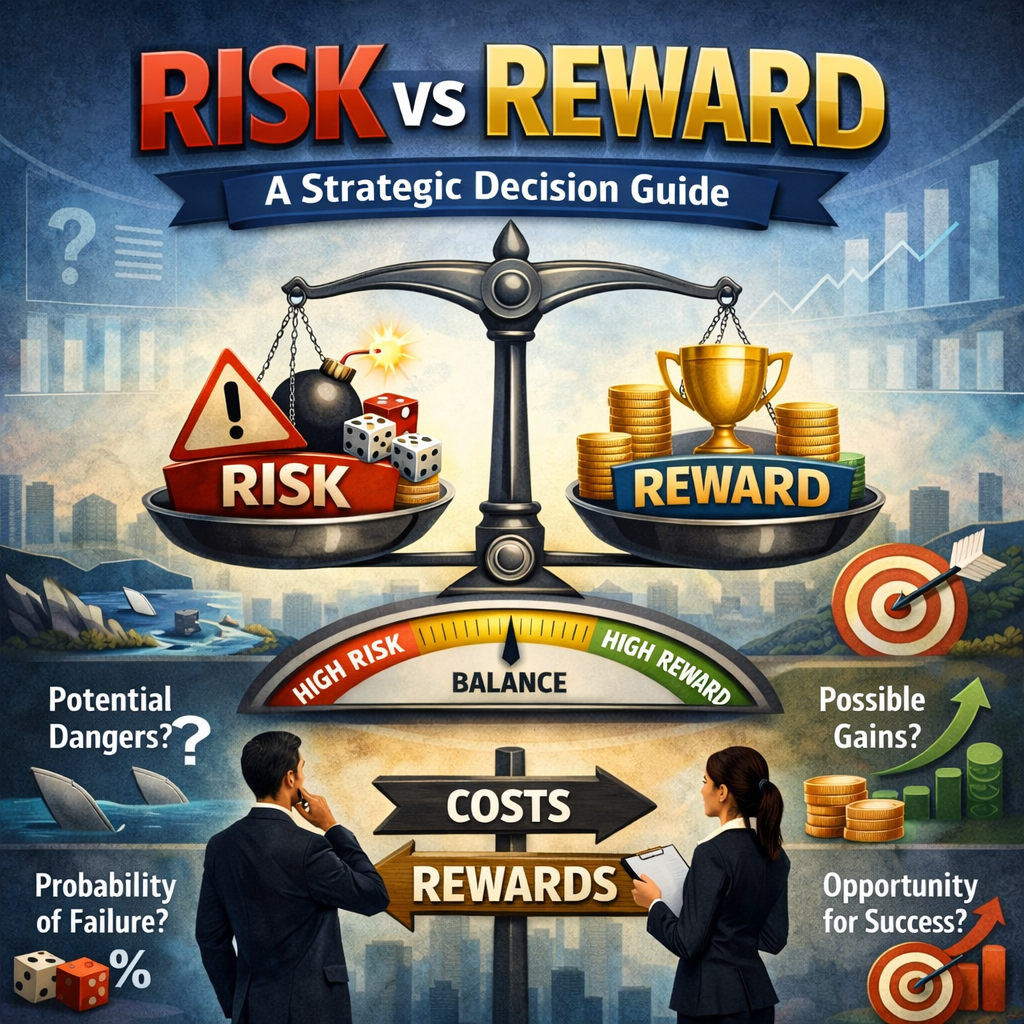
In every business environment, decision-makers are constantly required to balance potential gains against possible losses. Whether launching a new product, entering a new market, or investing in emerging technology, leaders must assess not only what they stand to gain but also what they might lose. This balancing act is known as risk vs reward evaluation, a core concept within modern decision frameworks.
Risk vs reward evaluation provides a structured approach for analyzing uncertainty and opportunity. Instead of relying on instinct or emotional judgment, this framework encourages logical, evidence-based thinking. As a result, organizations can make more confident decisions that align with strategic objectives while minimizing unnecessary exposure to risk.
What Is Risk vs Reward Evaluation?
Risk vs reward evaluation is a decision-making process that compares the potential benefits of an action against its possible negative consequences. The goal is not to eliminate risk entirely, which is rarely possible, but to determine whether the expected reward justifies the level of risk involved.
In practical terms, this framework answers a fundamental question:
“Is this decision worth the risk?”
This type of evaluation is widely used across industries, including finance, business strategy, project management, healthcare, technology, and public policy. Any scenario involving uncertainty, investment, or strategic choice can benefit from a systematic risk vs reward analysis.
Why Risk vs Reward Evaluation Matters?
Without a structured framework, decision-making often becomes biased or overly cautious. On one hand, some organizations avoid risk altogether and miss valuable growth opportunities. On the other hand, excessive risk-taking can lead to financial loss, reputational damage, or operational failure.
Risk vs reward evaluation helps prevent both extremes by offering several key benefits:
1. Better Strategic Decisions
By evaluating both upside and downside, leaders gain a realistic understanding of potential outcomes.
2. Improved Resource Allocation
Time, money, and human capital are directed toward initiatives with the highest expected return.
3. Greater Transparency
Stakeholders can clearly see why certain risks are accepted while others are rejected.
4. Reduced Emotional Bias
Decisions become more objective and less influenced by fear or overconfidence.
Ultimately promotes balanced thinking in environments defined by uncertainty.
Core Principles
Although the framework can be applied in many ways, it is guided by several fundamental principles.
First, risk should be identified and categorized before being measured. This includes financial, operational, legal, and reputational risks.
Second, reward must be clearly defined in measurable terms, such as revenue growth, cost savings, or strategic advantage.
Third, probability matters. A high reward with a very low likelihood may not be preferable to a moderate reward with a high probability.
Finally, decisions should align with organizational risk tolerance and long-term goals.
Together, these principles ensure that remains practical and aligned with real business priorities.
How Risk vs Reward Evaluation Works?
Following a structured process that supports consistent and repeatable decision-making.
Step 1: Define the Decision
Clearly identify the choice that needs to be made and its strategic importance.
Step 2: Identify Potential Rewards
List all expected benefits, including financial, operational, and strategic outcomes.
Step 3: Identify Potential Risks
Analyze possible negative consequences, including worst-case scenarios.
Step 4: Assess Probability and Impact
Estimate how likely each outcome is and how significant its effect would be.
Step 5: Compare Risk and Reward
Evaluate whether the expected reward outweighs the associated risk.
Step 6: Make the Decision
Choose the option that offers the best balance between opportunity and exposure.
This structured approach transforms uncertainty into manageable insight.
Common Risk vs Reward Evaluation Techniques
Many organizations deploy structured risk-benefit evaluation methods to support complex decisions. For instance, legal and risk professionals use structured risk-benefit analysis to compare both the likelihood and impact of risks alongside expected gains, helping determine whether potential actions are worthwhile. See: Legal Thomsonreuters.
Risk Matrix
A risk matrix plots likelihood against impact, categorizing risks as low, medium, or high. This visualization helps prioritize which risks require mitigation.
Best for: Project management, operational planning.
Expected Value Analysis
This technique calculates potential outcomes by multiplying probability by impact. It provides a numerical estimate of expected reward or loss.
Best for: Financial forecasting, investment decisions.
Scenario Analysis
Scenario analysis evaluates multiple future possibilities, including best-case, worst-case, and most likely outcomes.
Best for: Strategic planning, policy development.
Cost-Benefit Analysis
Although traditionally financial, cost-benefit analysis is often combined with risk evaluation to assess whether benefits justify potential costs.
Best for: Capital investments, infrastructure projects.
Real-World Applications
Risk vs reward evaluation is deeply embedded in modern organizational decision-making.
Finance and Investment
Investors assess return potential against volatility, liquidity, and market risk.
Business Strategy
Executives evaluate expansion opportunities against competitive threats and regulatory risk.
Technology
Organizations weigh innovation benefits against cybersecurity and implementation risk.
Healthcare
Medical professionals evaluate treatment benefits against potential side effects.
Across all industries, risk vs reward evaluation supports smarter, evidence-based choices.
Choosing the Right Level of Risk
One of the most important aspects of risk vs reward evaluation is understanding risk tolerance. Different organizations and individuals have different thresholds for acceptable risk.
High-growth startups may accept higher risk in exchange for rapid expansion. In contrast, established enterprises often prioritize stability and long-term sustainability. Therefore, risk vs reward evaluation must always consider organizational culture, financial position, and strategic vision.
There is no universal right level of risk—only what is appropriate for a specific context.
Common Mistakes in Risk vs Reward Evaluation
Even well-designed frameworks can fail if applied incorrectly.
One common mistake is underestimating risk due to optimism bias.
Another error involves focusing only on worst-case scenarios and ignoring potential rewards.
Additionally, relying on incomplete data can distort conclusions.
Most importantly, failing to revisit evaluations as conditions change leads to outdated decisions.
Risk vs reward evaluation should be dynamic, not static.
Risk vs Reward Evaluation vs Other Decision Frameworks
Unlike simple prioritization models and emphasizes uncertainty and probability. While frameworks like weighted scoring focus on ranking options and focuses on understanding potential consequences.
In comparison to tradeoff analysis, which examines compromises between objectives, and specifically addresses uncertainty and exposure. Therefore, it is particularly valuable in high-stakes or volatile environments.
The Strategic Value
At a strategic level and strengthens organizational resilience. Over time, it encourages disciplined thinking, accountability, and realistic planning.
Leaders who consistently apply this framework make fewer impulsive decisions and respond more effectively to change. More importantly, they build cultures that reward thoughtful risk-taking rather than reckless behavior or excessive caution.
In this sense and becomes a competitive advantage.
Conclusion
Risk vs reward evaluation is one of the most essential decision frameworks in modern business and leadership. By systematically comparing potential gains against possible losses, it enables individuals and organizations to navigate uncertainty with confidence.
Rather than avoiding risk or chasing reward blindly, this framework promotes balanced, strategic decision-making. In an environment defined by constant change and complexity, mastering is not optional—it is a fundamental requirement for sustainable success.