
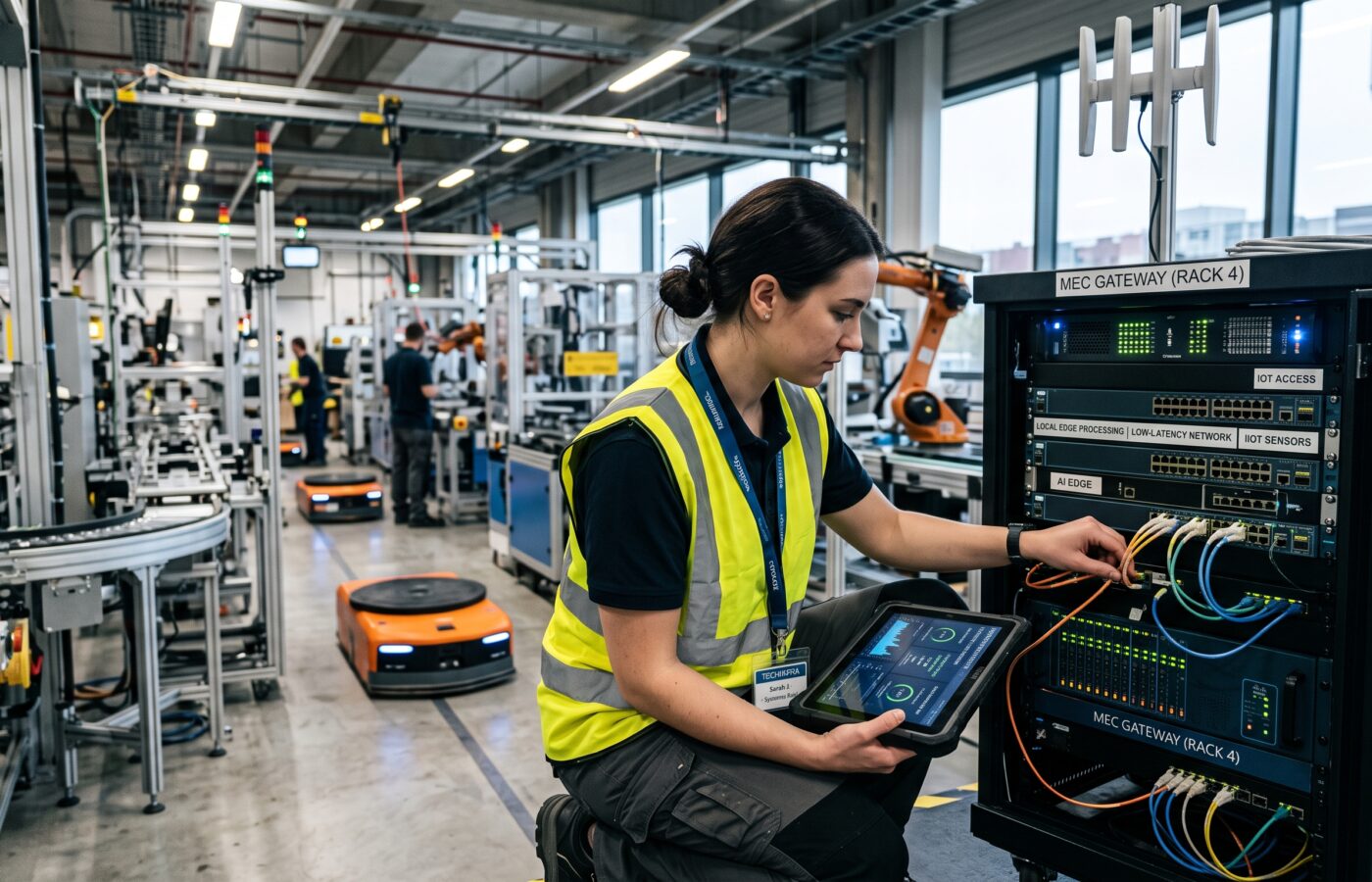
The Rise of Edge Computing: Transforming IoT, AI, and Smart Networks

I’ve spent the better part of seven years designing cloud infrastructure, and clients almost always ask me the same question eventually. Why does the app feel slow when the servers are so powerful? In fact, nine times out of ten, the server isn’t the problem. Instead, the distance the data has to travel is. That’s the gap edge computing closes. That’s also why I’ve shifted a good chunk of my own architecture practice toward it over the past couple of years.
Edge computing isn’t a buzzword I picked up at a conference. On the contrary, it’s become a core part of how I plan infrastructure for clients running factories, hospitals, retail chains, and connected vehicle fleets. In this piece, I’ll walk through what edge computing actually is and why it’s picking up so much momentum right now. I’ll also cover where I think it’s headed for teams working with IoT, AI, and next-generation networks.
What Edge Computing Actually Means
At its simplest, edge computing processes data close to where it’s created. Instead of shipping every byte back to a centralized data center, a nearby edge node handles the work on the spot. For example, a factory sensor, a delivery truck, a hospital monitor, and a retail checkout terminal all generate data locally. None of them need to send that data hundreds of miles away just to get a response.
That said, the traditional cloud model still matters here, and I’m not suggesting anyone rip out their cloud environment. What’s changed is the balance. Centralized cloud computing still handles the heavy lifting well: training large models, running analytics warehouses, storing archives. But picture a self-driving car reacting to an obstacle, or a factory robot arm stopping before it damages a part. In those moments, a few hundred milliseconds of network latency isn’t a minor inconvenience; it’s a failure. So edge computing exists to close that specific gap.
Why Edge Is Gaining Ground Right Now
A few years ago, edge computing lived mostly in conversations among telecom engineers and a handful of manufacturing IT teams. Since then, that’s changed, and I’d point to three forces converging at once.
First, there’s the sheer volume of connected devices. Industry researchers now expect roughly 29 billion connected IoT devices online by 2030, and each one produces data that has to go somewhere. As a result, sending all of it to a central cloud gets expensive fast, and it’s often physically impractical given available bandwidth.
Second, there’s artificial intelligence. AI used to live in the cloud and stay there, but that’s changing quickly. Purpose-built AI chips, like Nvidia’s Jetson line, now bring real inference power to small, energy-efficient edge devices. For instance, a production line camera checking for defects no longer has to send footage to a distant data center. Instead, a chip bolted to the camera itself runs the analysis and returns a decision in milliseconds.
Third, and most simply, there’s money. Market analysts currently value the global edge computing market at somewhere around $21 to $28 billion. Growth projections, meanwhile, run in the high twenties percent annually through the mid-2030s. North America alone, for example, generated roughly $7 billion of that activity in a recent year. Once budget committees notice numbers like that, edge computing stops looking like an R&D curiosity. Instead, it starts showing up as a line item in next year’s infrastructure plan.
Edge Computing and the IoT Explosion
If you work anywhere near IoT, you already know the pain of data gravity. A single connected factory floor, for instance, can generate more telemetry in an hour than most companies used to produce in a month. Because of that, funneling it upstream to a central cloud creates bottlenecks. It also drives up bandwidth costs and adds latency that defeats the purpose of having sensors in the first place.
Edge computing flips that model instead. Local gateways filter, aggregate, and act on data before it ever leaves the building.
Consider agriculture, for example. Edge nodes on rural farmland let private wireless networks process soil, moisture, and yield data on-site, even where reliable broadband is scarce. Or consider retail. Edge nodes at the point of sale handle inventory checks and personalized offers in real time, instead of waiting on a round trip to a distant server.
In short, the pattern repeats across industries. Keep routine decisions local, and only send the cloud what genuinely needs deeper analysis or long-term storage.
Edge Computing and AI: A Natural Pairing
I’d argue AI is the single biggest reason edge computing moved from “interesting” to “necessary” over the last two years. Training a model still happens in the cloud, where compute density can chew through massive datasets. But running that model, what’s called inference, increasingly happens at the edge instead.
For example, picture a hospital using computer vision to flag anomalies during a live procedure. Or picture a warehouse robot navigating around people and obstacles. Neither can afford to wait on a network round trip. Because of that, edge AI puts a trained model directly onto local hardware and lets decisions happen at the source.
This trend is also trickling down to everyday devices. AI-capable laptops with dedicated neural processing units can now run meaningful analytics locally. That matters enormously for field teams working in remote locations with unreliable connectivity.
At the same time, this pairing changes how I think about privacy and compliance. Processing patient data locally, rather than routing it through third-party cloud storage, makes it considerably easier to stay within healthcare privacy rules. Similarly, the same logic applies to financial services and any industry where sensitive data shouldn’t leave the building unnecessarily.
Building Smart Networks at the Edge
Smart networks depend on one principle, whether we’re talking about smart grids, smart cities, or private industrial 5G: local intelligence paired with centralized oversight. Consider a power grid that phones home to a distant data center every time it rebalances load. That grid isn’t smart; it’s just slow. By contrast, edge nodes distributed across substations can detect anomalies and respond within milliseconds, then report summarized data upward for long-term planning.
5G plays a major role here too. Specifically, low-latency 5G paired with edge nodes close to end users makes real-time traffic management, autonomous vehicle coordination, and low-latency video streaming workable at scale. Telecom providers have noticed this, and as a result, they’re increasingly offering edge infrastructure as part of their own service stack. Cell towers and regional facilities, in other words, are becoming computing hubs rather than just connectivity points.
Autonomous vehicles show why this matters most clearly. A car interpreting radar and LiDAR data can’t wait on a distant server to tell it whether to brake. So that interpretation has to happen locally, in real time. Network connectivity, meanwhile, becomes a secondary channel for coordination and mapping updates rather than the primary decision path.
Where I’ve Seen It Work in Practice
Across the clients I’ve worked with, the highest-value edge deployments cluster around a few recurring scenarios.
For instance, manufacturing plants use edge nodes for predictive maintenance. Vibration and thermal sensors, specifically, catch early signs of equipment failure long before a breakdown happens. Meanwhile, hospitals use local processing to keep surgical monitoring systems responsive, without depending on a hospital-wide network staying perfectly stable. Retailers, similarly, use edge infrastructure to cut down on checkout friction. Even a few seconds of delay, after all, can drive customers to abandon a purchase and cost real sales. And logistics companies use it to keep delivery fleets making smart routing decisions even when cellular coverage drops out mid-route.
None of this is hypothetical. In fact, these are the projects that land on my desk regularly now. Across every industry, though, the common thread stays the same: the business can’t tolerate the latency or the bandwidth cost of a fully centralized approach anymore.
The Real Challenges Architects Are Wrestling With
I don’t want to paint this as frictionless, because it isn’t. Edge deployments introduce a genuinely harder security problem than centralized cloud environments do. After all, you’re no longer protecting a handful of data centers. Instead, you’re responsible for potentially thousands of distributed devices, each a possible entry point. Often, different manufacturers built them with inconsistent firmware update practices. For that reason, security planning needs to happen at the design stage, not as an afterthought.
There’s a real talent gap too. Managing a fleet of edge nodes takes a different skill set than managing a virtual machine in a cloud console. Even so, most teams I work with are still building that muscle. Edge hardware and software also haven’t standardized the way cloud platforms have. Consequently, that fragmentation produces plenty of proof-of-concept projects but far fewer production-scale rollouts, since those still take real planning and patience to get right.
Seven Shifts I’m Watching Over the Next Few Years
Based on current projects and industry research, here’s where I expect edge computing to head next.
On the Technology Side
First, edge AI moves beyond simple inference into more sophisticated, multimodal processing. It increasingly handles video, audio, and sensor data together instead of in isolation. Second, management platforms mature enough that deploying and maintaining thousands of distributed devices starts to look routine, rather than like a custom engineering project. Third, telecom providers keep expanding their role as edge infrastructure hosts. This blurs the line between network carrier and cloud provider. Finally, on-premise and hybrid deployment models keep gaining ground over pure cloud-based edge, particularly among large enterprises with existing data center investments.
On the Business Side
Meanwhile, security tooling built specifically for distributed edge environments becomes a standard budget line rather than an afterthought. At the same time, smaller and mid-sized businesses start adopting edge infrastructure as hardware costs come down. So far, that shift has mostly stayed limited to large enterprises. And finally, industrial IoT and automation keep leading edge spending, since factories and logistics operations see the clearest, most immediate return on investment.
None of this replaces the cloud; instead, it complements it. In practice, the architectures I design today almost always involve both. Cloud handles heavy computation, long-term storage, and model training, while edge handles real-time decisions, local resilience, and reduced bandwidth costs. Honestly, getting that balance right is most of the job now.
Final Thoughts
Edge computing has moved past the experimental phase. In short, it answers a problem every connected business eventually runs into: data volume and latency requirements that a purely centralized model can’t satisfy anymore. Maybe you’re managing IoT sensors on a factory floor, running AI inference for a healthcare application, or building out a smart grid. Either way, the real question isn’t whether to consider edge computing anymore. It’s how to fit it into an architecture that already includes the cloud, without creating a management nightmare in the process.
If there’s one thing I’d tell any team starting this journey, it’s this: resist treating edge computing as a wholesale replacement for cloud infrastructure. Instead, treat it as a specialized tool for the moments when distance and delay genuinely matter. Then build your security and management practices around that from day one.
Frequently Asked Questions
What is edge computing in simple terms?
Edge computing processes data close to where it’s generated, such as on a factory sensor, a retail terminal, or a local network node. In other words, it skips the trip to a distant, centralized cloud data center. That cuts the delay between a data event and the decision that follows it.
Source: IBM – Edge Computing Use Cases
How is edge computing different from cloud computing?
Cloud computing centralizes processing and storage in large, remote data centers, which works well for heavy workloads like model training or long-term storage. By contrast, edge computing distributes some of that processing closer to end users and devices, which matters when latency, bandwidth, or local reliability take priority. In practice, most modern architectures use both together.
Source: Accenture – Edge Computing Index
Why is edge computing important for IoT?
IoT devices generate enormous volumes of data continuously, and sending all of it to a central cloud for processing is often too slow and too costly. So instead, edge computing lets local gateways filter and act on that data immediately, sending upstream only what genuinely needs deeper analysis.
Source: TierPoint – Edge Computing and IoT
How does edge computing support AI applications?
Cloud environments typically train AI models, since compute resources there are dense and scalable. Increasingly, though, those models run, or “infer,” directly on edge devices instead. As a result, this enables real-time decisions in applications like computer vision, robotics, and predictive maintenance without a network round trip.
Source: TechTarget – Edge Computing Trends
Is edge computing secure?
Edge computing can strengthen data security by keeping sensitive information local instead of transmitting it across networks. However, it also expands the number of devices and entry points that need protection. Because distributed hardware from different manufacturers often runs inconsistent update practices, security planning becomes essential at the design stage.
Source: Esper – Edge Computing Use Cases
How big is the edge computing market right now?
Estimates vary by research firm. Still, most currently place the global edge computing market in the low tens of billions of dollars. Annual growth rates, meanwhile, run in the high twenties percent, projected through the mid-2030s as AI, IoT, and 5G adoption accelerate demand.
Source: Global Market Insights – Edge Computing Market
References
- TechTarget – 10 Edge Computing Trends to Watch in 2026 and Beyond
- IBM – Edge Computing: Top Use Cases
- Global Market Insights – Edge Computing Market Size & Share, Growth Trends 2026–2035
- Accenture – Edge Computing Index
- TierPoint – Edge Computing and IoT: Key Benefits & Use Cases
- Esper – Common Use Cases and Examples of Edge Computing
- Mender.io – IoT in 2026: Edge AI, Growing Complexity, and the Demand for Smarter Updates