


In today’s fast-paced business environment, leaders and teams face constant pressure from competing demands, limited resources, and rising expectations. As a result, making the right decisions about what to focus on has become a strategic necessity rather than a simple operational task. For this reason, prioritization frameworks play a critical role in helping organizations navigate complexity and achieve sustainable success.
Rather than relying on intuition or subjective opinions, prioritization frameworks provide structured methods for evaluating tasks, projects, and initiatives. In essence, they help decision-makers allocate time, budget, and talent toward activities that generate the highest value. Ultimately, these frameworks answer a fundamental business question: What deserves attention first, and why?
What Are Prioritization Frameworks?
Prioritization frameworks are systematic decision-making models used to rank work items based on defined criteria such as value, urgency, effort, risk, or strategic alignment. By doing so, they bring clarity and consistency to complex choices that might otherwise feel overwhelming.
Across industries, these frameworks are commonly applied in product management, project planning, marketing strategy, financial allocation, and even personal productivity. In practice, any scenario involving limited resources and multiple options can benefit from a structured prioritization approach.
Why Prioritization Frameworks Matter?
Without a clear framework, prioritization often becomes reactive and emotionally driven. Consequently, decisions may favor urgent requests over important initiatives, leading to inefficiencies and long-term misalignment.
Moreover, prioritization frameworks improve decision quality by replacing assumptions with objective criteria. In addition, they ensure alignment with organizational goals, allowing teams to focus on high-impact work rather than low-value activity. Equally important, these frameworks promote transparency, making it easier to explain decisions to stakeholders and build trust.
From a strategic perspective, effective prioritization directly influences profitability, customer satisfaction, and operational efficiency. Therefore, organizations that master prioritization consistently outperform those that operate without structure.
Core Principles of Effective Prioritization
Although prioritization frameworks vary in design, most of them share several foundational principles.
First, they are value-driven, focusing on business outcomes rather than personal preferences.
Second, they rely on comparative analysis, evaluating options relative to each other.
Third, they emphasize objectivity by using measurable criteria whenever possible.
Finally, they are repeatable, allowing consistent application across different projects and time periods.
Together, these principles ensure that prioritization becomes a disciplined process instead of a one-time judgment call.
Popular Prioritization Frameworks Explained
Eisenhower Matrix (Urgent vs Important)
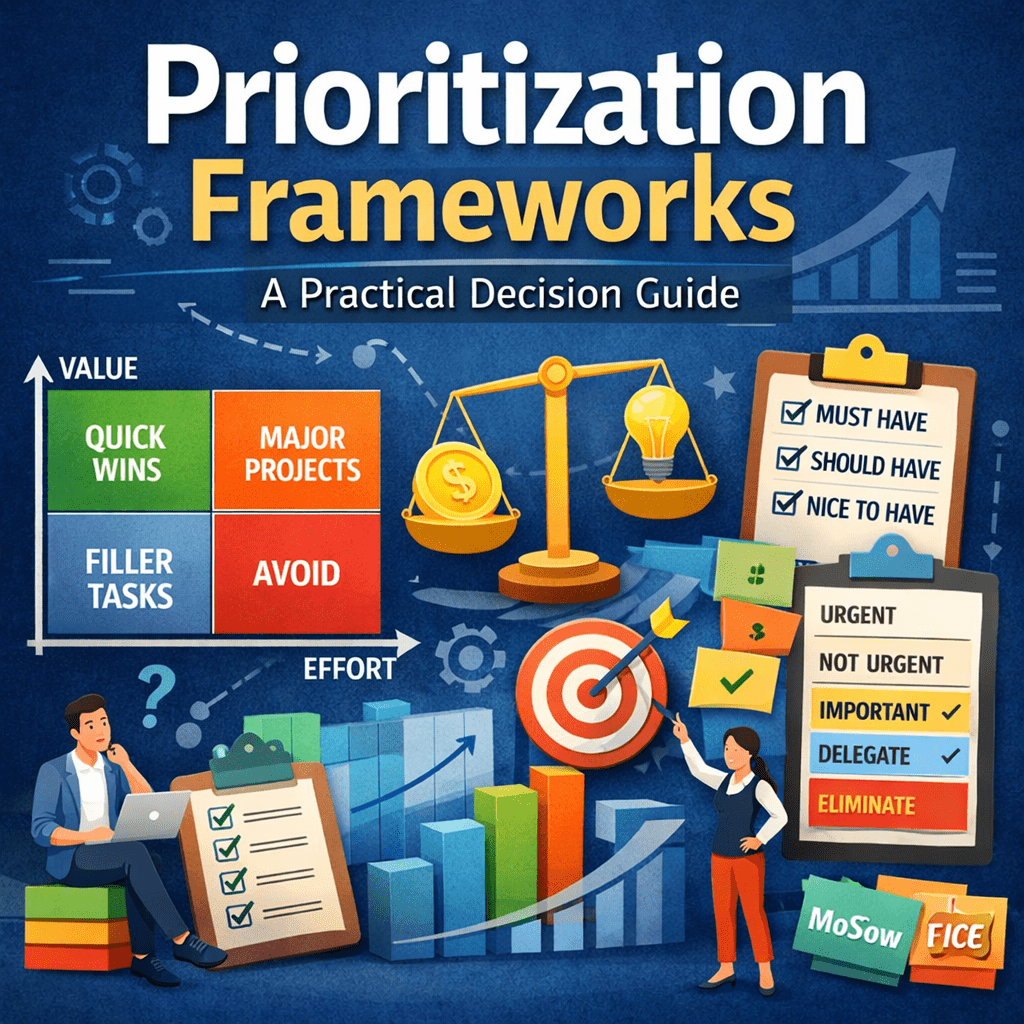
The Eisenhower Matrix categorizes tasks into four quadrants based on urgency and importance. Specifically, it separates critical activities from distractions, enabling individuals and leaders to manage time more effectively.
This framework is especially useful for daily planning and executive decision-making. As a result, it helps reduce burnout by encouraging focus on strategic priorities instead of constant firefighting.
MoSCoW Method
The MoSCoW method divides requirements into four categories: Must have, Should have, Could have, and Won’t have. By applying this structure, teams can define scope more clearly and manage stakeholder expectations.
In agile environments, MoSCoW is widely used to prioritize features and deliverables. Furthermore, it prevents scope creep by clearly identifying what is out of bounds.
RICE Framework
The RICE framework introduces a quantitative approach by scoring initiatives based on Reach, Impact, Confidence, and Effort. Consequently, it allows organizations to compare projects using a standardized formula.
This model is particularly effective in product management and growth strategy. In fact, many technology companies rely on RICE to determine which features deserve immediate investment.
Value vs Effort Matrix
The Value vs Effort Matrix plots initiatives on a two-dimensional chart. As a result, teams can quickly identify quick wins, long-term investments, and low-priority activities.
Because of its simplicity, this framework works well in workshops and brainstorming sessions. Moreover, it encourages collaborative decision-making and visual thinking.
Kano Model
The Kano Model evaluates features based on customer satisfaction rather than internal priorities. Specifically, it distinguishes between basic needs, performance drivers, and delight factors.
This framework is highly valuable for customer experience design. Therefore, organizations focused on user-centric innovation often rely on Kano for strategic product decisions.
Choosing the Right Prioritization Framework
No single framework works for every situation. Instead, the ideal choice depends on context, goals, and available data.
For complex portfolios, quantitative models like RICE or weighted scoring systems are more effective. On the other hand, simpler frameworks such as Eisenhower or MoSCoW are better suited for fast-paced operational decisions.
In many cases, organizations combine multiple frameworks. For example, MoSCoW may define scope while RICE determines execution order.
How to Implement Prioritization Frameworks Successfully
To gain real value, frameworks must be implemented with discipline and consistency.
First, clarify strategic objectives so priorities align with long-term goals.
Next, select evaluation criteria that reflect business value and risk.
Then, gather reliable data from analytics, customer feedback, and financial reports.
After that, apply the chosen framework consistently across all decisions.
Finally, review priorities regularly to adapt to changing conditions.
Through this structured approach, prioritization becomes an ongoing strategic capability rather than a one-time exercise.
Common Mistakes to Avoid
Even the most sophisticated prioritization frameworks can fail if misused.
One common mistake is overcomplicating the model with too many variables. Another risk involves biased scoring, where personal opinions override objective data. Additionally, ignoring qualitative insights can limit strategic understanding. Most importantly, failing to revisit priorities leads to outdated decisions.
Frameworks should support human judgment, not replace it entirely.
The Strategic Impact of Prioritization Frameworks
At a higher level, prioritization frameworks shape organizational culture. Over time, they encourage disciplined thinking, reduce emotional decision-making, and promote accountability.
High-performing organizations are not those that pursue every opportunity. Instead, they are the ones that consistently select the right opportunities and execute them well. In this sense, prioritization becomes a competitive advantage.
Conclusion
Prioritization frameworks are essential tools for modern decision-making. By introducing structure, transparency, and objectivity, they enable individuals and organizations to focus on what truly matters.
From simple models like the Eisenhower Matrix to advanced systems such as RICE and Kano, these frameworks transform complexity into clarity. Ultimately, mastering prioritization is not just about productivity—it is about strategic leadership, sustainable growth, and long-term success.