


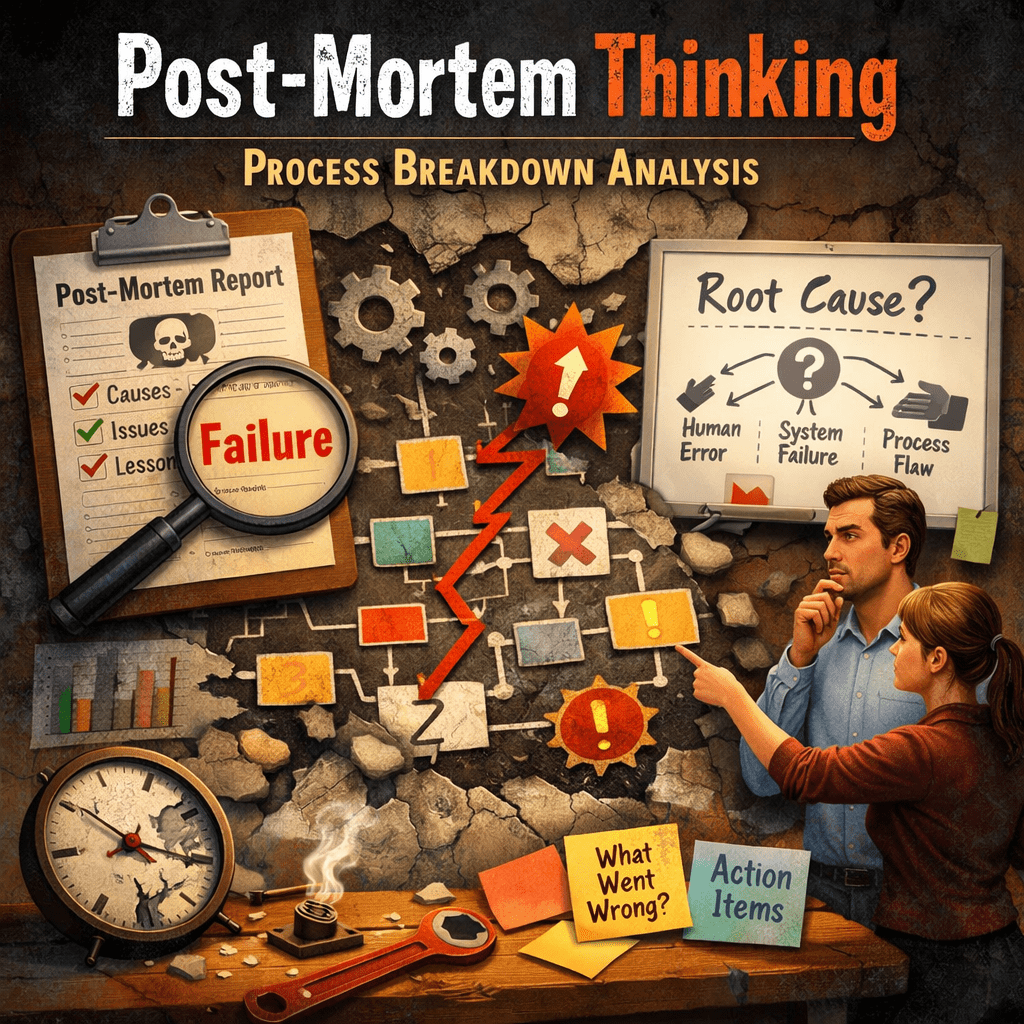
In complex organizations, most failures are not caused by a single mistake or individual decision. Instead, they emerge from a chain of small process failures that accumulate over time. Understanding where and why these failures occur is essential for building resilient systems. This is where post-mortem thinking becomes a powerful management discipline, especially when applied to process breakdown analysis.
Post-mortem thinking provides a structured method for reviewing incidents, projects, or initiatives after they fail or underperform. By focusing on process breakdown analysis, organizations can move beyond surface-level symptoms and identify systemic weaknesses in workflows, controls, and decision pathways. When implemented correctly, post-mortem thinking transforms operational setbacks into sustainable improvements.
What Is Process Breakdown Analysis?
Process breakdown analysis is the systematic examination of workflows to identify points where procedures failed, deviated, or produced unintended outcomes. It focuses on how work is actually performed, not how it is supposed to be performed on paper.
In the context of post-mortem thinking, process breakdown analysis aims to answer critical questions:
- Where did the process fail?
- What sequence of events led to the breakdown?
- Which controls were missing or ineffective?
- How did human, technical, and organizational factors interact?
- What changes will prevent similar failures in the future?
This approach shifts the focus from blame to system design.
Why Process Breakdown Analysis Matters
Many organizations conduct post-mortems but stop at general conclusions such as “poor communication” or “lack of resources.” While these observations may be accurate, they are often too vague to drive meaningful change.
Process breakdown analysis adds depth by uncovering:
1. Hidden Inefficiencies
Inefficiencies that appear minor individually can compound into major failures.
2. Structural Weaknesses
Gaps in governance, approvals, or escalation pathways become visible.
3. Risk Exposure
Uncontrolled processes increase the likelihood of compliance, financial, or reputational risks.
4. Performance Bottlenecks
Delays, handoff failures, and rework cycles reveal where productivity is lost.
Without this level of analysis, organizations treat symptoms rather than causes.
Common Types of Process Breakdowns
Process breakdowns occur across all industries and functions. Some of the most common categories include:
Operational Breakdowns
Failures in daily workflows, such as missed steps, unclear responsibilities, or inconsistent execution.
Communication Breakdowns
Information not reaching the right people at the right time.
Technology Breakdowns
System outages, data errors, or poorly integrated platforms.
Governance Breakdowns
Lack of accountability, unclear ownership, or ineffective oversight.
Decision-Making Breakdowns
Delays, conflicting priorities, or decisions based on incomplete data.
Post-mortem thinking helps organizations classify these breakdowns and address them systematically.
The Role of Post-Mortem Thinking in Process Improvement
Post-mortem thinking is not simply a diagnostic tool; it is a continuous improvement mechanism. When applied to process breakdown analysis, it supports:
- Lean management initiatives
- Six Sigma quality programs
- Risk management frameworks
- Compliance and audit processes
- Digital transformation strategies
In each case, post-mortems provide evidence-based insights that guide redesign efforts.
A Structured Framework for Process Breakdown Analysis
To maximize learning, organizations should adopt a consistent framework for post-mortem reviews.
Step 1: Define the Incident or Failure
Clearly describe what went wrong, when it occurred, and its impact.
Step 2: Map the End-to-End Process
Visualize the workflow from start to finish, including handoffs and decision points.
Step 3: Identify Breakdown Points
Highlight where the process deviated from expectations.
Step 4: Analyze Root Causes
Use techniques such as root cause analysis, the Five Whys, or fishbone diagrams.
Step 5: Evaluate Control Effectiveness
Assess whether existing policies, tools, and approvals worked as intended.
Step 6: Design Corrective Actions
Propose specific changes to prevent recurrence.
This structured approach ensures post-mortems lead to measurable improvements.
Human Factors in Process Breakdowns
One of the most overlooked aspects of process breakdown analysis is human behavior. While systems and tools matter, people ultimately execute processes.
Post-mortem thinking reveals patterns such as:
- Cognitive overload
- Role ambiguity
- Training gaps
- Incentive misalignment
- Fatigue or burnout
Understanding these factors allows organizations to redesign processes that align with real human capabilities, not idealized assumptions.
Technology and Process Failures
Digital systems are often blamed for failures, but technology rarely fails in isolation. Most technology-related breakdowns involve:
- Poor system design
- Inadequate user training
- Weak data governance
- Lack of integration
- Overreliance on automation
Post-mortem thinking uncovers how human and technical systems interact, enabling smarter digital transformation strategies.
Building a Culture That Supports Process Post-Mortems
Post-mortem thinking only works in environments that encourage honest reflection. Organizations must avoid blame-oriented cultures that suppress valuable insights.
Key cultural enablers include:
Psychological Safety
Employees must feel safe reporting errors without fear of punishment.
Leadership Transparency
Leaders should openly acknowledge process failures and support improvement efforts.
Continuous Learning
Post-mortems should be framed as learning opportunities, not performance evaluations.
Documentation and Knowledge Sharing
Insights must be captured and shared across teams.
When these conditions exist, process breakdown analysis becomes part of everyday operations.
Measuring the Impact of Process Improvements
Post-mortem thinking is only valuable if it leads to real change. Organizations should track the impact of corrective actions using clear metrics:
- Cycle time reduction
- Error rates
- Rework frequency
- Customer satisfaction
- Compliance incidents
These indicators validate whether process redesign efforts are working.
Common Mistakes in Process Post-Mortems
Despite best intentions, many organizations fail to realize the full value of post-mortem thinking.
Superficial Reviews
Focusing on obvious issues without deeper analysis.
Blame Assignment
Targeting individuals instead of systems.
No Follow-Through
Failing to implement recommended changes.
Overcomplication
Creating overly complex frameworks that discourage participation.
Effective post-mortems prioritize simplicity, honesty, and action.
Best Practices for High-Impact Process Breakdown Analysis
To ensure post-mortem thinking drives continuous improvement:
- Conduct reviews within weeks of incidents
- Include cross-functional participants
- Use standardized templates
- Focus on system design, not personalities
- Assign ownership for corrective actions
These practices turn post-mortems into strategic tools.
Post-Mortem Thinking as a Competitive Advantage
Organizations that master process breakdown analysis develop stronger operational resilience. They respond faster to disruptions, recover more effectively from failures, and innovate with greater confidence.
Over time, post-mortem thinking builds:
- Better decision-making systems
- More reliable workflows
- Stronger risk controls
- Higher organizational trust
In contrast, organizations that ignore process failures repeat the same mistakes and fall behind more adaptive competitors.
Conclusion: From Failure to Operational Excellence
Post-mortem thinking is one of the most effective ways to achieve operational excellence. By applying process breakdown analysis, organizations move beyond superficial explanations and address the systemic roots of failure.
Rather than treating incidents as isolated problems, post-mortem thinking reframes them as valuable sources of intelligence. Each breakdown becomes an opportunity to refine workflows, strengthen controls, and improve performance.
In a world of increasing complexity, the organizations that thrive are not those that avoid failure entirely—but those that learn faster, redesign smarter, and continuously evolve through disciplined post-mortem thinking.