


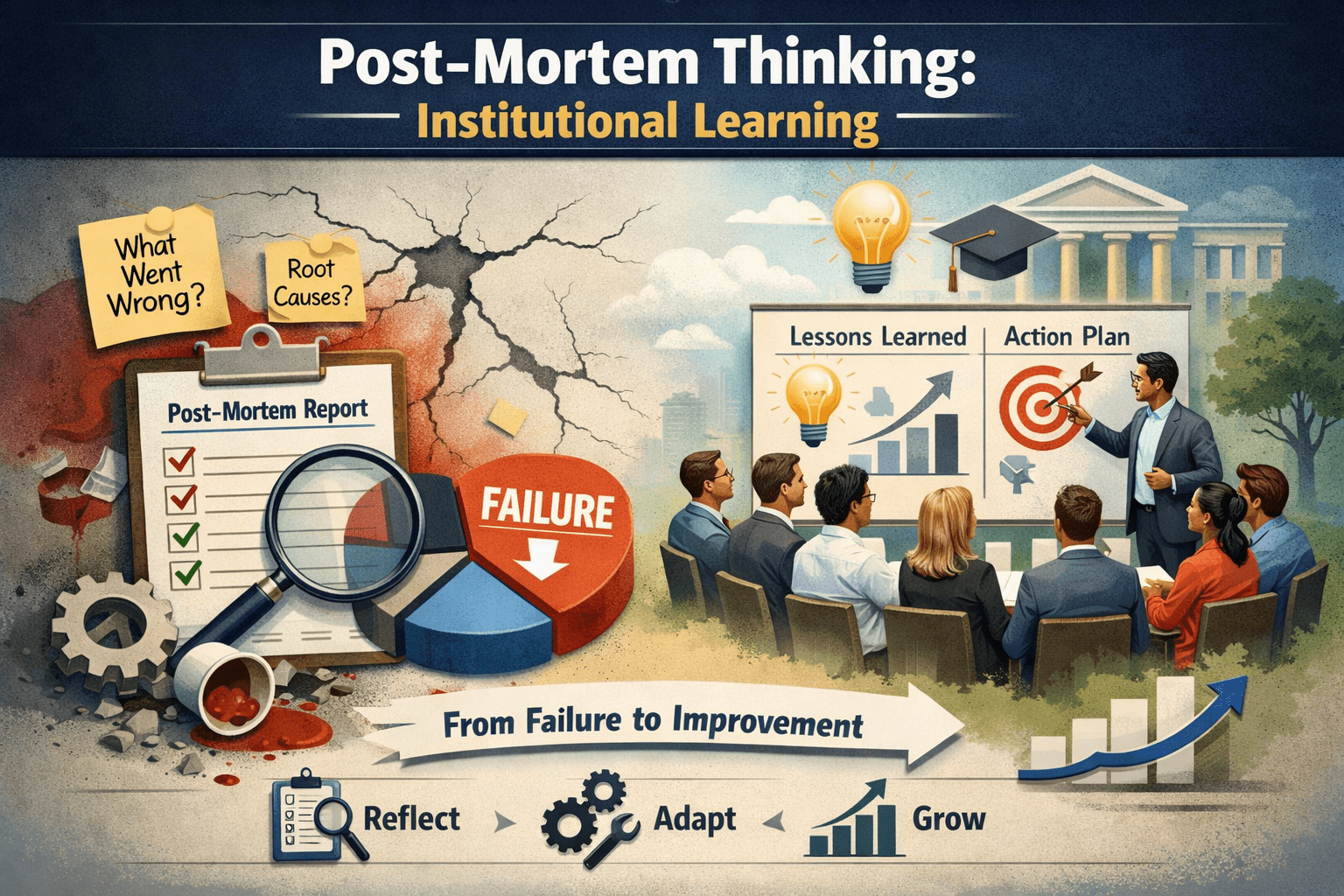
In complex and fast-changing environments, organizations cannot rely solely on experience or intuition to improve performance. Sustainable success depends on the ability to learn systematically from both success and failure. This is where post-mortem thinking becomes a critical driver of institutional learning.
Post-mortem thinking is a structured approach to analyzing projects, decisions, or events after they occur. Rather than focusing on individual accountability, it emphasizes collective learning and system improvement. When integrated into organizational processes, post-mortem thinking transforms isolated experiences into shared knowledge, enabling institutions to adapt, evolve, and strengthen over time.
Understanding Institutional Learning
Institutional learning refers to the process by which organizations convert experience into durable knowledge that influences future behavior. Unlike individual learning, which resides in people, institutional learning is embedded in processes, policies, systems, and culture.
True institutional learning ensures that:
- Lessons are documented and retained
- Knowledge is accessible across teams
- Insights influence future decisions
- Mistakes are not repeated
- Best practices are continuously refined
Without institutional learning, organizations become dependent on individual memory, making them vulnerable to knowledge loss, inconsistency, and repeated failures.
Why Post-Mortem Thinking Is Essential for Institutional Learning
Many organizations claim to value learning, but few have structured mechanisms to capture and apply it. Post-mortem thinking provides the discipline needed to transform events into organizational knowledge.
Post-mortems support institutional learning by:
1. Creating Shared Understanding
Post-mortems bring stakeholders together to develop a common narrative of what happened and why.
2. Making Learning Explicit
Insights are documented instead of remaining implicit or informal.
3. Supporting Evidence-Based Decisions
Future strategies are informed by real data rather than assumptions.
4. Strengthening Organizational Memory
Lessons persist beyond individuals and leadership changes.
In effect, post-mortem thinking acts as the bridge between experience and institutional wisdom.
The Difference Between Reflection and Institutional Learning
Reflection alone does not guarantee learning. Many organizations reflect on past outcomes but fail to convert insights into structural change.
Institutional learning requires three elements:
Capture
Documenting insights in a structured format.
Integration
Embedding lessons into workflows, policies, and training.
Reinforcement
Ensuring new practices are consistently applied.
Post-mortem thinking provides the mechanism for all three.
How Post-Mortem Thinking Builds Organizational Knowledge
Post-mortems generate knowledge in several forms:
Process Knowledge
Understanding how workflows operate in practice.
Strategic Knowledge
Insights into market behavior, customer needs, and competitive dynamics.
Risk Knowledge
Patterns of vulnerability and systemic weaknesses.
Cultural Knowledge
Behavioral norms, communication patterns, and leadership dynamics.
When this knowledge is aggregated over time, it forms a powerful institutional asset.
A Framework for Institutional Learning Through Post-Mortems
To ensure post-mortem thinking leads to real learning, organizations should follow a structured framework.
Step 1: Define the Learning Objective
Clarify what the organization hopes to learn from the review.
Step 2: Reconstruct the Event
Document key decisions, actions, and outcomes.
Step 3: Analyze Root Causes
Identify systemic factors rather than individual mistakes.
Step 4: Extract Transferable Lessons
Focus on insights that apply beyond the specific case.
Step 5: Embed Lessons Into Systems
Update processes, policies, tools, and training.
Step 6: Monitor Behavioral Change
Track whether new practices are being adopted.
This framework ensures learning is institutionalized, not forgotten.
The Role of Leadership in Institutional Learning
Leadership plays a decisive role in shaping whether post-mortem thinking becomes a learning tool or a compliance exercise.
Effective leaders:
- Encourage honest reflection
- Model learning behavior
- Reward insight generation
- Protect psychological safety
- Invest in knowledge systems
Without leadership support, post-mortems risk becoming superficial rituals.
Psychological Safety and Learning Culture
Institutional learning cannot occur in fear-based environments. Employees must feel safe discussing errors, risks, and uncomfortable truths.
Post-mortem thinking supports psychological safety by:
- Shifting focus from blame to systems
- Normalizing failure as part of learning
- Encouraging cross-functional dialogue
- Validating diverse perspectives
Over time, this builds a learning culture where continuous improvement is embedded in daily operations.
Knowledge Retention and Organizational Memory
One of the greatest threats to institutional learning is knowledge loss. When employees leave or projects end, critical insights often disappear.
Post-mortem thinking mitigates this risk by:
- Creating documented learning repositories
- Standardizing review templates
- Integrating lessons into onboarding programs
- Establishing communities of practice
These mechanisms ensure learning survives personnel changes and organizational growth.
Institutional Learning and Continuous Improvement
Post-mortem thinking aligns closely with continuous improvement methodologies such as Lean, Six Sigma, and Agile.
In these contexts, post-mortems:
- Identify improvement opportunities
- Validate process changes
- Support iterative experimentation
- Reduce variation and waste
Institutional learning becomes the engine that sustains improvement over time.
Measuring Institutional Learning
Learning must be measurable to be managed. Organizations should track indicators that reflect learning effectiveness:
- Reduction in repeated errors
- Faster recovery from disruptions
- Improved process performance
- Higher employee engagement
- Increased innovation rates
These metrics demonstrate whether post-mortem insights are producing real change.
Common Barriers to Institutional Learning
Despite its value, institutional learning often fails due to predictable challenges.
Cultural Resistance
Fear of blame discourages honest analysis.
Knowledge Silos
Insights remain confined within teams.
Lack of Follow-Through
Lessons are documented but not implemented.
Information Overload
Excessive documentation reduces usability.
Post-mortem thinking addresses these barriers by enforcing structure, accountability, and relevance.
Best Practices for Post-Mortem-Based Learning
To maximize institutional learning:
- Conduct reviews consistently, not only after crises
- Involve diverse perspectives
- Focus on systemic patterns
- Use simple and standardized formats
- Assign ownership for lesson implementation
These practices ensure learning becomes operational, not theoretical.
Institutional Learning as a Strategic Advantage
Organizations that excel at institutional learning outperform competitors over the long term. They adapt faster, make better decisions, and avoid repeating costly mistakes.
Post-mortem thinking strengthens strategic capability by:
- Enhancing foresight
- Improving resource allocation
- Strengthening governance
- Supporting innovation
In volatile environments, learning becomes a more powerful asset than capital or technology.
Conclusion: From Experience to Organizational Wisdom
Post-mortem thinking is not about analyzing the past for its own sake. It is about building the future through disciplined learning.
By embedding post-mortem thinking into institutional processes, organizations convert isolated experiences into shared knowledge, operational improvements, and strategic resilience. Institutional learning ensures that mistakes are not wasted and successes are not accidental.
In a world where change is constant and uncertainty unavoidable, the ability to learn collectively is the ultimate source of sustainable advantage. Through post-mortem thinking, organizations transform experience into enduring organizational wisdom.