


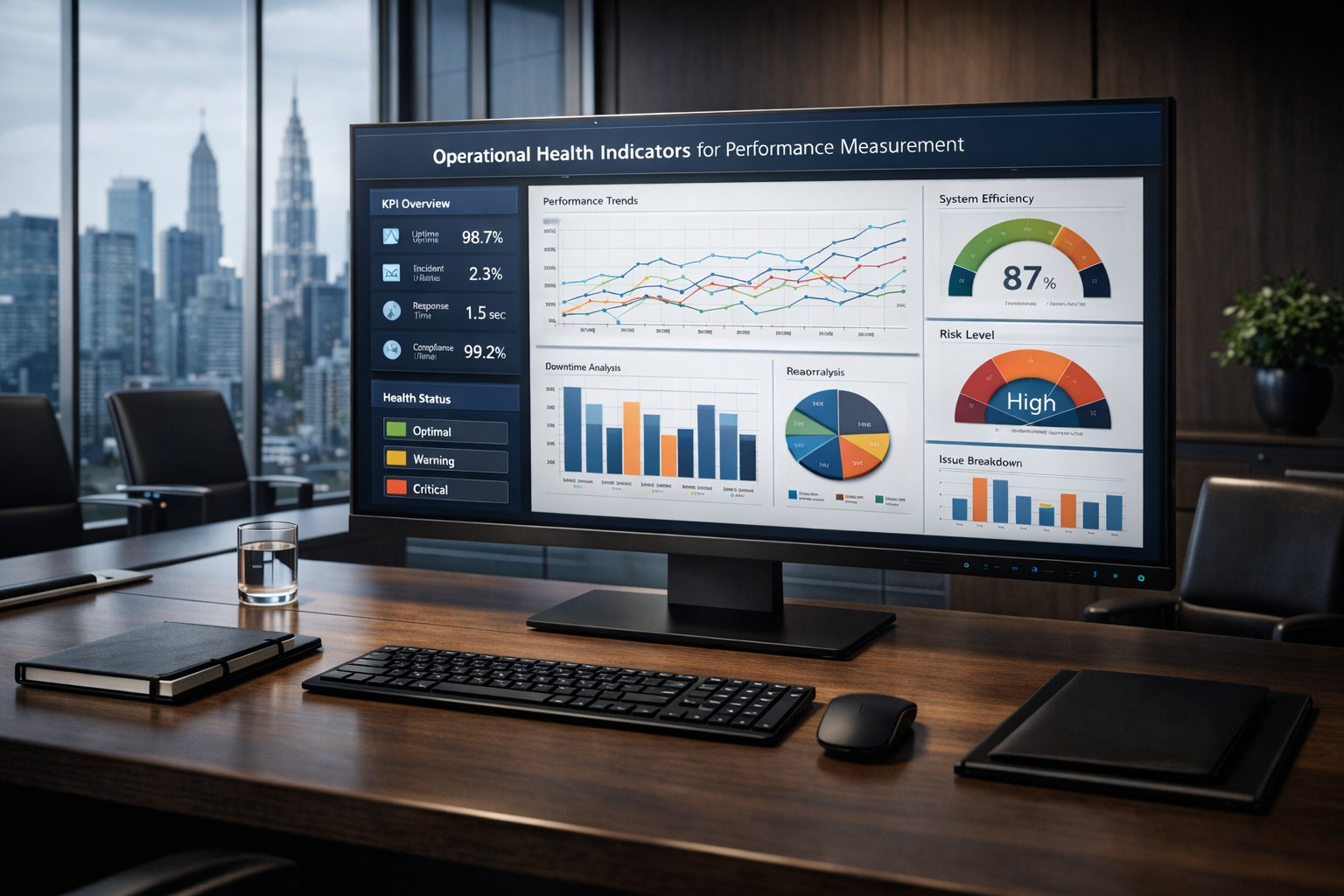
Operational health indicators are essential for organizations that want to maintain efficient, resilient, and scalable operations. However, without structured measurement, many teams rely on fragmented data or anecdotal insights. As a result, operational problems are often discovered too late, after they have already impacted performance.
Therefore, playing a central role in performance measurement. They provide real-time visibility into how systems, processes, and teams are functioning. More importantly, they enable leaders to detect inefficiencies early, optimize workflows, and maintain long-term operational stability.
Understanding Operational Health Indicators
Operational health indicators are metrics that measure the effectiveness, reliability, and efficiency of daily business operations. For a broader industry view, see this operational KPIs guide from Insightsoftware.
Unlike financial metrics, which reflect outcomes, operational indicators reveal how work actually gets done. Consequently, they serve as leading signals for future performance.
Furthermore, supporting three key objectives. First, they help monitor system stability. Second, they identify process bottlenecks. Third, they enable continuous improvement through data-driven insights.
As a result, operational health becomes a foundational layer of performance measurement.
Why Operational Health Indicators Matter?
Many organizations prioritize revenue, growth, and customer metrics. While these are important, they are ultimately dependent on internal operational quality.
In contrast, measuring the underlying mechanisms that drive outcomes. For example, poor system uptime directly impacts customer satisfaction. Likewise, inefficient workflows increase costs and reduce productivity.
Therefore, does matter because they:
- Detect risk before failure occurs
- Reveal inefficiencies hidden in processes
- Support resilience and scalability
- Improve decision-making accuracy
In other words, strong operational health enables sustainable performance.
Core Categories of Operational Health Indicators
Operational health indicators generally fall into five major categories.
1. System Reliability Indicators
System reliability indicators measure the stability and availability of technical infrastructure.
Common examples include:
- System uptime
- Downtime frequency
- Mean time between failures (MTBF)
- Mean time to recovery (MTTR)
As a result, these indicators reveal whether systems can support business demand.
Moreover, high reliability reduces operational risk and prevents cascading failures.
2. Process Efficiency Indicators
Process efficiency indicators measure how effectively workflows convert inputs into outputs.
Key metrics include:
- Cycle time
- Throughput rate
- Process completion rate
- Error frequency
Therefore, these indicators highlight friction, waste, and opportunities for automation.
Additionally, improving efficiency directly reduces operational costs.
3. Resource Utilization Indicators
Resource utilization indicators evaluate how well assets, labor, and infrastructure are used.
Important metrics include:
- Capacity utilization
- Staff workload distribution
- Equipment utilization rate
- Inventory turnover
Consequently, these indicators help optimize staffing, scheduling, and asset investment.
4. Quality and Compliance Indicators
Quality indicators measure the consistency and accuracy of outputs.
Examples include:
- Defect rates
- Rework frequency
- Compliance violations
- Audit success rates
As a result, quality indicators protect brand reputation and regulatory standing.
Furthermore, quality directly influences customer trust and operational credibility.
5. Service Delivery Indicators
Service delivery indicators evaluate how effectively operations meet internal and external expectations.
Common metrics include:
- Response time
- Resolution time
- Service-level agreement (SLA) compliance
- First-contact resolution
Therefore, these indicators reflect how operational performance impacts customer experience.
Operational Health Indicators vs Financial Metrics
Operational indicators differ from financial metrics in purpose and timing.
Financial metrics measure outcomes, such as profit or revenue. In contrast, operational indicators measure conditions that produce outcomes.
For example:
- Financial metric: monthly revenue
- Operational indicator: order processing time
As a result, operational health indicators act as leading indicators, while financial metrics act as lagging indicators.
Therefore, performance measurement systems must integrate both perspectives.
Building an Operational Health Framework
A structured framework ensures that operational health indicators remain relevant and actionable.
Step 1: Align Indicators with Strategic Objectives
Operational metrics must support business goals such as:
- Scalability
- Cost efficiency
- Reliability
- Customer satisfaction
Otherwise, measurement becomes disconnected from strategy.
Step 2: Define Clear Measurement Standards
Each indicator should include:
- A precise definition
- A consistent calculation method
- A reliable data source
- A monitoring frequency
Without standardization, data becomes unreliable.
Step 3: Segment Operational Data
Segmentation reveals hidden insights.
For example, segment by:
- Department
- Region
- Product line
- Customer type
As a result, segmentation improves diagnostic accuracy.
Step 4: Establish Performance Thresholds
Thresholds define acceptable performance ranges.
For instance:
- Acceptable downtime: under 1%
- Target response time: under 30 minutes
Therefore, thresholds convert data into actionable alerts.
Common Mistakes in Operational Health Measurement
Several mistakes weaken operational performance measurement.
First, tracking too many indicators creates noise.
Second, ignoring leading indicators delays intervention.
Third, relying on manual reporting introduces bias.
Finally, measuring without action wastes effort.
Therefore, operational health indicators must be limited, automated, and decision-oriented.
Operational Health and Risk Management
Operational health indicators are also essential for risk management.
Specifically, they help detect:
- System vulnerabilities
- Process breakdowns
- Compliance risks
- Capacity constraints
As a result, organizations can implement preventive controls instead of reactive fixes.
Moreover, operational health indicators support business continuity planning.
The Role of Operational Health in Scalability
Scalability depends on operational maturity.
For example:
- Manual processes do not scale
- Poor monitoring increases failure risk
- Inconsistent quality limits growth
Therefore, operational health indicators reveal whether growth is sustainable.
Additionally, they help determine when to invest in automation, infrastructure, or training.
From Monitoring to Optimization
The goal of operational health indicators is not monitoring alone. Instead, it is optimization.
Indicators should trigger:
- Process redesign
- Technology upgrades
- Resource reallocation
- Training initiatives
In other words, insight must lead to improvement.
Integrating Operational Health into Performance Culture
Operational health indicators are most effective when embedded into organizational culture.
This includes:
- Regular performance reviews
- Transparent dashboards
- Cross-functional accountability
- Continuous improvement mindset
As a result, teams become proactive rather than reactive.
Operational Health and Digital Transformation
Digital transformation increases system complexity. Therefore, operational health indicators become even more critical.
For example:
- Cloud infrastructure requires uptime monitoring
- Automation requires error tracking
- APIs require performance measurement
Consequently, digital operations demand real-time operational visibility.
Conclusion: Operational Health as Strategic Infrastructure
Operational health indicators are not just technical metrics. Instead, they form strategic infrastructure for performance measurement.
Specifically, they provide:
- Early warning systems
- Process visibility
- Risk detection
- Scalability insights
Ultimately, organizations that master operational health move from firefighting to foresight. As a result, they achieve higher efficiency, stronger resilience, and sustainable performance.
In conclusion, operational health indicators transform performance measurement from reactive reporting into proactive operational intelligence.