


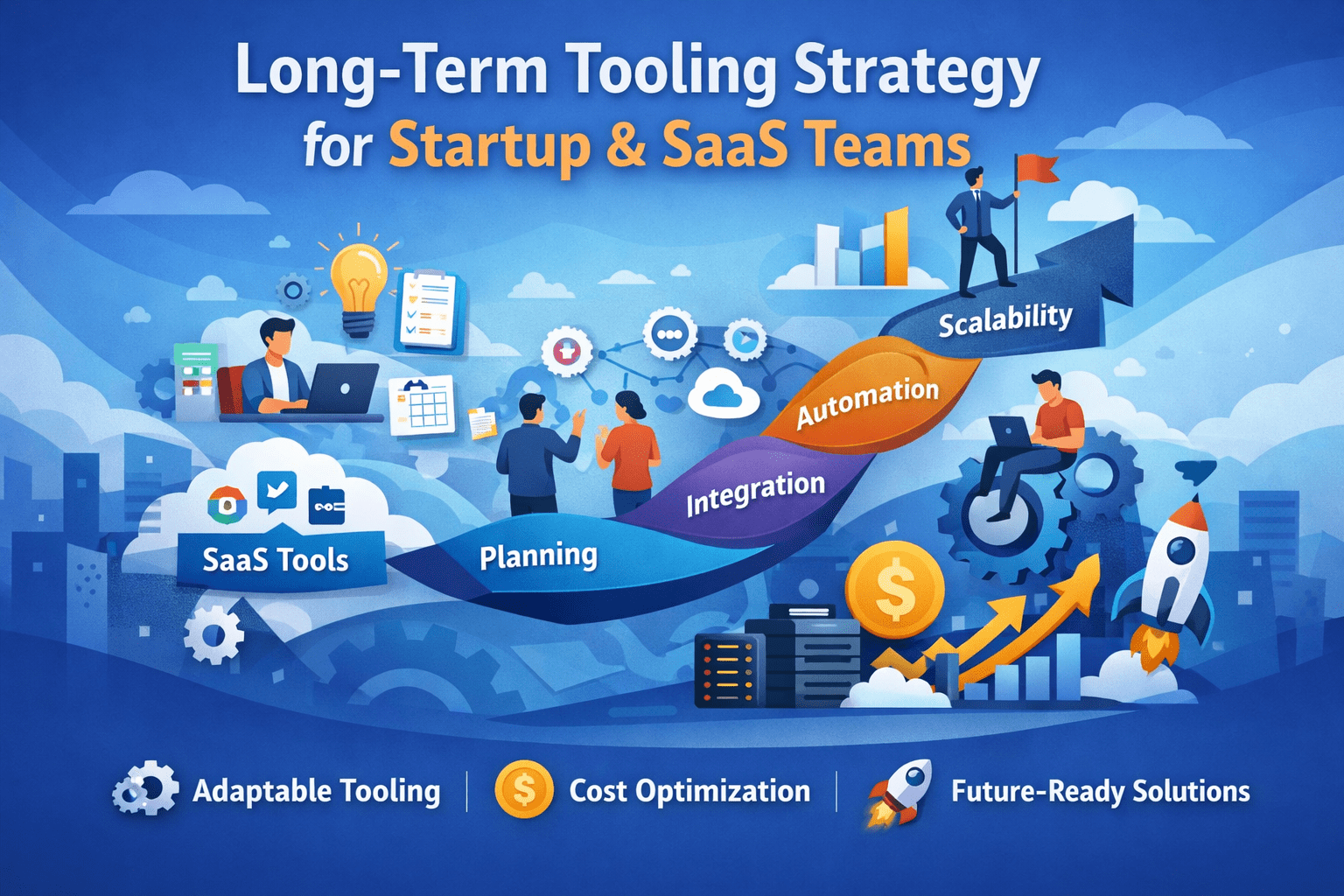
A long-term tooling strategy is essential for startups and SaaS companies that want to scale efficiently without creating operational chaos. While many teams focus on short-term needs when selecting tools, the real competitive advantage comes from choosing, managing, and evolving a tool stack with the future in mind. Without a clear long-term tooling strategy, startups often suffer from tool sprawl, rising costs, poor integrations, and slow execution.
Why a Long-Term Tooling Strategy Matters?
Startups move fast, but growth without direction leads to inefficiency. A long-term tooling strategy ensures that today’s software decisions do not become tomorrow’s bottlenecks.
A well-defined strategy helps teams:
- Avoid constant tool migrations
- Control software costs over time
- Maintain clean, scalable workflows
- Improve team productivity and adoption
- Support long-term business goals
For SaaS companies in particular, internal tools often influence product quality, customer experience, and operational reliability.
Understanding Long-Term Tooling Strategy vs Short-Term Tool Choices
Many startups confuse buying tools with having a strategy. A long-term tooling strategy goes beyond selecting individual platforms—it defines how tools work together over years, not weeks.
Short-term tool choices focus on:
- Immediate needs
- Speed of setup
- Low upfront cost
A long-term tooling strategy focuses on:
- Scalability and flexibility
- Integration and data consistency
- Vendor stability
- Total cost of ownership
Understanding this distinction is the first step toward building a mature software foundation.
Aligning Tooling Strategy With Business Vision
A long-term tooling strategy must align with where the business is going, not just where it is today. Tools should support your product roadmap, go-to-market plans, and organizational structure.
To implement these long-term plans effectively, many teams follow established SaaS integration best practices to choose tools that will remain compatible with future workflows, data formats, and security needs.
Key alignment questions include:
- How fast do we expect to scale?
- Will teams remain small or expand rapidly?
- Do we plan to operate globally?
- How complex will our workflows become?
When tooling decisions reflect business vision, they remain relevant as the company grows.
Core Principles of a Long-Term Tooling Strategy
Successful startups follow a few core principles when developing a long-term tooling strategy.
1. Prioritize Core Competencies
Tools should support—not distract from—your core value proposition. If a function is not central to differentiation, buying a reliable solution is usually better than building one.
2. Design for Integration
Disconnected tools create friction. A long-term tooling strategy favors platforms that integrate well and share data smoothly.
3. Plan for Change
Growth brings new requirements. Tools should be flexible enough to evolve without forcing constant replacements.
4. Optimize for Adoption
The best tool is the one your team actually uses. Ease of use and training matter more than feature depth.
Building a Scalable Tool Stack
A scalable tool stack is the backbone of a long-term tooling strategy. This means choosing platforms that can handle increased usage, complexity, and users without breaking down.
Scalability considerations include:
- Performance under growth
- Predictable pricing models
- Support for automation
- Ability to handle multiple teams or regions
Scalable tools reduce the need for disruptive migrations later.
Managing Cost Over the Long Term
Cost management is a critical but often overlooked is the subscription fees may seem small individually but can grow quickly as teams expand.
Best practices include:
- Tracking total software spend quarterly
- Reviewing unused or overlapping tools
- Evaluating cost vs value delivered
- Planning multi-year cost projections
A strategic approach to cost ensures that tools remain assets, not liabilities.
Governance and Ownership of Tools
As startups grow, unclear ownership leads to tool sprawl. A strong long-term tooling strategy includes governance.
This involves:
- Assigning tool owners
- Defining approval processes for new tools
- Documenting usage standards
- Regularly auditing the tool stack
Governance does not slow teams down—it creates clarity and accountability.
Security and Compliance in Long-Term Planning
Security requirements evolve as startups scale. What works for a five-person team may not be sufficient for a company handling sensitive customer data.
A long-term tooling strategy should account for:
- Access control and permissions
- Data protection and backups
- Compliance requirements as the business grows
- Vendor security practices
Proactive planning reduces risk and builds trust with customers and partners.
Avoiding Tool Sprawl and Technical Debt
Tool sprawl is one of the biggest threats when teams add tools reactively without removing or consolidating existing ones.
To prevent this:
- Review tools regularly
- Eliminate redundancy
- Standardize where possible
- Document approved tools
Reducing sprawl improves efficiency and lowers operational complexity.
Evolving the Tooling Strategy Over Time
A long-term tooling strategy is not static. It must evolve as the company grows, markets change, and technology advances.
Healthy evolution includes:
- Quarterly or annual tool reviews
- Gathering feedback from users
- Monitoring vendor roadmaps
- Testing alternatives before switching
Continuous improvement ensures that your tooling strategy remains aligned with reality.
Measuring the Success
To ensure effectiveness, startups should measure the impact of their tooling strategy.
Useful indicators include:
- Tool adoption rates
- Reduction in manual work
- Improved cycle times
- Cost efficiency over time
- Fewer emergency tool changes
Measurement turns strategy into an actionable, data-driven process.
Common Mistakes to Avoid
Even experienced founders make mistakes when planning. Avoid these pitfalls:
- Choosing tools based on hype
- Over-customizing early
- Ignoring integration needs
- Failing to plan for scale
- Letting teams add tools without oversight
Avoiding these mistakes protects both speed and stability.
A Practical Framework
Startups can simplify decision-making by following a clear framework:
- Define business goals
- Map current and future workflows
- Identify core vs non-core functions
- Choose scalable, integrable tools
- Assign ownership and governance
- Review and refine regularly
This framework keeps tooling decisions consistent and future-focused.
Final Thoughts
A long-term tooling strategy is not about finding perfect tools—it is about building a system that grows with your startup or SaaS business. When tools are chosen intentionally, integrated thoughtfully, and reviewed regularly, they become enablers of speed, clarity, and scale.
By aligning tools with business vision, prioritizing scalability, controlling costs, and avoiding sprawl, startups can create a resilient foundation for long-term success. The companies that scale most effectively are not those with the most tools, but those with the strongest long-term tooling strategy.