


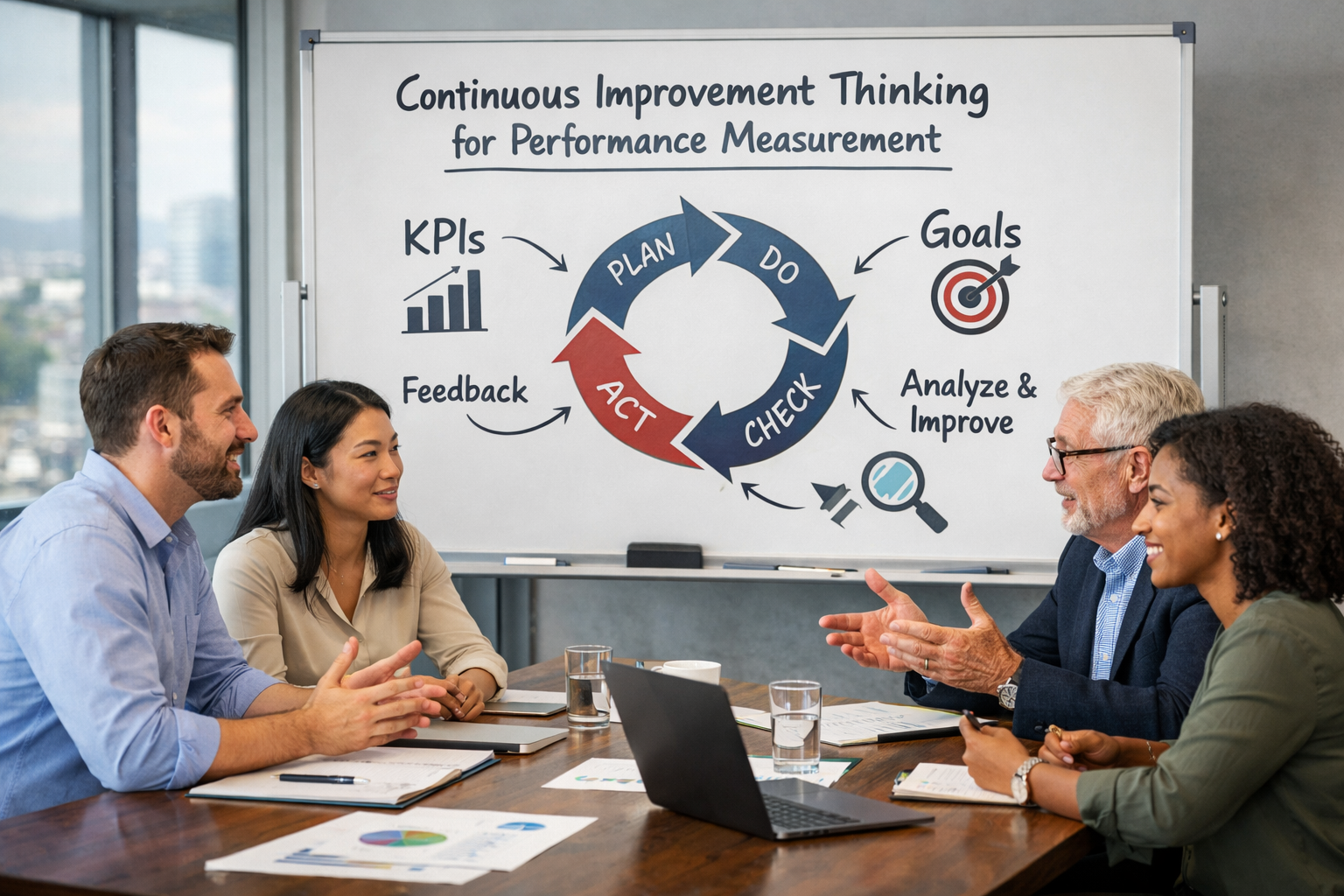
Continuous improvement thinking is a foundational principle in modern performance measurement. Organizations operate in increasingly complex environments where static processes quickly become outdated. Therefore, the ability to continuously assess, adapt, and optimize performance is no longer optional—it is a strategic necessity.
In performance measurement and shifts the focus from periodic evaluation to ongoing learning. Instead of treating metrics as final judgments, organizations use them as signals for refinement. As a result, performance becomes a dynamic system rather than a fixed outcome.
Understanding Continuous Improvement Thinking
Continuous improvement thinking is a mindset and methodology focused on ongoing incremental enhancement. It emphasizes learning from data, experimenting with processes, and refining systems over time.
In performance measurement, this approach means that metrics are not only used to report results but also to guide improvement cycles. Research on performance measurement and continuous improvement systems shows that structured measurement frameworks are directly linked to long-term organizational resilience.
Unlike traditional improvement models, which rely on large, infrequent change initiatives, continuous improvement promotes small, consistent adjustments. Consequently, organizations reduce risk while increasing adaptability.
In performance measurement, this approach means that metrics are not only used to report results but also to guide improvement cycles. Therefore, measurement becomes a tool for action rather than observation.
Why Continuous Improvement Thinking Matters in Performance Measurement?
Many organizations measure performance only to evaluate success or failure. However, this approach limits the value of data. Instead, continuous improvement thinking transforms performance measurement into a feedback system.
Specifically, continuous improvement enables organizations to:
- Detect inefficiencies early
- Adapt to market changes
- Improve quality and reliability
- Increase employee engagement
- Enhance long-term competitiveness
As a result, performance measurement becomes proactive instead of reactive.
Core Principles of Continuous Improvement Thinking
Several principles define continuous improvement thinking.
1. Systems Perspective
Performance must be viewed as an interconnected system. Therefore, changes in one area influence outcomes in others.
2. Data-Driven Learning
Decisions should be based on evidence rather than intuition. Consequently, metrics guide experimentation and validation.
3. Iterative Progress
Improvement occurs through cycles of testing, learning, and refining. As a result, progress becomes sustainable.
4. Employee Involvement
Continuous improvement requires participation at all levels. Therefore, frontline insights become essential inputs.
Continuous Improvement vs Traditional Performance Measurement
Traditional performance measurement focuses on periodic reporting. Typically, organizations review metrics monthly or quarterly, then implement large corrective actions.
In contrast, continuous improvement thinking encourages real-time monitoring and small adjustments.
| Traditional Model | Continuous Improvement Model |
|---|---|
| Periodic review | Ongoing evaluation |
| Large changes | Incremental changes |
| Reactive actions | Proactive learning |
| Static benchmarks | Adaptive targets |
Therefore, continuous improvement creates a more resilient and responsive measurement system.
The Continuous Improvement Cycle
Performance measurement becomes most effective when embedded in a continuous improvement cycle.
Step 1: Measure
Collect relevant performance data using standardized metrics.
Step 2: Analyze
Identify patterns, anomalies, and gaps in performance.
Step 3: Improve
Design and implement small process improvements.
Step 4: Validate
Measure outcomes to confirm effectiveness.
Step 5: Repeat
Refine further based on new insights.
As a result, improvement becomes systematic and repeatable.
Key Metrics for Continuous Improvement Thinking
Not all metrics support continuous improvement equally. Therefore, organizations should prioritize leading indicators that reveal process behavior.
Common examples include:
- Cycle time
- Error rate
- First-pass yield
- Customer response time
- Employee engagement score
Unlike outcome metrics, these indicators highlight improvement opportunities early.
Continuous Improvement Thinking Across Business Functions
Operations
In operations, continuous improvement reduces waste, increases throughput, and improves quality.
For example:
- Monitoring defect rates enables process redesign.
- Tracking equipment downtime supports preventive maintenance.
Therefore, operational performance becomes more predictable and efficient.
Customer Experience
Continuous improvement improves customer satisfaction through ongoing feedback analysis.
For instance:
- Survey data identifies pain points.
- Behavioral metrics reveal usability issues.
As a result, organizations adapt services based on real customer needs.
Human Resources
In HR, continuous improvement enhances employee performance and engagement.
Examples include:
- Monitoring training effectiveness.
- Tracking turnover and satisfaction.
- Refining onboarding processes.
Consequently, workforce capability increases over time.
Product and Innovation
Continuous improvement thinking supports innovation by enabling rapid experimentation.
For example:
- Feature usage metrics guide development priorities.
- User feedback drives iterative design.
Therefore, products evolve based on evidence rather than assumptions.
Building a Performance Measurement System for Continuous Improvement
To support continuous improvement thinking, performance measurement systems must be intentionally designed.
Step 1: Define Improvement Objectives
First, clarify what needs to improve: quality, speed, cost, or experience.
Otherwise, metrics become unfocused.
Step 2: Select Actionable Metrics
Choose metrics that teams can influence directly. Avoid metrics that are too abstract or delayed.
For example:
- Prefer cycle time over quarterly revenue.
- Prefer process error rate over annual audit score.
Therefore, measurement supports immediate action.
Step 3: Establish Feedback Loops
Ensure that data flows quickly to decision-makers.
This includes:
- Real-time dashboards
- Regular performance reviews
- Cross-functional communication
As a result, insights lead to timely improvement.
Step 4: Empower Teams
Continuous improvement requires decentralized decision-making.
Therefore:
- Teams should own their metrics.
- Leaders should support experimentation.
- Failures should be treated as learning opportunities.
Consequently, improvement becomes cultural rather than procedural.
Common Mistakes in Continuous Improvement Measurement
Several mistakes weaken continuous improvement efforts.
First, focusing only on outcomes ignores process behavior.
Second, using too many metrics creates confusion.
Third, delaying feedback slows learning.
Finally, punishing failure discourages experimentation.
Therefore, measurement systems must support learning, not control.
The Role of Technology in Continuous Improvement Thinking
Technology plays a critical role in enabling continuous improvement.
For example:
- Analytics platforms automate data collection.
- Dashboards visualize trends in real time.
- AI tools identify patterns and anomalies.
- Workflow systems support rapid iteration.
Consequently, performance measurement becomes faster, deeper, and more scalable.
Continuous Improvement and Organizational Culture
Continuous improvement thinking cannot succeed without cultural alignment.
Organizations must promote:
- Transparency in data
- Psychological safety
- Learning over blame
- Collaboration over silos
As a result, employees become active participants in performance improvement.
Continuous Improvement Thinking in Strategic Decision-Making
Strategic decisions benefit from continuous improvement data.
Quantitative metrics reveal trends.
Qualitative feedback explains context.
Together, they support:
- Investment prioritization
- Risk management
- Process redesign
- Market adaptation
Therefore, strategy becomes evidence-driven rather than opinion-based.
From Measurement to Excellence
The ultimate purpose of continuous improvement thinking is not measurement—it is excellence.
Metrics should inspire:
- Better processes
- Better products
- Better services
- Better employee experiences
In other words, data should drive transformation.
Conclusion: Continuous Improvement as Performance Infrastructure
Continuous improvement thinking is not a project. It is a way of operating.
In performance measurement, it transforms metrics from static reports into strategic learning systems. As a result, organizations gain adaptability, resilience, and sustained competitiveness.
Ultimately, organizations that embrace continuous improvement thinking move beyond short-term performance tracking. Instead, they build long-term capability for learning, optimization, and growth.