


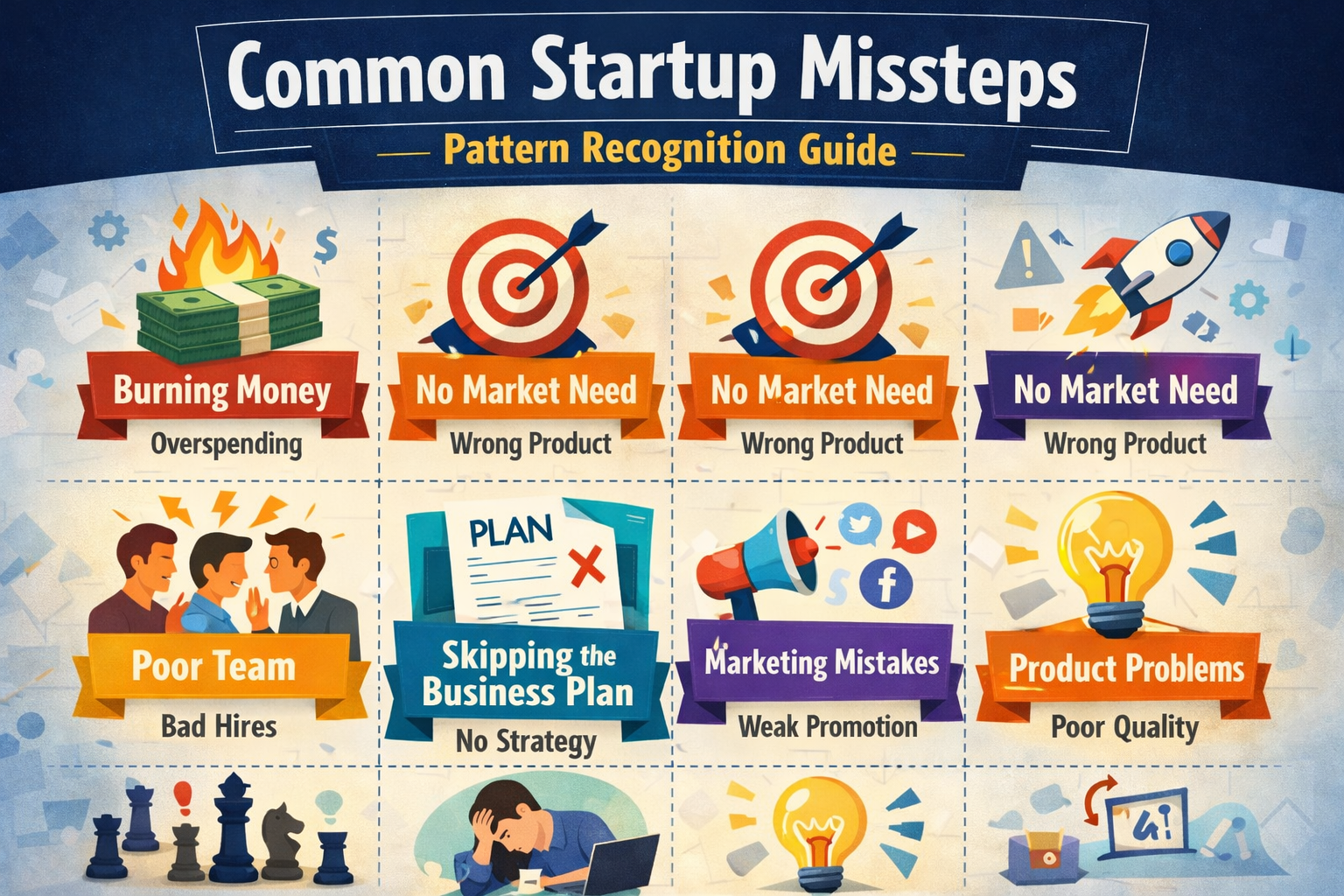
Startups are often portrayed as fast-moving, innovative, and disruptive. While this image is partly true, the reality is that most startups fail. Research across industries consistently shows that failure is rarely caused by a single catastrophic decision. Instead, it results from a series of predictable, recurring mistakes. Understanding common startup missteps requires more than experience—it requires pattern recognition and insight.
Pattern recognition enables founders and investors to identify recurring failure structures across different companies, markets, and stages. Insight transforms these observations into strategic learning. Together, they provide a practical framework for avoiding costly errors and improving the probability of success.
This article explores the most frequent startup missteps, the patterns behind them, and how entrepreneurs can use structured learning to build stronger, more resilient companies.
Why Pattern Recognition Matters for Startups?
Most founders learn through personal experience, which is expensive and slow. Pattern recognition compresses learning by drawing lessons from hundreds or thousands of cases instead of one.
Instead of asking:
- What went wrong with my startup?
Pattern recognition asks:
- What keeps going wrong across many startups?
This shift from anecdotal thinking to systemic insight is critical for strategic decision-making.
Misstep 1: Building Without Real Market Demand
The most common startup failure pattern is solving a problem that does not exist or is not painful enough.
Observable Signs:
- Low customer engagement
- Difficulty converting early users
- Heavy marketing required for minimal traction
- Product used occasionally, not habitually
Insight:
Pattern recognition shows that founders often fall in love with solutions instead of problems. They validate ideas with opinions instead of behavior. Successful startups test willingness to pay, not just interest.
Misstep 2: Premature Scaling
Many startups fail by growing too fast before establishing a stable business model.
Observable Signs:
- Hiring aggressively before product-market fit
- Spending heavily on marketing without retention
- Expanding into new markets prematurely
Insight:
Patterns show that premature scaling amplifies weaknesses. It increases burn rate, operational complexity, and internal chaos before the core system is proven.
Misstep 3: Poor Founder-Market Fit
Another recurring misstep is when founders operate outside their domain of expertise.
Observable Signs:
- Misunderstanding customer needs
- Inefficient sales cycles
- Reliance on external consultants
- Slow learning curves
Insight:
Pattern recognition reveals that founder-market fit matters as much as product-market fit. Teams that deeply understand the industry make better assumptions, faster decisions, and more credible offerings.
Misstep 4: Weak Business Models
Many startups focus on user growth without a clear path to profitability.
Observable Signs:
- No defined revenue model
- High acquisition cost
- Low lifetime value
- Constant pivoting
Insight:
Successful startups design monetization early—even if they delay charging. Pattern recognition shows that business model clarity shapes product design, customer selection, and operational strategy.
Misstep 5: Ignoring Customer Feedback
Founders often believe they know better than users.
Observable Signs:
- Feature development disconnected from user requests
- Negative reviews ignored
- Support tickets dismissed
- Low repeat usage
Insight:
Patterns show that startups fail when they treat feedback as noise instead of signal. High-performing teams build continuous discovery systems that integrate customer insight into every development cycle.
Misstep 6: Overengineering and Feature Bloat
Another classic misstep is building overly complex products.
Observable Signs:
- Long development cycles
- Large codebases
- Confusing interfaces
- Low adoption of most features
Insight:
Pattern recognition reveals that simplicity scales better than complexity. Successful startups optimize for learning speed, not technical perfection.
Misstep 7: Poor Team Dynamics
Startups are fragile systems. Internal conflict can destroy momentum faster than market competition.
Observable Signs:
- Role confusion
- Founder disputes
- Low morale
- Communication breakdowns
Insight:
Patterns show that interpersonal issues are a leading cause of early-stage failure. Psychological safety, role clarity, and aligned incentives are more important than technical talent.
Misstep 8: Cash Flow Mismanagement
Many startups die not because they fail strategically, but because they run out of money.
Observable Signs:
- No financial forecasting
- High fixed costs
- Overreliance on funding rounds
- Lack of runway visibility
Insight:
Pattern recognition shows that cash flow discipline is a survival skill. Startups that treat cash as a strategic resource, not just fuel, survive longer and negotiate better.
Misstep 9: Overconfidence and Cognitive Bias
Founders are especially vulnerable to cognitive distortions.
Common Biases:
- Optimism bias
- Confirmation bias
- Sunk cost fallacy
- Survivorship bias
Insight:
Pattern recognition helps neutralize these biases by grounding decisions in data and external reference points instead of internal beliefs.
Misstep 10: Lack of Execution Discipline
Ideas are cheap. Execution is hard.
Observable Signs:
- Missed deadlines
- Constant pivots
- Unclear priorities
- Reactive decision-making
Insight:
Patterns show that successful startups use structured execution systems:
- Weekly planning
- Clear KPIs
- Accountability mechanisms
- Regular retrospectives
Turning Failure Patterns into Strategic Advantage
Pattern recognition is not about avoiding risk—it is about managing risk intelligently.
Startups can operationalize insight by:
1. Building Learning Systems
- Post-mortems
- Experiment tracking
- Hypothesis testing
2. Using External Benchmarks
- Compare metrics with industry standards
- Study failed startups, not just unicorns
3. Designing for Adaptability
- Modular product architecture
- Flexible pricing
- Lean operational models
Case Pattern: Why “Promising” Startups Still Fail
Many failed startups had:
- Funding
- Media attention
- Strong teams
But collapsed due to:
- Misaligned incentives
- Poor execution
- Ignored feedback
- Weak financial discipline
Pattern recognition reveals that failure is rarely dramatic—it is cumulative.
The Strategic Role of Insight for Founders
Founders who develop pattern recognition gain:
- Faster learning curves
- Better risk assessment
- Improved investor communication
- Stronger strategic intuition
They stop asking “What should I do?” and start asking “What usually happens next?”
Building a Pattern-Aware Startup Culture
To reduce failure risk, startups should embed pattern recognition into culture:
Leadership Level:
- Encourage transparency
- Reward learning, not just results
- Share failure openly
Team Level:
- Document assumptions
- Test continuously
- Review decisions regularly
System Level:
- Use dashboards
- Track leading indicators
- Maintain institutional memory
Conclusion: Why Most Startup Failures Are Predictable?
Most startup failures are not surprising—they are structurally predictable. The same mistakes repeat across markets, technologies, and generations of founders.
Pattern recognition and insight transform experience into intelligence. They allow entrepreneurs to see beyond their own narratives and learn from the collective history of innovation.
Understanding common startup missteps is not about avoiding failure entirely. It is about failing earlier, cheaper, and smarter—while building systems that increase the odds of long-term success.
In the startup world, vision creates possibility. But pattern recognition creates sustainability.