
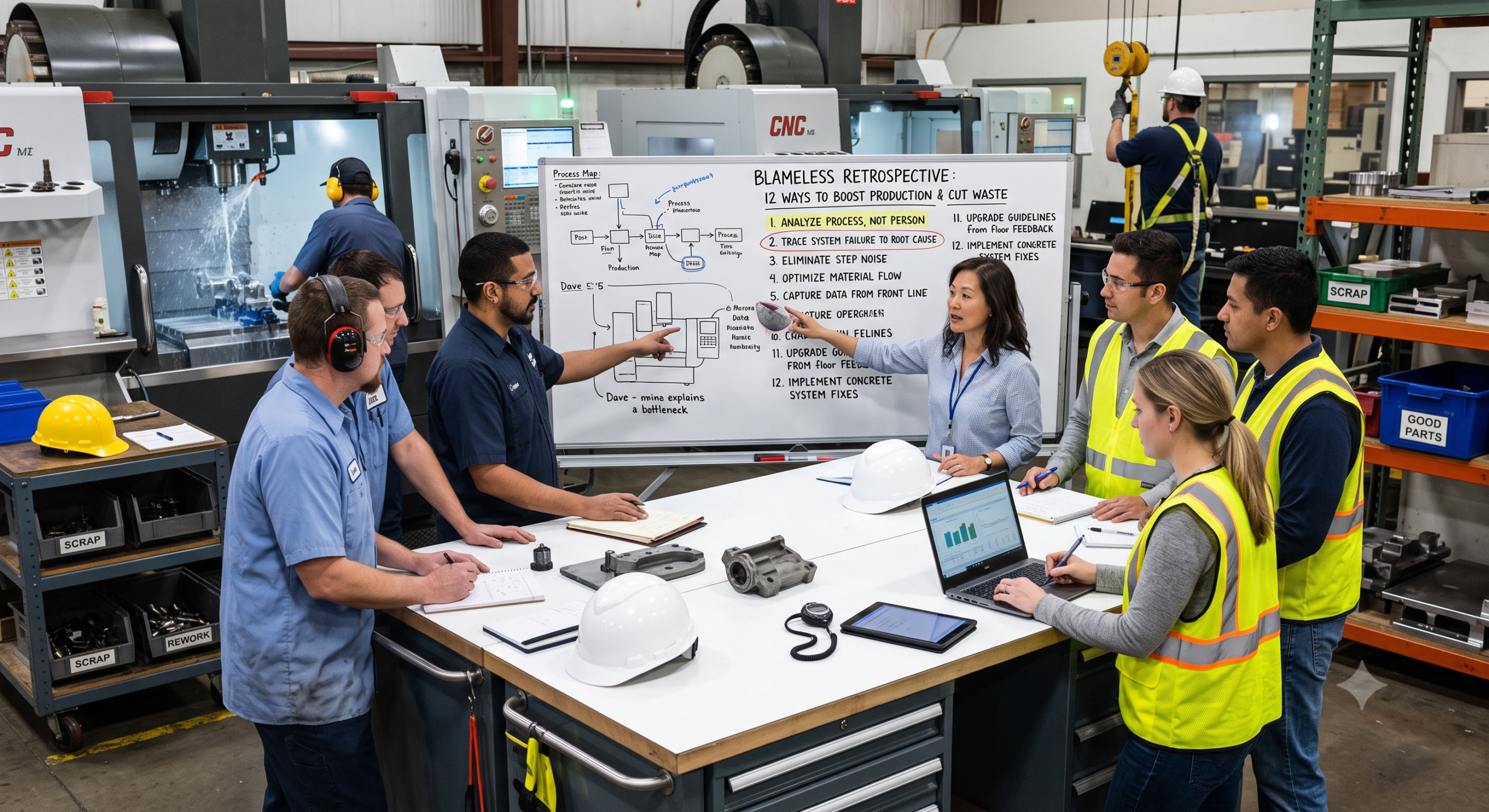
12 Simple Ways Blameless Retrospectives Boost Production and Cut Waste

When something goes wrong on the production floor—whether a machine grinds to a halt or a batch of product comes out ruined—the first reaction in many companies is to look for someone to blame. Managers want to know who pushed the wrong button, who skipped a step, or who was on duty when the breakdown happened. But pointing fingers is a terrible way to run a business. It never fixes the underlying problem, hurts morale, and scares people. If you want to stop this cycle, protect your profit margins, and maximize daily throughput, you must switch your approach and run Blameless Retrospectives immediately. When employees fear getting fired or written up, they start hiding small mistakes, delaying bad news, and keeping quiet about broken processes.
From my perspective as Chief Operating Officer, blame is a massive bottleneck. It slows down your operations, drags out your timelines, and sends your scrap rates through the roof. If you want to run a highly profitable operation, you must change how you look at mistakes. A breakdown or a quality issue does not represent a personal failure by an employee; it provides valuable data telling you that your system has a flaw. The single fastest way to unlock hidden capacity and protect your profit margins is to use Blameless Retrospectives.
When you stop punishing people for honest mistakes, you completely change how your company learns. Employees stop hiding problems and start helping you fix them. This guide breaks down exactly how to use Blameless Retrospectives to wipe out waste, speed up production, and build a smoother, more profitable operation.
Why a Blameless Culture Changes Your Production Metrics
To understand why a blameless culture matters, look at the core numbers that define your day-to-day success: throughput (how much good product you ship), cycle time (how long it takes to make that product), and scrap rate (how much material you throw in the trash).
       [ Blameless Culture ]
                 │
                 ▼
     [ Fast, Honest Reporting ]
                 │
      ┌──────────┴──────────┐
      ▼                     ▼
[Faster Cycle Times]   [Way Less Scrap]
      │                     │
      └──────────┬──────────┘
                 ▼
       [ Higher Total Output ]
In a culture of blame, people hide mistakes. If a machine starts acting up, an operator might spend hours trying to fix it themselves to avoid getting in trouble. By the time they finally ask for help, hours of production time disappear, and the machine fills the factory floor with a mountain of defective, unuseable parts.
When you introduce Blameless Retrospectives, the moment something feels off, the operator stops the line and calls for backup. They know management cares about fixing the machine, not punishing the person. This quick action cuts down on downtime, stops bad parts from leaving the station, and keeps production moving smoothly.
12 Strategies to Improve Efficiency and Cut Down on Waste
1. Separate the Person from the System Flaw
The first rule of Blameless Retrospectives is simple: always assume your employees came to work wanting to do a good job. If an operator accidentally picks the wrong setting on a piece of equipment, do not focus on their temporary lack of attention. Instead, look at the equipment. Why did the machine let them select a setting that would ruin the batch? Why did the software lack a simple pop-up warning, or a barcode scanner that matches the product to the right setting automatically? Humans get tired and distracted; a good system expects those moments and protects the business anyway.
2. Don’t Just Blame the Person Closest to the Mistake
Managers often blame the person who was standing right next to a machine when it broke. If a part snaps because it ran out of oil, traditional supervisors blame the worker on that shift for missing the fluid levels. Our Blameless Retrospectives look deeper. We often find that the maintenance software failed to send out a reminder, or that the purchasing team bought a cheaper, lower-quality oil to save a few bucks. Look past the immediate trigger to find the root cause, so you can fix it everywhere.
3. Drop Personal Pronouns When Solving Problems
When your team sits down to figure out why a line went down, ban words like “he,” “she,” and “you.” Instead of asking why she skipped the secondary check, ask why the workspace layout separates the secondary check from the main assembly line. Instead of asking why you ran the line too fast, ask why the control panel allows speeds that cause material jams. This simple shift in language stops people from getting defensive and gets everyone focused on fixing the setup during Blameless Retrospectives.
4. Write Your Reports in Simple, Clean Digital Formats
The lessons you learn during a review should never get lost in a long email thread or a messy document. We format all our post-incident reports using simple, structured text files with clear headings. This makes it easy for teams at our other plants—and even our digital data tools—to scan old reports, spot trends, and see if a specific type of machine fails the same way across different facilities.
---
incident_id: 2026-MFG-089
machine_type: CNC_Precision_Mill
main_issue: Long_Cycle_Time
root_cause: Software_Error
---
5. Boost First-Pass Yield by Watching Material Inflow
First-pass yield means making a product perfectly the first time without having to fix it later. When our yield numbers drop, we do not tell our workers to be more careful. We inspect the incoming materials. Often, we find that a supplier shipped components that deviate just a fraction of a millimeter, forcing our workers to struggle during assembly. Fixing this at the source keeps your scrap rate low and your lines moving fast.
6. Speed Up Production by Cutting Out Wait Time
When production slows down, the worst thing a manager can do is yell at people to work faster. Rushing leads to injury and mistakes. Instead, look at the gaps in your process. Map out the entire journey of a product and find where it sits idle. You will often find administrative logjams, like a worker waiting forty-five minutes for a supervisor to sign a piece of paper before they can move a pallet. Automate those handoffs to save time safely.
7. Upgrade Your Maintenance Schedules Using Machine Data
Fixing machines on a rigid calendar schedule—like changing parts every six months regardless of use—is outdated. We use data from past breakdowns to set up better alerts. By looking at the exact temperature spikes or vibration changes that preceded a mechanical failure in the past, we can program sensors to warn our maintenance crew before a breakdown occurs, saving hours of downtime.
8. Stop Throwing Money Away on Material Waste
Scrap material represents pure profit thrown into the garbage. When a line starts producing too much waste, hold a quick review to find out exactly where the machinery ruins the parts. You might discover that a robotic arm grips the parts just a little too hard during high-speed transfers, or that a pneumatic valve fires a millisecond late. A quick adjustment to the automation stops the damage and saves money immediately.
9. Share What You Learn Across Every Shift and Plant
One of the biggest mistakes a company can make is letting its shifts operate like isolated islands. If the night shift figures out a great way to prevent a machine jam, that knowledge needs to reach the day shift and your other factories. Keep an open, simple digital library of what went wrong and how the team fixed it, so a lesson learned in Indiana protects your operations in Texas the next morning.
10. Give Your Workers Peace of Mind to Unlock Speed
People cannot work efficiently if they constantly walk on eggshells. When an operator knows they will face public shaming if a line stops, they will run the equipment as slowly as possible to avoid any risk. By creating a safe environment built on Blameless Retrospectives, your team feels comfortable running machines at their optimal, engineered speeds, unlocking huge boosts in your total output.
11. Fix Your Instruction Manuals with Feedback from the Floor
When corporate engineers write instruction manuals in a vacuum, they rarely spend time on the factory floor. As a result, they often produce confusing guidelines that workers cannot follow under real production pressures. Use your Blameless Retrospectives to ask your operators where the official manuals fail them. Let your frontline team help rewrite the guidelines so they stay practical, accurate, and easy to follow.
12. Focus on Real Actions, Not Vague Promises
A review achieves nothing if it ends with a vague promise like “everyone needs to try harder.” Your Blameless Retrospectives should always end with concrete, measurable changes and a clear deadline. Instead of telling people to watch a gauge more closely, install an automatic shutoff valve that triggers if the pressure goes too high. Change the physical environment so the mistake becomes impossible to repeat.
The Real Numbers: Before and After Blameless Reviews
Here is a quick look at how the numbers change when a company ditches a culture of blame and embraces an open, system-focused approach.
| Key Performance Area | The Old Blame Culture | The New Blameless Culture | The Bottom-Line Result |
| Time to Report a Problem | 142 Minutes (Workers tried to hide it) | 11 Minutes (Immediate call for help) | 92% faster response, stopping defects early |
| Total Production Time | 48.5 Hours (Slowed down by rework) | 31.2 Hours (Clean, uninterrupted runs) | 35.6% faster delivery to your customers |
| Average Scrap Rate | 4.82% of all materials wasted | 1.15% of all materials wasted | 76.1% drop in money spent on wasted supply |
| Unexpected Downtime | 74.3 Hours per Month | 18.1 Hours per Month | 75.6% more time available to make products |
Frequently Asked Questions
If no one gets blamed, how do you hold people accountable?
Accountability does not mean finding a scapegoat to punish. In a culture that relies on Blameless Retrospectives, accountability falls on managers and engineers to fix the underlying system. When an employee makes a mistake, the team must figure out why the system allowed that mistake to happen and build a safeguard against it. True negligence or breaking safety rules on purpose remains a disciplinary issue, but we treat honest mistakes as opportunities to build a stronger system.
How do you keep these review meetings from turning into gripe sessions?
To keep meetings short and productive, anchor them strictly to data. Start the meeting by looking at the hard facts: times, sensor readings, and production logs. Do not allow personal opinions or complaints about other teams. Focus on a clear timeline of events and ask direct questions: when did the numbers start to drift, what alerts went off, and what can we change in our machinery or software to keep it from happening again?
How quickly should you hold a review after an incident?
You should hold a review within twenty-four to forty-eight hours after the team resolves the issue. Human memory fades incredibly fast. If you wait a week, people will forget the minor details—like a strange sound the machine made or a subtle change in room temperature—that could be the key to finding the real root cause.
Helpful Resources for Further Reading
To learn more about how top organizations run blameless operations and optimize their efficiency, check out these helpful guides:
-
Google SRE Postmortem Culture Guide: Learn how top engineering and technology operations build reliable systems by focusing on blameless reviews. Check out their official strategies on Google SRE Culture.
-
The Atlassian Team Playbook: A practical guide packed with simple templates for running root-cause reviews and using the “Five Whys” method without pointing fingers. Read more at the Atlassian Incident Management Guide.
-
The DevOps Institute Resource Center: A collection of case studies showing how safe, open workplaces reduce errors and cut down production times in complex environments. Read their latest research at DevOps Institute Insights.