


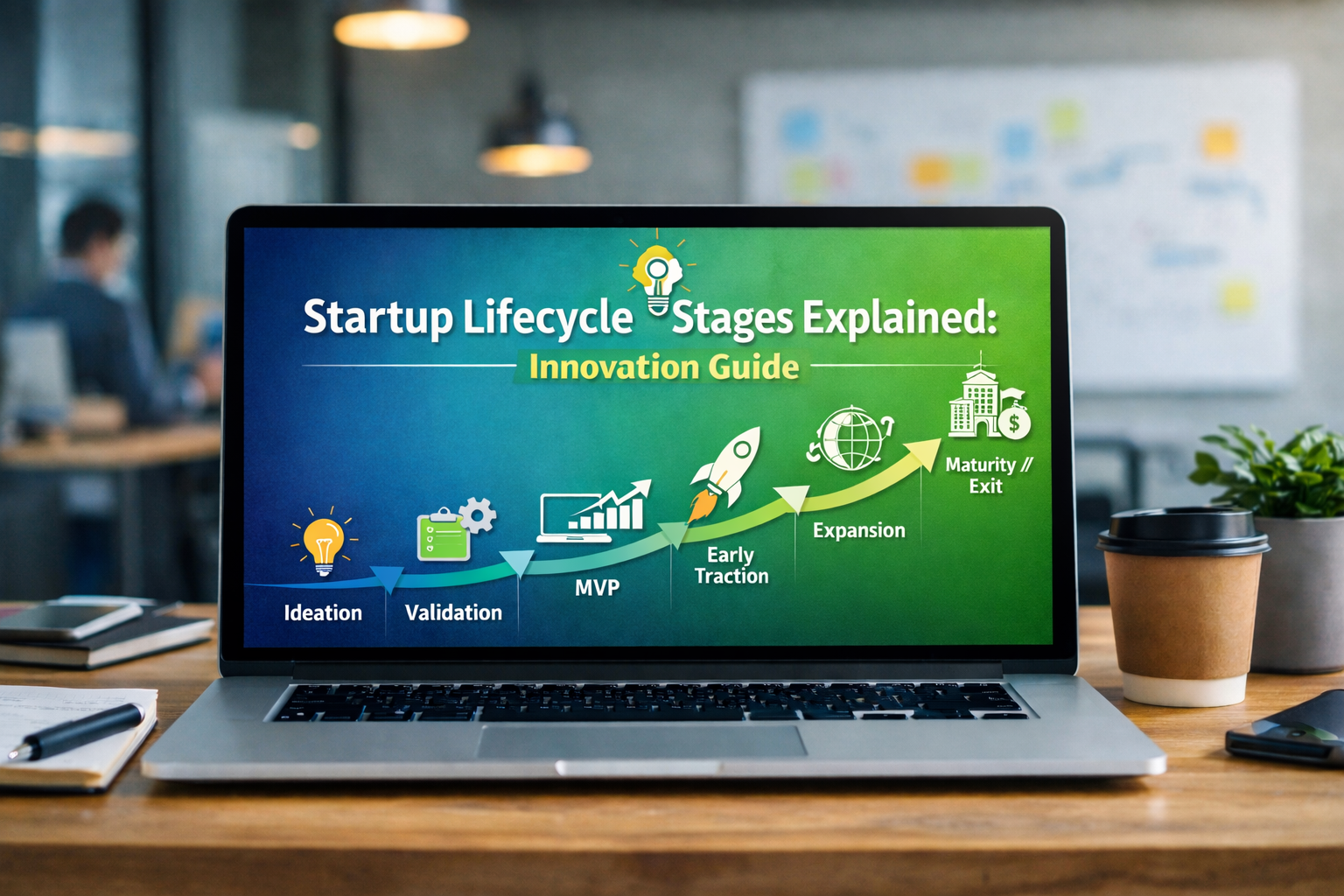
Understanding Startup Lifecycle Stages Explained is essential for founders, investors, and innovation leaders who want to build scalable, technology-driven companies. Although every startup journey looks different, most ventures follow predictable stages. Therefore, recognizing these phases allows entrepreneurs to reduce risk, allocate resources wisely, and innovate strategically.
In this guide, we break down each stage in detail while highlighting the technical and innovation priorities that define startup success.
What Is the Startup Lifecycle?
The startup lifecycle refers to the structured progression a company follows from idea to maturity or exit. While timelines vary significantly, the underlying development pattern remains consistent. As a result, founders who understand these patterns make smarter strategic decisions.
Generally, startups move through the following phases:
- Ideation
- Validation
- MVP Development
- Early Traction
- Growth
- Expansion
- Maturity or Exit
Now, let’s explore how Startup Lifecycle Stages Explained applies to each phase.
1. Ideation Stage: Defining the Opportunity
At the beginning, everything starts with a problem. Instead of building immediately, successful founders first analyze market gaps. Consequently, they focus on identifying pain points rather than rushing into product development.
During this phase, entrepreneurs typically:
- Conduct market research
- Interview potential customers
- Analyze competitors
- Develop clear value propositions
Moreover, innovation at this stage remains conceptual. Rather than writing code, teams validate assumptions. For instance, they may launch landing pages or run small digital experiments. As a result, they gather insights before committing significant resources.
Without proper ideation discipline, startups often fail before they even begin.
2. Validation Stage: Testing Market Demand
Once an idea shows promise, the next logical step is validation. At this point, founders must confirm that real users are willing to pay for the solution.
Therefore, startups often deploy:
- Beta programs
- Pre-orders
- Pilot testing
- Waitlists
- A/B marketing campaigns
Instead of building full-scale systems, teams use prototypes and no-code tools. Consequently, development remains lean and agile.
Data becomes critical during this stage. In addition, analytics platforms, user tracking tools, and customer feedback loops provide measurable evidence. If traction appears weak, founders must pivot quickly. However, if strong signals emerge, development can accelerate.
Thus, validation represents one of the most decisive moments in Startup Lifecycle Stages Explained.
3. MVP Stage: Building the Core Solution
After validation confirms demand, startups move into MVP development. At this stage, execution becomes the priority.
An MVP includes only essential features needed to solve the core problem. In contrast to fully developed products, MVPs avoid unnecessary complexity. Therefore, teams conserve both time and capital.
From a technical perspective, founders should prioritize:
- Lean system architecture
- Scalable cloud infrastructure
- Modular code structures
- Continuous integration pipelines
Furthermore, early technical decisions influence long-term scalability. If architecture lacks flexibility, future expansion becomes difficult. Consequently, engineering discipline must align with growth vision.
Through iterative releases and user feedback, the product gradually improves. As a result, innovation shifts from theoretical to practical.
4. Early Traction Stage: Achieving Product-Market Fit
Once users actively engage with the product, early traction emerges. However, traction alone does not guarantee sustainability. Instead, startups must confirm product-market fit.
Indicators typically include:
- Increasing user retention
- Consistent revenue growth
- Strong customer referrals
- High engagement metrics
At this stage, operational systems require strengthening. Therefore, startups implement:
- CRM platforms
- Performance optimization tools
- Enhanced cybersecurity protocols
- Automated onboarding systems
Additionally, data analytics drives product refinement. Rather than guessing, founders rely on measurable insights. Consequently, feature updates become evidence-based.
Within Startup Lifecycle Stages Explained, this phase marks the transition from survival to momentum.
5. Growth Stage: Scaling Infrastructure and Teams
After product-market fit stabilizes, startups shift toward growth. At this point, expansion becomes deliberate rather than experimental.
To support scaling, organizations must:
- Expand talent acquisition
- Improve operational workflows
- Enhance customer acquisition systems
- Diversify revenue streams
Technologically, scalability becomes essential. Therefore, companies often adopt:
- Microservices architecture
- Advanced cloud solutions
- Automated marketing platforms
- Business intelligence dashboards
Moreover, process optimization gains importance. As teams grow, structured workflows prevent inefficiencies. Consequently, innovation expands beyond product features to include organizational design.
Growth demands discipline. However, it also requires continuous experimentation.
6. Expansion Stage: Entering New Markets
Once the startup achieves stable growth, expansion becomes the next objective. Unlike early growth, expansion involves diversification.
For example, companies may:
- Enter new geographic regions
- Launch complementary products
- Form strategic partnerships
- Target enterprise clients
Because expansion increases complexity, technology must evolve accordingly. Thus, startups integrate:
- Localization frameworks
- API ecosystems
- Enterprise-grade security compliance
- Advanced DevOps practices
In addition, artificial intelligence and predictive analytics often enhance strategic decision-making. As a result, expansion becomes data-informed rather than speculative.
Understanding Startup Lifecycle Stages Explained ensures that expansion occurs at the right time—not prematurely.
7. Maturity or Exit Stage: Strategic Reinvention
Eventually, startups reach maturity. At this stage, leadership must decide whether to scale independently or pursue exit opportunities. You can see a broader breakdown of how tech companies evolve from seed to acquisition in this detailed analysis of startup growth from seed to exit.
Common exit paths include:
- Acquisition
- Merger
- IPO
- Private equity investment
Meanwhile, operational stability becomes critical. Therefore, mature startups strengthen:
- Compliance frameworks
- Financial reporting systems
- Cybersecurity defenses
- Governance structures
Although growth may stabilize, innovation must not decline. Instead, companies focus on continuous improvement and ecosystem expansion. Consequently, reinvention prevents stagnation.
Innovation Across All Startup Stages
Innovation does not belong to a single phase. Instead, it evolves throughout the lifecycle.
- During ideation, innovation centers on disruptive thinking.
- In validation, experimentation dominates.
- Throughout MVP development, lean engineering leads.
- During traction, data-driven iteration prevails.
- In growth, operational innovation emerges.
- Throughout expansion, strategic diversification defines progress.
- Finally, in maturity, continuous optimization ensures longevity.
Because innovation adapts at each phase, startups must align strategy with lifecycle realities.
Common Mistakes Across Startup Stages
Even experienced founders make preventable errors.
First, premature scaling can exhaust capital before product-market fit stabilizes.
Second, ignoring technical debt restricts future flexibility.
Third, weak data strategies lead to misguided decisions.
Finally, complacency during growth undermines long-term sustainability.
Therefore, awareness of Startup Lifecycle Stages Explained helps founders anticipate risks before they escalate.
Why Startup Lifecycle Awareness Matters?
Lifecycle awareness improves strategic clarity. Furthermore, it strengthens investor confidence. In addition, it enhances operational efficiency.
When leadership understands stage-specific priorities, resource allocation becomes precise. As a result, growth becomes intentional rather than accidental.
Ultimately, mastering Startup Lifecycle Stages Explained empowers founders to innovate intelligently, scale sustainably, and compete effectively in today’s technology-driven marketplace.