
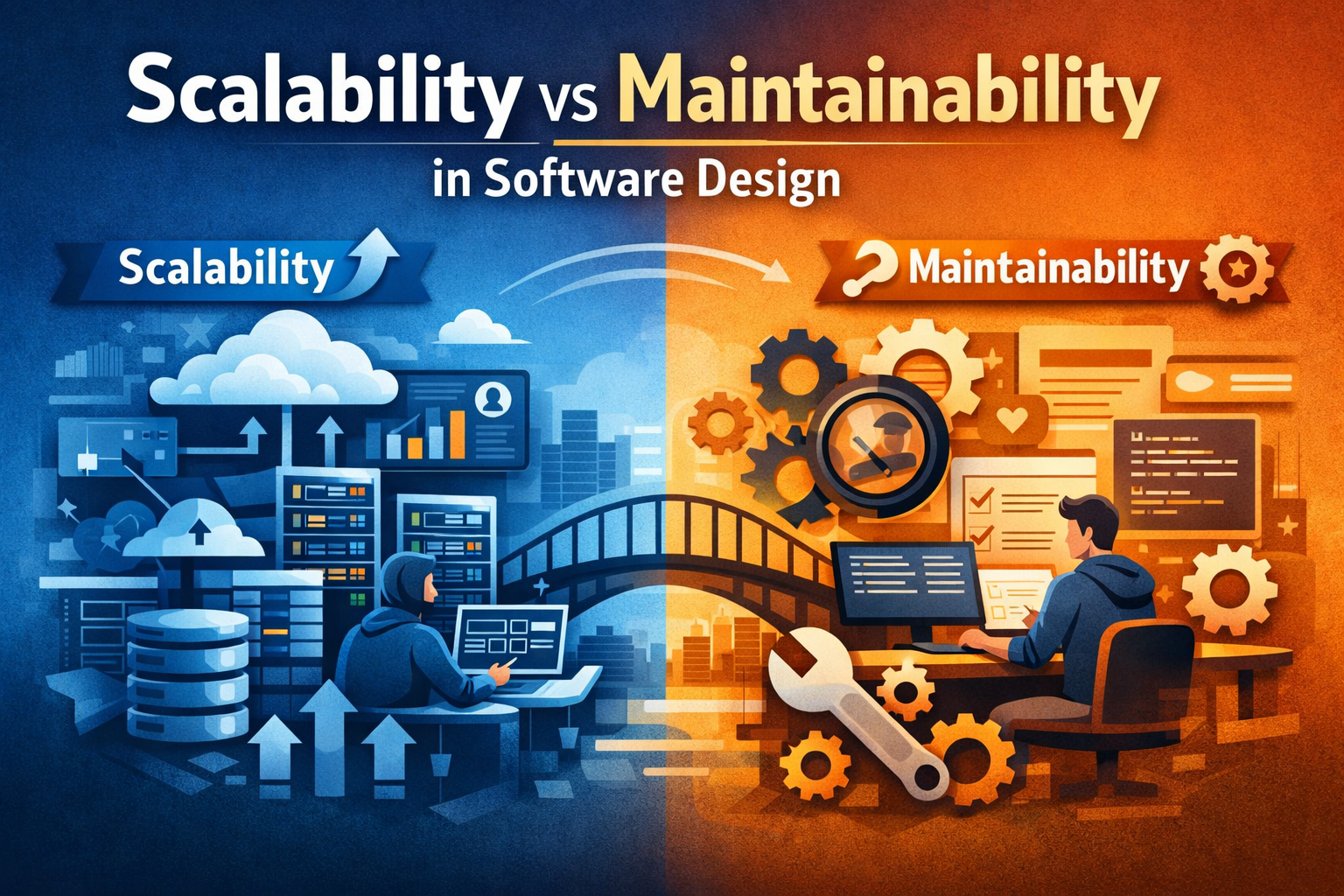
Scalability vs Maintainability in Software Design

When building modern software products, few architectural decisions are as important as Designing for Scalability vs Maintainability. Although both are essential for long-term success, they often compete for attention, resources, and engineering focus.
On one hand, scalability ensures your system can grow without breaking. On the other hand, maintainability ensures your team can improve and manage the system over time. Therefore, understanding how to balance designing for scalability vs maintainability is critical in every stage of software development.
In this beginner-friendly yet expert-level guide, we will explore how software products are built end-to-end while focusing on how scalability and maintainability shape each phase.
What Does Designing for Scalability vs Maintainability Really Mean?
Before diving deeper, it is important to define both terms clearly.
Scalability refers to a system’s ability to handle increasing load without performance degradation. In other words, a scalable system continues to perform reliably as user traffic, data volume, or transaction requests increase. For a deeper breakdown of engineering fundamentals, you can read this explanation of reliability, scalability, and maintainability explained.
Although these goals seem aligned, designing for scalability vs maintainability often requires trade-offs. For example, highly distributed systems may scale efficiently; however, they can introduce operational complexity that reduces maintainability.
Consequently, successful teams treat scalability and maintainability as strategic decisions rather than technical afterthoughts.
The End-to-End Software Development Lifecycle
To fully understand designing for scalability vs maintainability, we must examine the entire product lifecycle. Each phase introduces architectural choices that impact long-term outcomes.
The typical stages include:
- Idea validation
- Product planning
- System architecture design
- Development
- Testing and quality assurance
- Deployment
- Monitoring and iteration
At every stage, decisions influence whether the system remains flexible, stable, and capable of growth.
Stage 1: Idea Validation and MVP Development
During early development, speed is the priority. Teams build a Minimum Viable Product (MVP) to validate assumptions and gather user feedback. Therefore, maintainability usually takes precedence over scalability.
Because traffic is still uncertain, designing complex distributed systems may be unnecessary. Instead, simple and modular architectures allow faster changes. For example, many startups begin with a monolithic architecture. Although it may not scale infinitely, it enables rapid iteration.
When focusing on designing for scalability vs maintainability at this stage, prioritize clarity, clean structure, and flexibility. As a result, your team can pivot quickly if market feedback demands change.
Stage 2: Architecture Decisions and Trade-Offs
Once the product shows traction, architectural decisions become more significant. At this point, designing for scalability vs maintainability becomes a balancing act.
Common architectural choices include:
- Monolithic systems
- Modular monoliths
- Microservices architectures
- Serverless solutions
If you anticipate rapid growth, scalability patterns become important. For instance, load balancing, caching layers, and database replication improve performance under heavy traffic. Additionally, stateless services allow horizontal scaling across multiple servers.
However, increasing architectural complexity may reduce maintainability. Microservices, while scalable, introduce network communication overhead and operational challenges. Therefore, only introduce complexity when data justifies it.
Stage 3: Development Practices and Code Quality
During development, daily coding decisions reflect the tension in designing for scalability vs maintainability.
For example, engineers might write highly optimized code to maximize performance. Nevertheless, aggressive optimization can reduce readability. Over time, unclear code increases technical debt and slows development.
Alternatively, developers can prioritize clean coding principles. Modular design, descriptive naming conventions, and proper documentation improve maintainability. Although this approach may not deliver maximum performance initially, it ensures sustainable growth.
Therefore, balance is key. Optimize where bottlenecks exist, but keep the majority of the system simple and readable.
Stage 4: Database and Infrastructure Design
Database design is another critical area in designing for scalability vs maintainability.
A highly scalable database architecture may include:
- Sharding
- Replication
- Distributed storage
- Read/write separation
These techniques improve performance at scale. However, they also increase complexity in debugging and maintenance.
In contrast, a simpler database setup is easier to manage but may struggle under heavy load. Therefore, it is wise to start simple and scale only when performance metrics require it.
Similarly, infrastructure decisions matter. Cloud-native systems with auto-scaling capabilities support growth. Meanwhile, Infrastructure as Code (IaC) improves maintainability by standardizing deployments.
Stage 5: Testing and Quality Assurance
Testing plays a crucial role in designing for scalability vs maintainability.
For maintainability, unit tests and integration tests protect code quality. Because automated tests detect regressions early, developers can refactor confidently.
For scalability, load testing and stress testing reveal system limitations. In addition, performance monitoring tools provide real-time insights into system behavior.
By combining both testing strategies, teams make data-driven decisions rather than assumptions.
Stage 6: Deployment and Monitoring
Deployment strategies directly influence scalability and maintainability.
To support scalability, teams implement:
- Auto-scaling groups
- Content delivery networks (CDNs)
- Distributed caching systems
Meanwhile, to improve maintainability, teams invest in:
- Structured logging
- Centralized monitoring dashboards
- Alerting systems
- Version control and rollback mechanisms
Without monitoring, scalability problems remain hidden. Without maintainable deployment processes, operational overhead increases. Therefore, both areas must work together.
When to Prioritize Scalability?
In certain scenarios, scalability must be prioritized from the beginning.
For example:
- Applications expecting viral growth
- Enterprise platforms with strict uptime requirements
- Data-heavy analytics systems
- Financial systems with high transaction volume
In these cases, investing in distributed architecture early reduces business risk.
When to Prioritize Maintainability?
More often, however, early-stage startups benefit from prioritizing maintainability.
If your team is small and requirements are evolving, flexibility matters more than immediate scaling capacity. Because innovation requires experimentation, simple systems allow faster feature delivery.
Furthermore, maintainable systems reduce long-term technical debt. As a result, development velocity remains consistent as the product grows.
The Evolutionary Approach to Designing for Scalability vs Maintainability
Rather than choosing one over the other, the smartest approach is evolutionary architecture.
First, build a modular and maintainable system. Next, monitor real-world performance data. Then, refactor specific components that require scaling.
For example, you may extract high-traffic modules into independent services while keeping the core system intact. This incremental strategy minimizes risk and preserves clarity.
Because growth happens gradually, architecture should evolve gradually as well.
Common Mistakes in Designing for Scalability vs Maintainability
Several common mistakes can undermine long-term success.
Premature optimization often leads to unnecessary complexity.
Ignoring technical debt eventually slows innovation.
Overengineering with microservices increases operational burden.
Lack of monitoring prevents informed scaling decisions.
Avoiding these mistakes ensures that both scalability and maintainability remain balanced.
Why Designing for Scalability vs Maintainability Determines Long-Term Success
Ultimately, designing for scalability vs maintainability shapes how a software product survives growth. A system that scales but cannot be maintained becomes fragile. Conversely, a system that is easy to maintain but cannot handle growth limits business expansion.
Therefore, sustainable software development requires strategic balance. Early on, maintainability accelerates innovation. Later, scalability supports expansion.
Successful teams understand timing. They build simple foundations first. Then, guided by real usage metrics, they scale responsibly. Throughout the lifecycle, they refactor thoughtfully to preserve clarity.
Final Thoughts
Designing for Scalability vs Maintainability is not a one-time decision. Instead, it is an ongoing architectural strategy that evolves with your product and your organization.
By understanding how software products are built end-to-end, you can make smarter decisions at every stage. Prioritize simplicity early. Introduce scalability when justified. Continuously monitor performance. Refactor to protect maintainability.
In the long run, the most successful software products are not the most complex. Rather, they are the ones that adapt, grow, and remain manageable over time.
That is the true balance of designing for scalability vs maintainability.